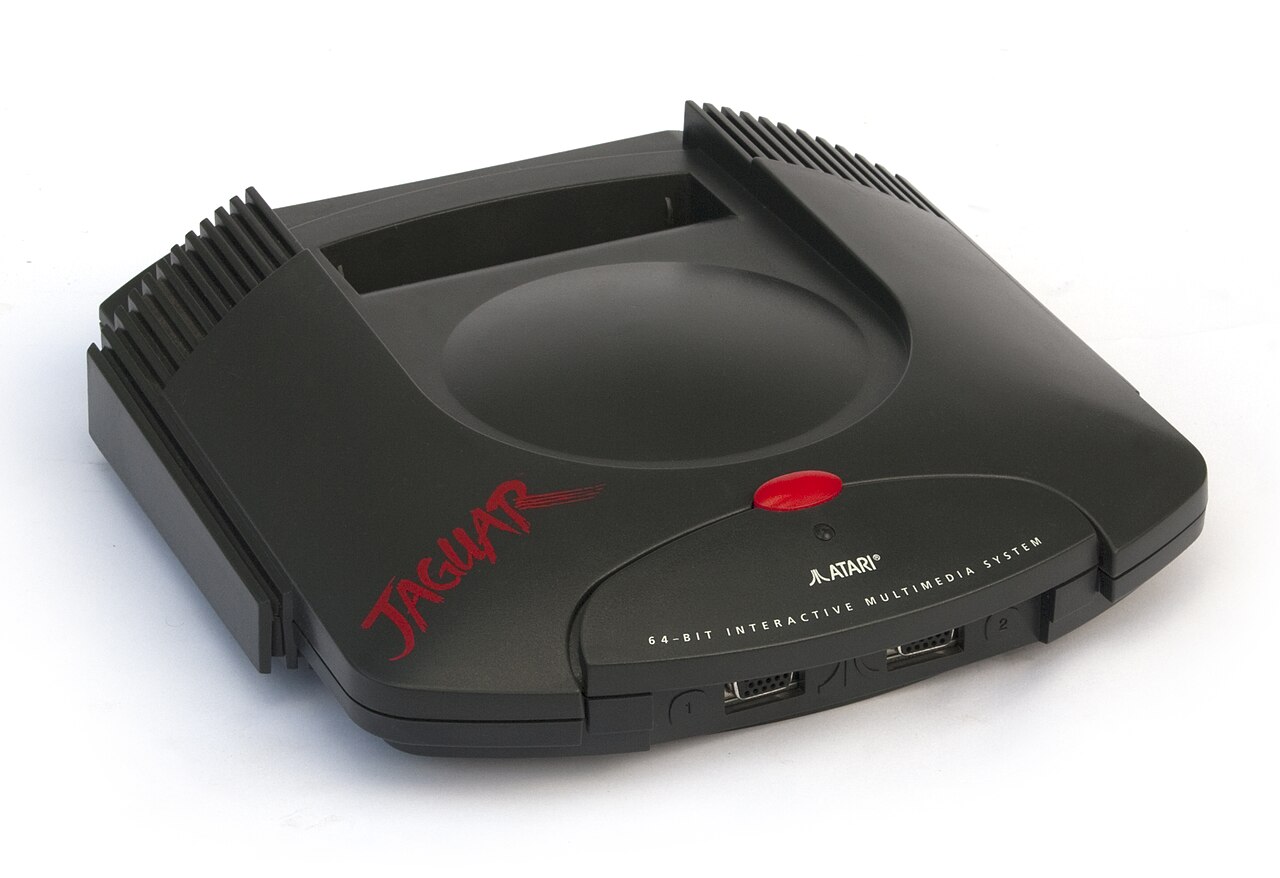
The Atari Jaguar is a fifth-generation home console released by Atari Corporation, first launching in North America in 1993.
Spec Table
| Spec | Value |
|---|---|
| Maker | Atari Corporation |
| Type | Home console |
| Generation | 5th generation |
| Release Date | North America: 1993 (initial); Europe: 1994; Japan: 1994 |
| Launch Price | $249.95 USD |
| Units Sold | Fewer than 150,000 |
| Media | ROM cartridges (up to 6 MB capacity) |
| CPU | Motorola 68000 @ 13.295 MHz; dual 32-bit RISC processors (Tom and Jerry chips) @ 26.591 MHz each; 2 MB RAM on 64-bit bus |
| Predecessor / Successor | Atari 7800 / None |
History
Atari Corporation launched the Jaguar in North America in 1993, marketed as the world’s first 64-bit home console—a technically questionable claim given its mixed-width architecture combining a Motorola 68000 with custom RISC processors. The system arrived as Sega and Nintendo were still selling 16-bit hardware, but that generational leap failed to translate into market advantage.
The Jaguar’s complex architecture proved difficult for developers to work with, resulting in a thin library of weaker early titles like Trevor McFur in the Crescent Galaxy and Evolution: Dino Dudes. Stronger later releases including Doom, Wolfenstein 3D, and Tempest 2000 showed the hardware’s potential, but third-party support never materialized to compete with Sega’s Genesis and Saturn, Nintendo’s Super NES, or Sony’s PlayStation.
With sales stalling at fewer than 150,000 units, Atari discontinued the Jaguar by 1996 and never built another home console. The system’s legacy endured through homebrew development after its patents were released to the public domain in 1999, giving the Jaguar an active afterlife among enthusiasts that outlasted its brief retail run.
Library Highlights
The Jaguar’s library never grew large, but it mixed ambitious original titles with notable ports that showed off the system’s RISC-powered graphics when developers pushed past the difficult tool chain.
- Cybermorph
- Alien vs. Predator
- Tempest 2000
- Doom
- Wolfenstein 3D
- Trevor McFur in the Crescent Galaxy
- Raiden
- Evolution: Dino Dudes
Variants
No major hardware variants are documented for the base Jaguar console. Atari later released the Jaguar CD as a separate add-on peripheral rather than a revised version of the main unit.
See the full Atari manufacturer hub for other systems the company released.
Collector Value
Because fewer than 150,000 Jaguar units ever sold, the console and its cartridges are considerably scarcer today than mainstream 1990s hardware, and prices reflect that rarity. Common launch titles in loose, tested condition remain reasonably affordable, but complete-in-box units and rarer late-life or homebrew releases can command steep premiums. Sealed consoles and shrink-wrapped games are especially prized by collectors and priced accordingly, given how few examples exist in that condition.
Buying Guide
Before buying a used Jaguar, confirm the seller includes the original power supply and composite or RF cables, since these are increasingly hard to source for a system this rare. Test the cartridge slot’s connector pins for corrosion or wear, and ask whether the unit has been verified to boot with an actual cartridge rather than just power on. Because the console is scarce, budget extra time to compare seller prices before committing to a purchase.
FAQs
When did the Atari Jaguar come out?
The Atari Jaguar launched in North America in 1993, followed by Europe and Japan in 1994.
How many units did the Atari Jaguar sell?
The Jaguar sold fewer than 150,000 units total, making it one of the poorest-selling major home consoles of its generation.
How much did the Atari Jaguar cost at launch?
The console launched at $249.95 USD.
What CPU does the Atari Jaguar use?
It combines a Motorola 68000 processor running at 13.295 MHz with two custom 32-bit RISC processors, code-named Tom and Jerry, running at 26.591 MHz each, alongside 2 MB of RAM on a 64-bit bus.
Was the Atari Jaguar really a 64-bit console?
Atari marketed the Jaguar as the world’s first 64-bit console, a claim that was technically questionable given the system’s underlying 68000 processor and mixed-width architecture.
Sources
Facts on this page last verified 2026-07-15.