Battlezone is a 1980 first-person shooter arcade game by Atari.
Quick Facts
| Title | Battlezone |
| Year | 1980 |
| Manufacturer | Atari |
| Designer(s) | Ed Rotberg, Owen Rubin, Roger Hector |
| Genre | First-person shooter |
| Hardware | Arcade cabinet with periscope-style viewfinder; later versions removed the periscope for improved visibility. |
| Ports | 8 ports, including Apple II, Atari 2600, and Commodore 64 — see Ports section |
History
Battlezone reached arcades in November 1980, built by a small Atari team led by Ed Rotberg alongside Owen Rubin and Roger Hector. Rotberg has said Atari’s own 1974 tank game was his direct inspiration for pushing the concept into three dimensions. Rubin is credited with the erupting volcano that sits on the horizon of the battlefield. The result used vector graphics rather than the sprite-based raster displays common at the time, giving the tanks, obstacles, and terrain crisp, glowing outlines instead of blocky pixels.
The cabinet’s periscope viewer, which framed the player’s view of the battlefield, set Battlezone apart from flatter tank games that came before it and helped sell the illusion of sitting inside a vehicle. That novelty, paired with the vector visuals, made the game a commercial success, and Atari eventually sold around 15,000 cabinets. The game’s design also drew outside attention: the U.S. Army commissioned a modified training version known as the Bradley Trainer, built to help gunners practice on the Bradley Fighting Vehicle, though only a pair of prototype units were ever produced. The Strong National Museum of Play has pointed to this military detour as one of the earliest examples of arcade technology being adapted for a serious training purpose, and has cited Battlezone’s tank-combat concept as a forerunner to later vehicular combat games. Decades later, historians still point to Battlezone as the game that proved a first-person 3D perspective could work in a coin-operated cabinet, a template later shooters would build on.
Gameplay
Battlezone puts the player behind the controls of a lone tank, steering with dual joysticks that each govern one tread, so pushing them in opposite directions rotates the tank in place while pushing both forward drives it ahead. The objective is simple to state and hard to master: survive by destroying enemy vehicles before they destroy you, all while navigating a wireframe landscape scattered with blocks, pyramids, and other obstacles that can block shots or crush a tank on contact. Enemies escalate in difficulty over a session, starting with slower enemy tanks before faster missiles and heavily armed supertanks appear. A radar readout at the top of the screen shows the position of nearby threats that are not currently visible through the periscope, letting players anticipate an attack from outside their immediate field of view. Firing is handled with a single button, but leading a moving target and accounting for obstacles in the way takes practice.
- Dual-joystick tank movement with independent left and right tread control
- Escalating enemy types: tanks, missiles, and supertanks
- Radar scanner tracking off-screen threats
- Wireframe vector terrain with destructible line of sight via obstacles
Cabinet & Hardware
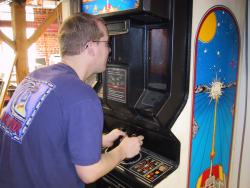
The original Battlezone cabinet placed a periscope-style viewfinder in front of the player, framing the vector display and reinforcing the feeling of looking out through a tank’s optics rather than at an ordinary arcade monitor. Later production runs dropped the periscope housing in favor of an open screen, a change operators and bystanders appreciated because it let onlookers actually watch the action rather than see only the back of the viewer’s head, though it traded away some of the original’s immersive framing.
Ports & Re-releases
| Platform | Year |
|---|---|
| Atari 2600 | 1983 |
| Apple II | 1984 |
| Commodore 64 | 1984 |
| VIC-20 | 1984 |
| ZX Spectrum | 1984 |
| IBM PC | 1984 |
| Atari 8-bit | 1988 |
| Atari ST | 1988 |
Most of Battlezone’s home conversions arrived through the early-to-mid 1980s home computer boom, bringing simplified versions of the vector-style visuals to machines that could not fully match the arcade’s dedicated display hardware. Check the Atari 2600 platform page for details on that particular port.
Where to Play Legally Today
- MAME, run only with legally owned ROM dumps from a cabinet or licensed source you own
- Original Atari 2600 or home computer cartridges and disks played on period-correct or emulated hardware you legally own
- Arcade museums and retro arcade venues, including The Strong National Museum of Play, that maintain a playable Battlezone cabinet
Collector Value
Original upright Battlezone cabinets, particularly early periscope-equipped units, are sought after by vector-game collectors, and surviving examples of the roughly 15,000 produced trade at a premium when the periscope housing and monitor are intact, since those parts are the most commonly damaged or removed over decades of use. Non-periscope cabinets and bare PCBs also circulate and tend to be more affordable entry points for collectors focused on the vector hardware rather than the full sit-down experience. Home ports on cartridge and disk formats such as the Atari 2600 version are widely available and inexpensive by comparison, making them accessible for collectors who want the game without pursuing a full-size cabinet.
FAQs
Who made Battlezone?
Battlezone was designed by Ed Rotberg, Owen Rubin, and Roger Hector, and was manufactured and released by Atari.
What year did Battlezone come out?
Battlezone came out in 1980, released by Atari for arcades.
What genre is Battlezone?
Battlezone is a first-person shooter, putting the player in control of a tank fighting other vehicles across an open vector-graphics landscape.
What hardware did Battlezone’s cabinet use?
Battlezone shipped in an arcade cabinet built around a periscope-style viewfinder; later production runs removed the periscope to improve visibility for players and bystanders.
Has Battlezone been ported to home systems?
Yes, Battlezone was ported to at least eight platforms between 1983 and 1988, including the Atari 2600, Apple II, Commodore 64, VIC-20, ZX Spectrum, IBM PC, Atari 8-bit computers, and the Atari ST.
See also the related Asteroids and Missile Command arcade pages, both released by Atari in the same era, plus the related Star Wars first-person shooter, and browse the Golden Age of Arcade Games hub for more classic titles.
Sources
- https://en.wikipedia.org/wiki/Battlezone_(1980_video_game)
- https://www.museumofplay.org/blog/from-battlezone-to-world-of-tanks/
Facts on this page last verified 2026-07-15.