This article contains Amazon affiliate links — as an Amazon Associate, RetroArcade earns from qualifying purchases.
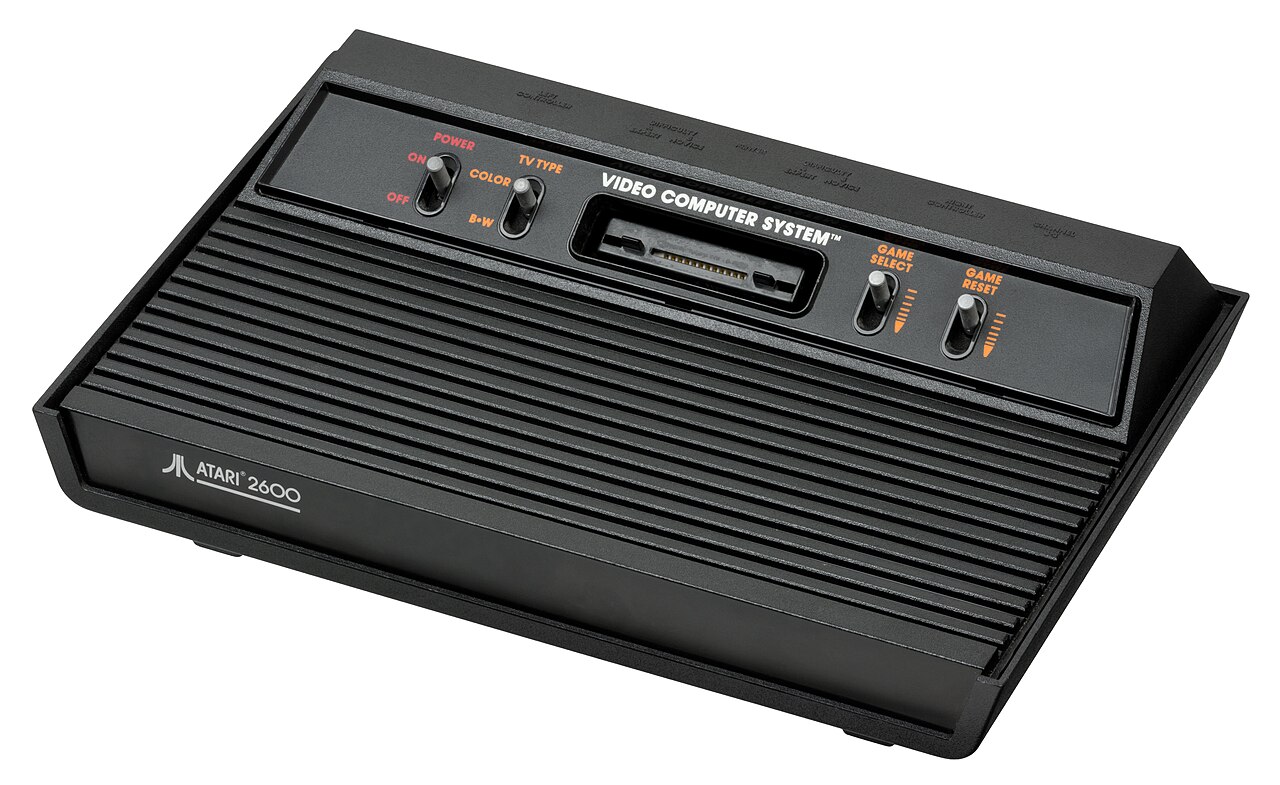
The Atari 2600 is a second-generation home console released by Atari in 1977.
Spec Table
| Spec | Value |
|---|---|
| Maker | Atari Inc. |
| Type | Home console |
| Generation | 2nd generation |
| Release Date | North America: 1977 (initial); Europe: 1978; France: 1982; Brazil: 1983; Japan: 1983 |
| Launch Price | $189.95 USD |
| Units Sold | 30 million |
| Media | ROM cartridge |
| CPU | MOS Technology 6507 @ 1.19 MHz, 128 bytes RAM |
| Predecessor / Successor | Atari Home Pong / Atari 5200 |

History
Atari introduced the console in 1977 as the Atari Video Computer System, a $189.95 machine built around the cost-reduced MOS 6507 processor and a cartridge slot that let owners buy new games without replacing the whole unit. Sales were modest at first, and the system only became a phenomenon in 1980 when Atari licensed a home port of Taito’s arcade hit Space Invaders. That single cartridge reportedly quadrupled console sales almost overnight, cementing the VCS, later renamed the Atari 2600, as the dominant home system of the early 1980s and turning “Atari” into a household name for video games generally.
The system’s open cartridge format was both its greatest strength and its biggest liability. Because Atari had no way to license or control who made cartridges, outside studios such as Activision built entire businesses producing 2600 games without Atari’s permission, birthing the third-party publishing model still used across the industry today. But that same openness let dozens of underfunded studios flood store shelves with rushed, low-quality titles by 1982, and Atari’s own share of the cartridge market fell sharply as shoppers lost confidence in the format. The rushed holiday tie-in E.T. the Extra-Terrestrial became emblematic of the decline; it sold well but was widely panned, and unsold stock was famously trucked to a New Mexico landfill in 1983, a story long dismissed as urban legend until a 2014 excavation confirmed hundreds of thousands of buried cartridges.
That oversupply and quality collapse fed directly into the North American video game crash of 1983, in which Atari’s parent company lost hundreds of millions of dollars and much of the home console industry briefly folded. The 2600 itself, however, kept selling. Its library, low retail price, and broad brand recognition gave it a longer commercial tail than most of its second-generation rivals, several of which disappeared entirely once their manufacturers exited the games business. Atari kept the console in production for another decade after the crash, finally discontinuing it in 1992, roughly 15 years after its debut.
By the time it left the market, the 2600 had reached an estimated 30 million units sold worldwide and had rolled out in stages across France, Brazil, and Japan through the early 1980s, well after its original 1977 North American debut. Its legacy rests less on any single game than on the model it established: cartridge-based hardware, a large third-party software ecosystem, and video games as a mainstream living-room product rather than an arcade-only novelty.
Library Highlights
The 2600’s catalog leaned heavily on home conversions of arcade hits alongside a handful of originals that became system-defining classics in their own right.
- Space Invaders
- Pac-Man
- Adventure
- Pitfall!
- Asteroids
- Combat
- Missile Command
- Breakout

Variants
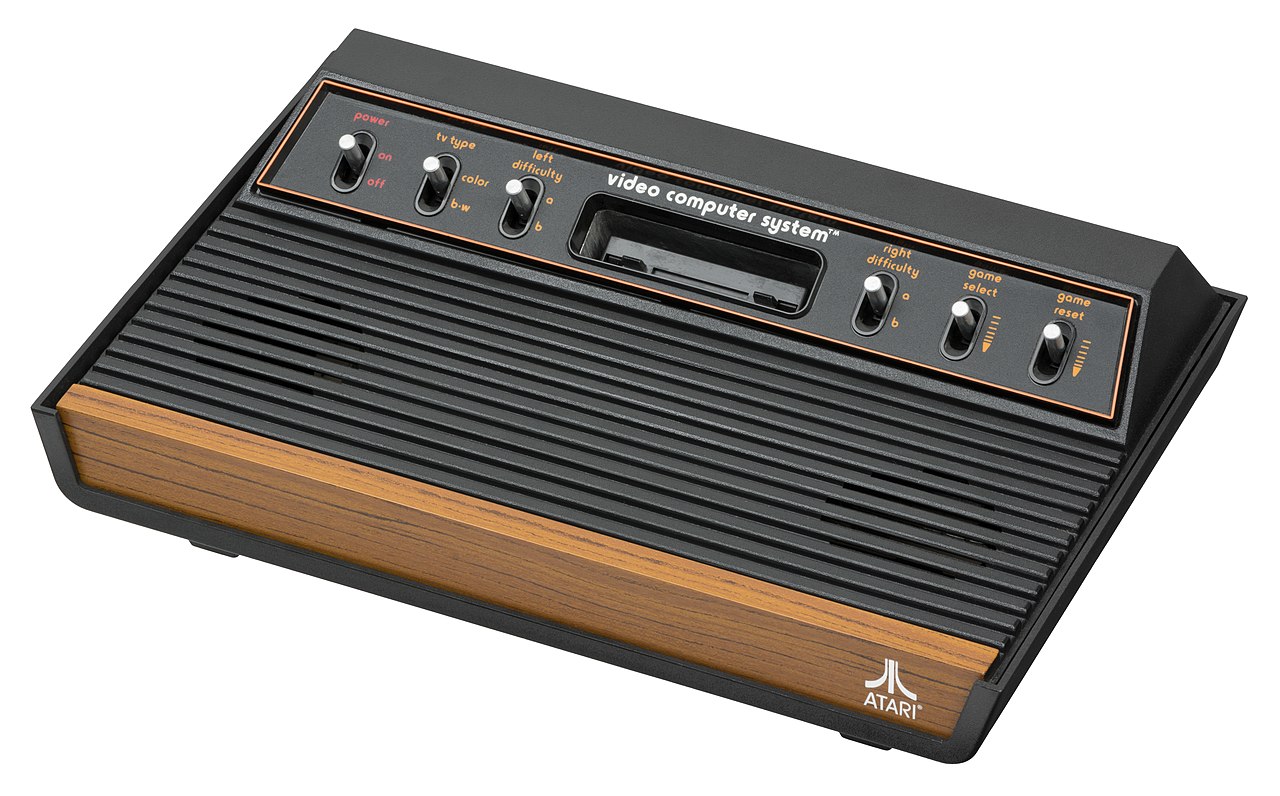
No major hardware variants are documented for the Atari 2600 in the source data used for this page. The console was sold under different regional release schedules, reaching Europe in 1978 and later France, Brazil, and Japan through the early 1980s, but no distinct hardware revisions or rebrands beyond the original design are recorded here. See the full Atari manufacturer hub for other systems the company released.
Collector Value
Because roughly 30 million units were produced over a 15-year production run, loose Atari 2600 consoles and common cartridges remain inexpensive and widely available to collectors today. Value climbs quickly for complete-in-box units with original packaging and manuals, and further for scarce or short-print cartridges and pre-crash third-party titles that saw limited distribution. Sealed, unopened stock from the era is rare and commands a significant premium over loose or boxed examples.
Buying Guide
Before buying a used Atari 2600, confirm the seller includes an original or compatible power supply and RF switch box, since these small parts are frequently missing or swapped and period-correct originals are getting harder to find. Check the cartridge slot’s contact fingers for corrosion or bent pins, a common failure point after decades of use, and ask whether the unit has actually been tested with a game rather than just powered on. Given how many 2600 units survive, there is rarely a reason to pay a premium for an untested console.
FAQs
When did the Atari 2600 come out?
The Atari 2600 launched in North America in 1977, followed by Europe in 1978, France in 1982, and Brazil and Japan in 1983.
How many units did the Atari 2600 sell?
The Atari 2600 sold approximately 30 million units over its production run.
How much did the Atari 2600 cost at launch?
The console launched at $189.95 USD.
What CPU does the Atari 2600 use?
It uses a MOS Technology 6507 processor running at 1.19 MHz with 128 bytes of RAM.
What console followed the Atari 2600?
Atari’s next home console was the Atari 5200, which succeeded the 2600 as the company’s flagship system.

Sources
Facts on this page last verified 2026-07-15.