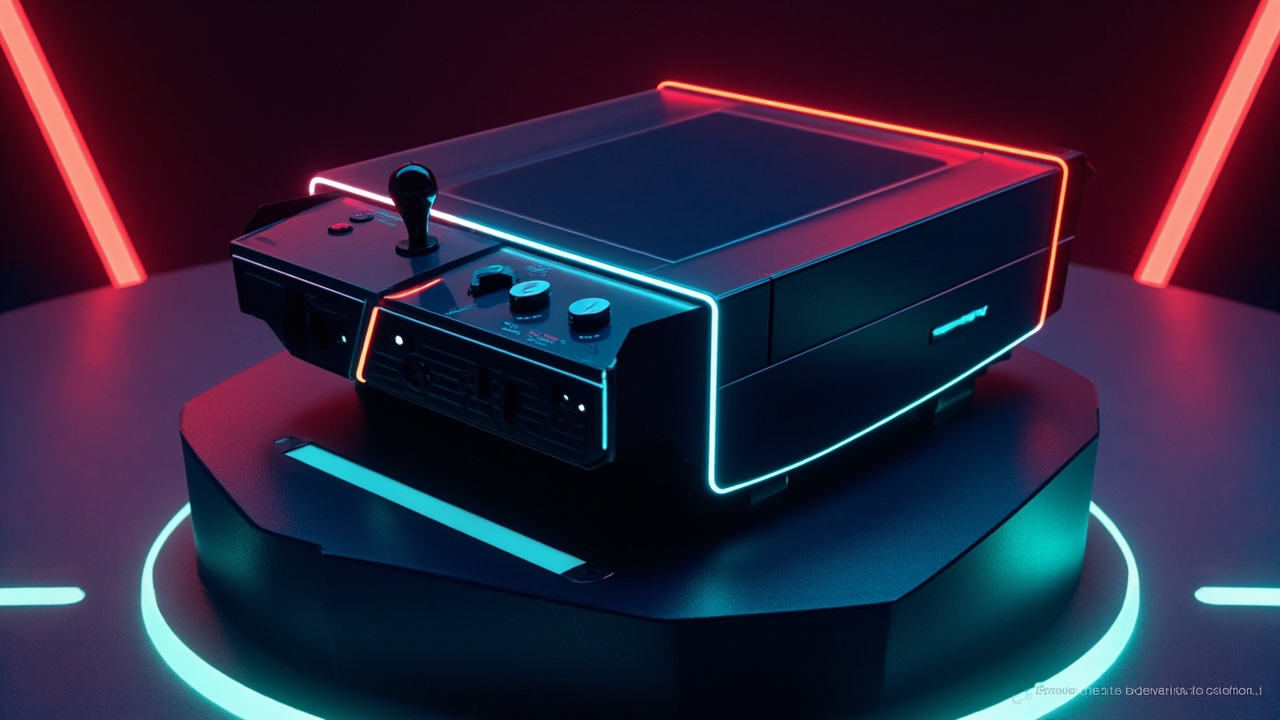
The Palladium Tele-Cassetten Game was a German-market home video game console released in 1978, during the formative years of the consumer video game industry. As a first-generation device, it emerged alongside a wave of pong-era and cartridge-based systems that defined how families first encountered interactive electronic entertainment in their living rooms. The console was sold exclusively in West Germany, where it served as one of the country’s earliest mass-market introductions to home gaming through retail and mail-order channels.
Released by Palladium, a private-label brand operated by the major German mail-order retailer Neckermann Versand AG, the system reached consumers through one of the era’s most dominant shopping channels. Its licensing arrangement with the American semiconductor manufacturer General Instrument tied the console to the AY-3-8xxx family of dedicated game chips, the same family of logic devices that powered a wide range of pong-style consoles throughout the late 1970s. Within a few years, the Tele-Cassetten Game would be replaced in the Palladium catalog by a more advanced successor system.
Quick Facts
| Specification | Detail |
|---|---|
| Maker | Palladium |
| Type | Home console |
| Generation | First generation |
| Released | 1978 (Germany) |
| Media | PC-50x cartridges |
History
The Palladium Tele-Cassetten Game entered the West German market in 1978 as one of a small group of first-generation consoles available to consumers in the country. Its release came at the height of the post-Pong boom, when retailers across Europe were eager to stock dedicated gaming hardware and capitalize on the public’s growing appetite for in-home electronic entertainment. Palladium, the brand printed on the unit’s shell, was not an independent console manufacturer but rather a private-label house name used by Neckermann Versand AG, one of West Germany’s largest mail-order and catalog retailers at the time.
Neckermann leveraged its established catalog business to push the Tele-Cassetten Game to a broad consumer base. Rather than develop the underlying hardware in-house, the company licensed the design from General Instrument, the American semiconductor firm whose AY-3-8xxx series of dedicated game chips became the de facto standard for budget consoles of the late 1970s. These chips integrated multiple simple games onto a single piece of silicon, allowing licensees to offer multi-game systems at relatively low cost. The result was a unit that could switch between several built-in-style experiences using physical selector switches and difficulty toggles, blending true cartridge expandability with the convenience of selectable on-board titles.
Despite being a single-region product, the Tele-Cassetten Game occupied a meaningful niche in the German market, where it competed with offerings from larger international brands. Its life cycle, however, was relatively brief. In 1982, Palladium introduced the Palladium Video Computer Game, a successor system that reflected the industry’s pivot toward more advanced second-generation designs. The Tele-Cassetten Game was discontinued as the new model took its place in the catalog.
The Game Library
The Tele-Cassetten Game combined on-board selectable games with a small cartridge library, all running through General Instrument’s AY-3-8xxx family of dedicated logic chips. Software was delivered on PC-50x cartridges, a format that was common across the wide ecosystem of AY-3-8xxx-based consoles of the era. These cartridges typically contained a single game chip and a small amount of supporting circuitry, allowing the system to swap in entirely new titles by simply exchanging the cart.
- Ball & Paddlegaming
- Submarine
- Cycling
- Car Race
- Shooting Gallery
- Wipeout
- Tank Battle
The mix reflects the standard AY-3-8xxx playbook of the era. Ball & Paddlegaming is the system’s paddle-and-ball entry, an obvious echo of the Pong tradition that defined first-generation hardware. Driving titles such as Car Race and Wipeout, along with Tank Battle, reflect the period’s fascination with simple chase and combat scenarios. Cycling, Shooting Gallery, and Submarine round out the catalog with sports and shooting interpretations that were commonly bundled or sold alongside the AY-3-8500 and its sibling parts. Multiple game selection switches and difficulty controls built into the console allowed players to tune the experience from title to title without software-side intervention.
Legacy
The Palladium Tele-Cassetten Game holds an unusual place in the historical record because it is occasionally misclassified as a second- or third-generation system despite being, by every meaningful technical measure, a first-generation console. Its reliance on General Instrument’s AY-3-8xxx series and its simple selectable games firmly anchor it in the 1977-1979 cohort of dedicated gaming hardware, alongside its better-known international peers.
Palladium shipped the console in two distinct hardware revisions. The earlier 825/530 model shipped without fire buttons on its controllers, presenting a minimalist input layout that matched the era’s paddle-era systems. The later 825/581 model added fire buttons to the controllers, signaling a small but meaningful evolution toward more action-oriented gameplay. The 825/530 also arrived bundled with two controllers and four games out of the box, making it a relatively complete starter package for first-time buyers of the late 1970s.
The system’s most direct line of historical descent runs through its successor, the Palladium Video Computer Game, which replaced the Tele-Cassetten Game in the Palladium catalog in 1982. That successor marked the brand’s transition into a more advanced era of home gaming and closed out the Tele-Cassetten Game’s commercial run.
Collecting It Today
For collectors interested in first-generation consoles, the Palladium Tele-Cassetten Game offers a focused slice of German gaming history. Because it was sold exclusively in Germany, surviving units tend to appear most often at European auctions, estate sales, and German-language collector forums, and documentation outside of German sources can be thin. Buyers should verify the model number on the case, the controller faceplate, and any accompanying paperwork to confirm whether the unit is the 825/530 (without fire buttons) or 825/581 (with fire buttons) revision, since both versions exist and draw different interest among enthusiasts.
As with most first-generation hardware of this age, condition matters considerably. Look for consoles with intact labels, unbroken cartridge doors, and clean interior boards free of battery leakage or capacitor damage, both common failure points in 45-year-old electronics. Original PC-50x cartridges are increasingly scarce, and the loose chips inside them are vulnerable to corrosion, so a working cart is worth more than a display-only cart. Bundles that still include both original controllers and the original power supply are especially desirable, and boxed examples with manuals are rare enough to be considered significant finds.
The Palladium Video Computer Game, the system’s 1982 successor, is the natural companion piece for collectors tracing the brand’s full arc and is documented alongside the rest of the catalog on the RetroArcade.com consoles hub.