
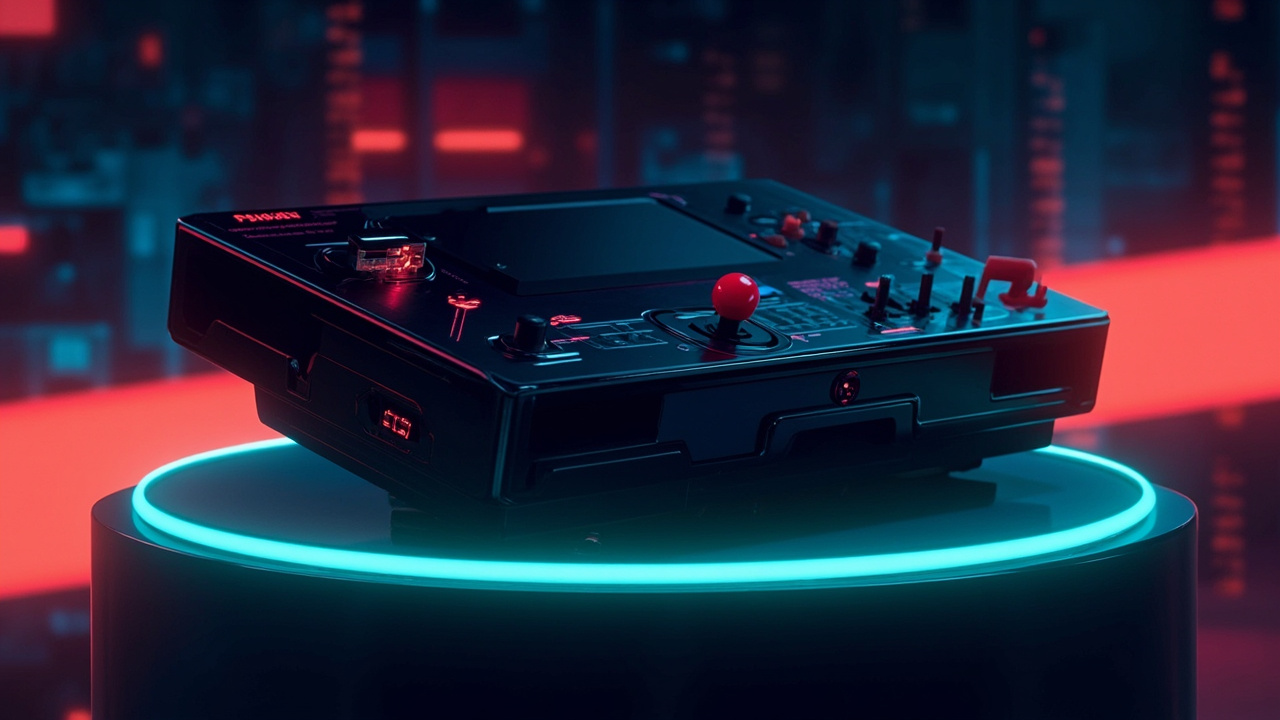
The Thumby is a diminutive handheld game console developed by TinyCircuits, released in 2022 at the start of the so-called ninth generation of gaming hardware. While its contemporaries in that generation include powerful home machines such as the PlayStation 5 and Xbox Series X, the Thumby carved out an entirely different niche: a keychain-sized device aimed at programmers, hobbyists, and educators rather than mass-market gamers.
Released into a marketplace that had grown accustomed to ever-larger install bases and increasingly demanding graphics, the Thumby instead championed minimalism. The device is widely cited as one of the smallest functional game consoles ever produced, with hardware specifications that would have been considered modest even by early-2000s standards. Its arrival reflected a broader maker-movement trend toward portable, programmable, open-experimentation devices that prioritize accessibility and learning over raw power.
By leaning into a small display, a low launch price, and direct support for the MicroPython programming language, TinyCircuits positioned the Thumby as both a novelty gift and a legitimate educational tool. The console fits into a wider ninth-generation landscape that increasingly values experimentation alongside conventional gaming, and it has earned a foothold in classrooms, coding clubs, and electronics hobbyist workspaces since its release.
Quick Facts
| Specification | Detail |
|---|---|
| Maker | TinyCircuits |
| Type | Handheld |
| Generation | 9 |
| Released | 2022 |
| Launch Price | $27.50 USD |
| Media | Digital distribution |
| CPU | Raspberry Pi RP2040 microcontroller with 2 ARM Cortex-M0+ cores (up to 133 MHz) |
History
The origins of the Thumby stretch back to roughly 2015 and 2016, when TinyCircuits began exploring the idea of an ultra-portable gaming device built around the company’s expertise in miniature electronics. An early prototype was shown to the public at the 2016 Bay Area Maker Faire, where the maker community’s reaction to the concept helped shape the product’s eventual direction and feature set.
Following years of internal iteration, TinyCircuits launched a Kickstarter campaign on September 28, 2021 to fund mass production of the device. The crowdfunding effort exceeded expectations, achieving its funding goal in under two hours. Backers responded enthusiastically to the proposition of a sub-five-gram handheld that could be programmed using MicroPython and carried a low price point, and the campaign’s success cleared the way for a retail release the following year.
The Thumby shipped in 2022 at a launch price of $27.50, positioning it firmly in the impulse-purchase category for hobbyists and gift-givers. Its small size, low cost, and educational focus made it a natural fit for classroom and club settings, and the device soon became a fixture in online tutorials, coding workshops, and DIY electronics communities around the world.
The Game Library
The Thumby arrives with a small collection of preloaded titles, and the device supports custom game development through the MicroPython environment. Among the bundled and notable releases are TinySaur (also referred to as Saur Run), a side-scrolling runner featuring a small dinosaur protagonist, and Thumgeon, a dungeon-crawling adventure built around the visual constraints of the 72 by 40 pixel display.
Other titles in the Thumby’s library include TinyTennis (sometimes referred to simply as Tennis), a pared-down take on the racket-sport genre, and Annelid, which draws on classic snake-style gameplay with its own twist on the worm mechanic. Additional notable releases include Space Debris, an arcade-style shooter set in orbit, and TinyBlocks (also listed as TinyTris), a falling-block puzzle game clearly inspired by the long lineage of Tetris-style titles. Together, these games illustrate the kind of compact, instantly readable design that the Thumby’s screen and controls naturally accommodate.
Because the device supports custom game development, the Thumby’s library extends well beyond the included titles. A community of developers has produced numerous homebrew games, with shared code libraries and tutorials making the platform approachable to first-time programmers. The digital distribution model means that new titles can be sideloaded onto the device without the need for physical media, an arrangement that suits the maker community’s collaborative spirit.
Legacy
The Thumby’s most often-cited claim to fame is its size. At roughly 1.2 by 0.7 by 0.3 inches and weighing only 4.7 grams, the device is regularly described as one of the world’s smallest functional game consoles. Its tiny form factor is more than a marketing gimmick; the entire industrial design reflects the project’s commitment to making a programmable handheld that can be taken anywhere, attached to a keychain, or used as a wearable accessory.
Beyond its physical dimensions, the Thumby is notable for being marketed primarily as a programming education tool. MicroPython support is built into the device’s firmware, lowering the barrier to entry for users who want to write their own games or experiment with embedded development. The 72 by 40 pixel 1-bit OLED screen, measuring just 0.38 by 0.27 inches, is intentionally limited, providing a constraint that mirrors the early days of consumer hardware and encourages creative problem-solving within tight boundaries.
The Thumby sits in TinyCircuits’ broader product line as the successor to the Pocket Arcade and was itself followed by the Thumby Color. The progression from Pocket Arcade to Thumby to Thumby Color reflects the company’s gradual refinement of its miniature-handheld concept, with each iteration adding capability while retaining the core appeal of a low-cost, programmable gaming device aimed at learners and tinkerers.
Collecting It Today
For collectors interested in the Thumby, the practical considerations differ sharply from those that apply to mass-market consoles of the ninth generation. Because the device is small, light, and inexpensive at retail, condition issues tend to center on the integrity of the OLED screen, the responsiveness of the directional pad and face buttons, and the condition of the USB cable used for charging and programming. Used units are often sold by hobbyists upgrading to the Thumby Color or moving on to other maker projects, and these devices typically retain their value as functional programming platforms rather than as display pieces.
Documentation matters more than box condition for many Thumby buyers. The original Kickstarter packaging, included accessories, and any printed quick-start guides are nice to have, but access to the device’s firmware, online tutorials, and MicroPython development environment is what makes the hardware useful in the long term. Collectors should also be aware that the device depends on community-maintained resources for sideloading games, so verifying that current software tools still support the original Thumby is worthwhile before committing to a purchase.
Given its low original retail price and educational positioning, the Thumby is best approached as a functional collectible: a piece of ninth-generation hardware that rewards hands-on use rather than shelf preservation. For readers exploring the broader landscape of retro and unusual game consoles, the consoles hub offers additional entries on devices from across the hobby.