Elevator Action is a 1983 platform shooter arcade game by Taito, sending secret Agent 17 down a thirty-story building to steal documents.
Quick Facts
| Title | Elevator Action |
| Year | 1983 |
| Manufacturer | Taito |
| Designer(s) | Toshio Kono |
| Genre | Platform shooter |
| Hardware | Taito SJ System arcade board |
| Ports | 7 ports, including Famicom/NES, Game Boy, and MSX — see Ports section |
History
Taito released Elevator Action to Japanese arcades in July 1983, with designer Toshio Kono building the game around a spy-infiltration premise rather than the space and fantasy themes common at the time. The concept cast the player as Agent 17, working through a thirty-floor building to retrieve classified documents. Composer Yoshio Imamura wrote the game’s theme music, which became closely associated with the title in the years afterward. North American arcades picked up the game that October, giving Taito a staggered rollout typical of coin-op releases in that period.
The game topped Japan’s Game Machine arcade earnings charts for three consecutive months in late 1983, an unusually long run for a single title, and its popularity carried into 1984 by ranking among North America’s five highest-grossing arcade games that year. Contemporary reviewers responded to its unusual setting; a write-up in Computer and Video Games singled out the game for having “a really original theme” compared to its contemporaries. Taito revisited the concept over a decade later with the arcade sequel Elevator Action Returns in 1994, and Hamster’s official Arcade Archives re-release later brought the original coin-op version to PlayStation 4 and Nintendo Switch, keeping the arcade edition available on current hardware rather than only in emulation or compilation form.
Gameplay
Elevator Action drops the player into the top floor of a thirty-story office building as Agent 17, tasked with reaching every red-marked door to collect secret documents before escaping through a getaway car waiting in the basement. Progress depends on riding elevators and taking stairways down through the building while enemy agents patrol the floors and stairwells, firing on sight. The player can walk, jump, duck, and fire a pistol, but close combat options matter just as much as shooting: jump-kicks and karate strikes drop enemies without spending ammunition, and elevators themselves can be used to crush pursuers standing beneath them. Shooting out overhead lights plunges a section of the building into darkness, letting the player slip past patrols unseen. Each collected document adds to the score, and clearing the building to reach the car at street level awards a further bonus before the descent begins again on a new building.
- Descend a 30-story building using elevators and stairways to reach red-marked document rooms
- Combat options beyond the pistol, including jump-kicks, karate strikes, and crushing enemies with elevators
- Shootable light fixtures that darken sections of the building for stealthier movement
- Bonus points for reaching the getaway car after clearing a building
Cabinet & Hardware
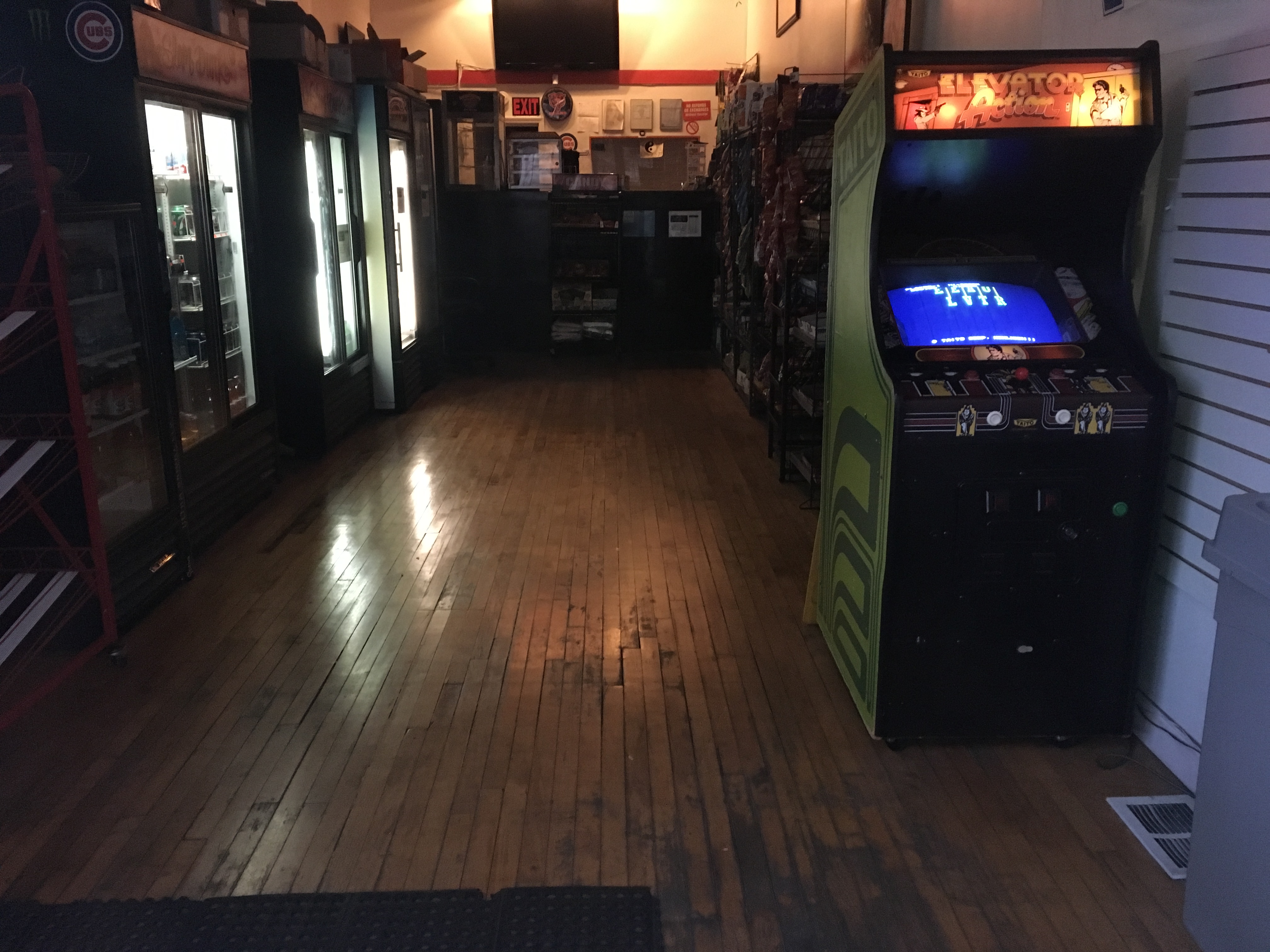
Elevator Action runs on the Taito SJ System, an arcade board Taito used across several of its early-1980s titles, giving the game’s rendering of stacked floors, moving elevator cars, and dynamic lighting a shared technical lineage with its cabinet-mates of the era. The upright cabinet’s control panel keeps the layout simple, pairing a single joystick with a jump button and a fire button so the jump-kick, duck, and shooting actions all stay within easy reach during fast descents.
Ports & Re-releases
| Platform | Year |
|---|---|
| Famicom/NES | 1985 |
| Game Boy | 1991 |
| MSX | Unspecified |
| SG-1000 | Unspecified |
| ZX Spectrum | Unspecified |
| Amstrad CPC | Unspecified |
| Commodore 64 | Unspecified |
Beyond its original home conversions, Elevator Action has resurfaced through Hamster’s official Arcade Archives line, which released the original coin-op version on PlayStation 4 in 2017 and on Nintendo Switch in 2019, preserving arcade-accurate play on modern hardware rather than a home-system adaptation. Check the NES and Game Boy platform pages for details on those specific ports.
Where to Play Legally Today
- Official Arcade Archives releases of Elevator Action on PlayStation 4 (2017) and Nintendo Switch (2019)
- MAME, run only with legally owned ROM dumps from a cabinet or licensed source you own
- Arcade museums and retro arcade venues that keep a working Elevator Action cabinet on their floor
Collector Value
Original Elevator Action cabinets are less common on the secondary market than mega-hits of the same era, making well-preserved uprights with intact side art and marquees a solid find for Taito collectors specifically hunting early-1980s titles. Standalone Taito SJ System PCBs occasionally circulate for collectors who already own a compatible cabinet shell and want to swap in the board. The home ports are the more accessible entry point: NES, Game Boy, and Commodore 64 cartridges and tapes turn up regularly at reasonable prices, giving collectors a way into the game’s history without committing to a full cabinet restoration.
FAQs
Who made Elevator Action?
Elevator Action was designed by Toshio Kono and manufactured by Taito, releasing to arcades in 1983.
What year did Elevator Action come out?
Elevator Action came out in 1983, the same year Taito released the platform shooter to arcades.
What genre is Elevator Action?
Elevator Action is a platform shooter, in which the player descends a multi-story building via elevators and stairways while fighting enemy agents and collecting secret documents.
What hardware did Elevator Action run on?
Elevator Action ran on the Taito SJ System arcade board.
Has Elevator Action been ported to home consoles?
Yes, Elevator Action has been ported to at least seven platforms, including the Famicom/NES, Game Boy, MSX, SG-1000, ZX Spectrum, Amstrad CPC, and Commodore 64.
See also the related Qix and Jungle Hunt arcade pages, and browse the Golden Age of Arcade Games hub for more classic Taito titles.
Sources
Facts on this page last verified 2026-07-15.