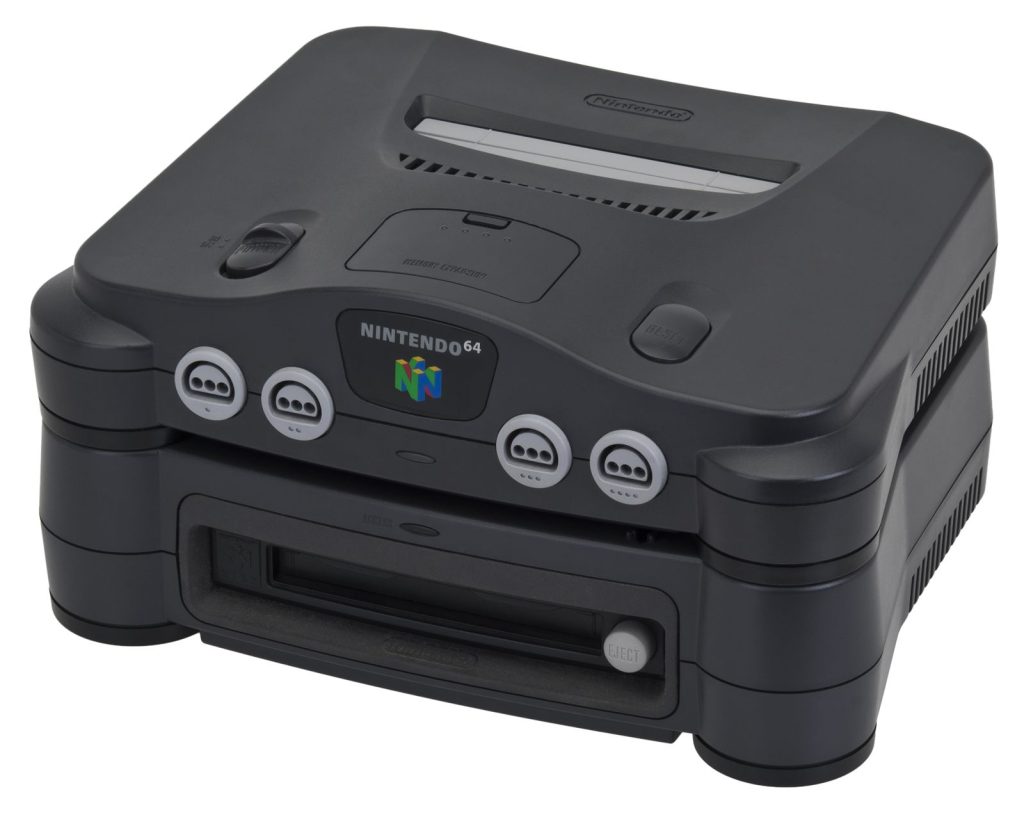
The Nintendo 64DD is a disk drive peripheral for the Nintendo 64, released by Nintendo exclusively in Japan on December 11, 1999.
Spec Table
| Spec | Value |
|---|---|
| Maker | Nintendo |
| Type | Peripheral |
| Generation | Not applicable |
| Release Date | Japan: December 11, 1999 (never released outside Japan) |
| Launch Price | $90 USD |
| Units Sold | 15,000 |
| Media | 64 MB rewritable magnetic disks |
| CPU | 32-bit coprocessor dedicated to disk operations |
| Predecessor / Successor | Satellaview / Not documented |
History
Nintendo signaled a dual-storage strategy for its next home console at the Shoshinkai trade show in 1995, when president Hiroshi Yamauchi outlined plans to pair the upcoming Nintendo 64 with an add-on disk drive. The device, later named the 64DD, was fully unveiled at Shoshinkai 1996 with promises of aggressive third-party support, but press came away underwhelmed by the lack of concrete details on capabilities or a release date. What followed was one of the most drawn-out development cycles in Nintendo’s history, with a planned 1997 launch slipping repeatedly through 1998 and past E3 1998, where Nintendo conceded the peripheral would “definitely not” ship that year. Ambitious titles built around the drive’s rewritable storage, including an early Legend of Zelda concept, were reassigned to cartridges instead because the disk medium could not match cartridge load times.
The 64DD finally reached Japanese buyers on December 11, 1999, sold initially by mail order bundled with a Randnet subscription rather than as a standalone retail product. Randnet, a joint venture between Nintendo and Recruit, connected the drive to a dial-up modem and offered a members-only portal, email, an e-commerce storefront, and avatar-creation tools. Registration was capped at 100,000 accounts, but limited dial-up adoption in Japan kept subscriptions far below that ceiling; Nintendo reported only 15,000 active users by October 2000, the same month it announced Randnet’s closure. The service shut down on February 28, 2001, after barely fourteen months, and only ten software disks were ever released for the format.
Commercial failure did not erase the 64DD’s influence. Its real-time clock and rewritable storage were built to let a game world persist and change on its own between sessions, an idea explored for a cancelled 64DD title code-named “Animal Forest.” When the format’s collapse forced that project onto a standard cartridge instead, its real-time clock and season-driven village concept survived and shipped in 2001 as Animal Crossing, launching a franchise that continues today. A separate cancelled 64DD pet-simulation prototype fed into the design of Nintendogs, and Nintendo later credited the avatar tools built for Mario Artist: Talent Studio as a forerunner of the Wii’s Mii characters. As a peripheral built for the Nintendo 64, the 64DD is remembered today as a commercial dead end that nonetheless reshaped Nintendo’s design thinking for a decade afterward.
Library Highlights
With only ten disks ever released, the 64DD’s library was less a game lineup than a set of creative software experiments, several of which anticipated ideas Nintendo would return to years later.
- Mario Artist: Paint Studio
- Mario Artist: Talent Studio
- Mario Artist: Polygon Studio
- Doshin the Giant
- SimCity 64
- F-Zero X Expansion Kit
- Mario Artist: Communication Kit
- Japan Pro Golf Tour 64
Variants
No major hardware variants are documented. The 64DD was sold in a single configuration, initially bundled through mail order with a Randnet Starter Kit rather than offered as a standalone retail unit, and it later saw limited retail availability once Randnet subscriptions opened to walk-in buyers. See the full Nintendo manufacturer hub for other systems the company released.
Collector Value
With only 15,000 units ever distributed and exclusively within Japan, the 64DD is among the rarest pieces of official Nintendo hardware, and complete-in-box examples with the Randnet Starter Kit packaging command steep premiums from serious collectors. Loose drives occasionally surface on Japanese resale markets but remain scarce internationally; individual software disks, especially the Mario Artist titles, are independently sought after and can be harder to find than the drive itself. Given the rarity, buyers should expect to pay import shipping and customs from Japan for most listings, and should budget separately for the drive, its AC adapter, and any disks, since complete bundles are uncommon.
Buying Guide
Before buying a 64DD, confirm the listing includes the original Nintendo 64-region AC adapter, since the drive requires its own dedicated power supply separate from the console’s. Ask whether the drive has been tested with a disk, as the mechanism’s belt-driven components are known to degrade with age and can cause read failures. Because the 64DD only works with a Japanese Nintendo 64 (or a modified unit), also verify the seller is including a compatible console or that yours has already been adapted, and check that any included disks are free of visible mold or disk-surface damage common to magnetic media this old.
FAQs
When did the Nintendo 64DD come out?
The Nintendo 64DD launched in Japan on December 11, 1999. It was never released outside Japan.
How many units did the Nintendo 64DD sell?
The 64DD sold only about 15,000 units, based on Randnet subscriber figures, making it one of Nintendo’s rarest and most commercially unsuccessful hardware releases.
How much did the Nintendo 64DD cost at launch?
The 64DD launched at $90 USD.
What media did the Nintendo 64DD use?
It used proprietary 64 MB rewritable magnetic disks, a departure from the ROM cartridges used by the standard Nintendo 64.
Did the Nintendo 64DD have a successor?
Not documented. Nintendo did not release a direct successor peripheral; its ideas around persistent, real-time-clock-driven game worlds instead carried forward into standalone titles like Animal Crossing on later consoles.
Sources
- https://en.wikipedia.org/wiki/Nintendo_64DD
- https://www.gamespot.com/articles/how-animal-crossing-was-born-from-one-of-nintendos-biggest-flops/1100-6475342/
- Hero photo: “64DD-Attached.jpg” by Evan-Amos, Wikimedia Commons, CC BY-SA 3.0.

Facts on this page last verified 2026-07-15.