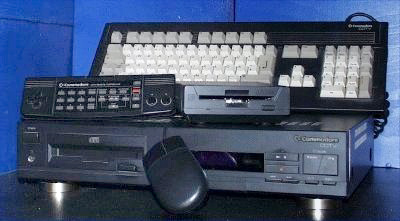
The Commodore CDTV is a fourth-generation home console released by Commodore International in 1991.
Spec Table
| Spec | Value |
|---|---|
| Maker | Commodore International |
| Type | Home console |
| Generation | 4th generation |
| Release Date | North America: 1991; UK: 1991 |
| Launch Price | $999 USD |
| Units Sold | 54,800+ |
| Media | CD-ROM |
| CPU | Motorola 68000 @ 7 MHz |
| Predecessor / Successor | Commodore 64 Games System / Amiga CD32 |
History
Commodore unveiled the CDTV in early 1991, positioning it as living-room entertainment furniture rather than a computer. Its black, VCR-like case housed a Motorola 68000 processor paired with a single-speed CD-ROM drive, running a remote-controlled interface instead of a desktop.
Commodore pitched the system as a multimedia device that could double as an encyclopedia and games machine years before CD-ROM became mainstream. However, the $999 launch price proved prohibitively high, undercutting its market appeal versus competing CD-based systems like the Philips CD-i and Pioneer LaserActive. Most software consisted of Amiga ports rather than CD-native titles, giving consumers little reason to choose the CDTV over a cheaper Amiga 500 with an add-on CD drive.
Sales concentrated in Europe, settling at roughly 54,800 units—a modest figure compared to the millions sold by cartridge-based competitors in the same generation. Commodore discontinued the CDTV in 1993, redirecting its CD-console efforts toward the Amiga CD32, a more conventional console redesign.
The CDTV remains historically significant as the first major console-format application of CD-ROM storage, yet it stands as a cautionary tale in multimedia console history—an ambitious venture launched before software libraries existed to exploit the medium.
Library Highlights
The CDTV’s library leaned heavily on ported Amiga classics rather than CD-native exclusives, giving buyers a taste of the platform’s strongest games even if few titles were built specifically to showcase the format.
- Lemmings
- Indiana Jones and the Last Crusade
- Defender of the Crown
- Sim City
Variants
No major hardware variants are documented. The CDTV was sold as a single core unit with an optional keyboard, mouse, and floppy drive add-ons that let it function closer to a standard Amiga computer, but Commodore did not release alternate CDTV models or regional hardware re-brands. See the full Commodore manufacturer hub for the company’s other systems.
Collector Value
Complete CDTV units with their remote, mouse, and original packaging are scarce today given the console’s low production numbers, and collectors pay a premium for examples in working condition with an intact CD-ROM drive belt, a common failure point on this hardware. Loose consoles missing the remote or peripherals turn up more often and sell for considerably less, while sealed or boxed examples with period software are rare enough to command strong prices whenever they surface.
Buying Guide
Before buying a used CDTV, ask the seller to confirm the CD-ROM drive spins up and reads discs reliably, since the drive belt and laser are the most common points of failure on units that have sat unused for decades. Check that the remote control and RF or composite cables are included, as period-correct CDTV remotes are increasingly difficult to source separately. Inspect the case for yellowing and confirm the power supply is the original or a known-safe replacement before powering on an untested unit.
FAQs
When did the Commodore CDTV come out?
The Commodore CDTV launched in 1991 in both North America and the UK.
How many units did the Commodore CDTV sell?
The CDTV sold roughly 54,800 units or more, a modest figure that reflected its high price and limited software library.
How much did the Commodore CDTV cost at launch?
The CDTV launched at $999 USD, a price widely blamed for its poor commercial performance.
What CPU does the Commodore CDTV use?
It uses a Motorola 68000 processor running at 7 MHz, the same core CPU family found in the Amiga 500.
What console followed the Commodore CDTV?
Commodore’s next CD-based console was the Amiga CD32, which replaced the CDTV in 1993.
Sources
Facts on this page last verified 2026-07-15.