This article contains Amazon affiliate links — as an Amazon Associate, RetroArcade earns from qualifying purchases.

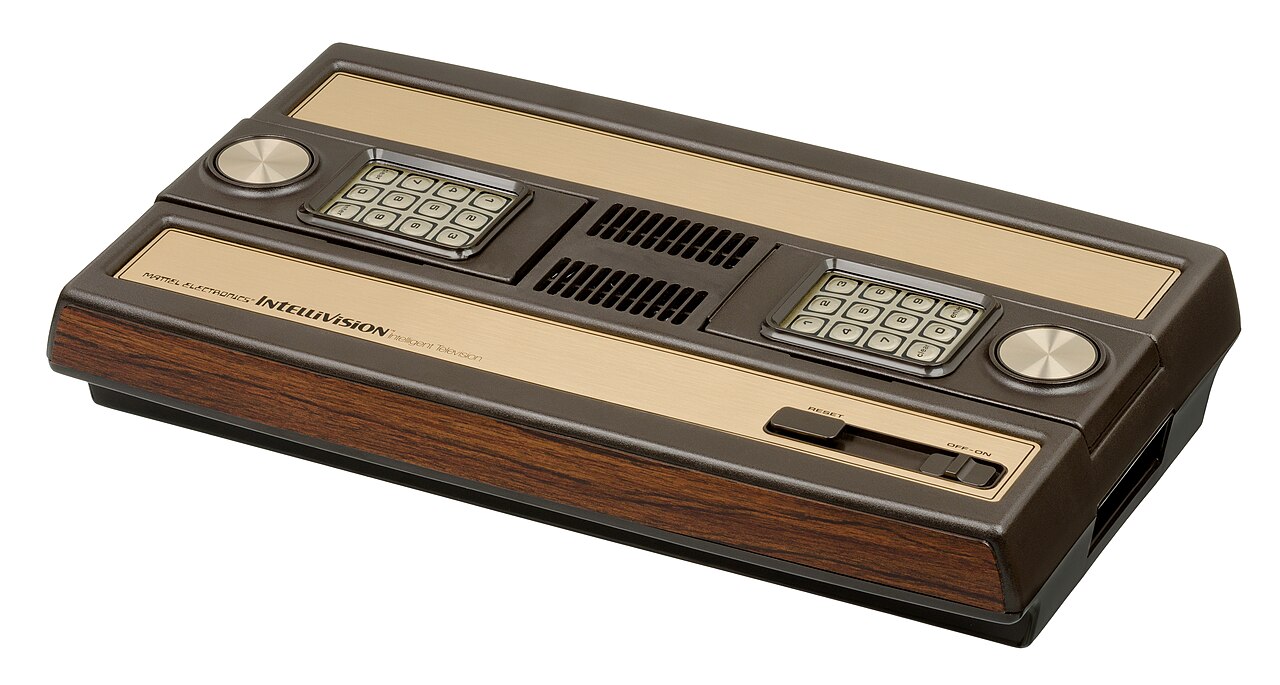
The Intellivision is a second-generation home console released by Mattel Electronics in 1979.
Spec Table
| Spec | Value |
|---|---|
| Maker | Mattel Electronics |
| Type | Home console |
| Generation | 2nd generation |
| Release Date | North America: 1979 (initial); United Kingdom: 1979; South Africa: 1982; Germany: 1982; France: 1982; Japan: 1982; Brazil: 1983 |
| Launch Price | $275 USD |
| Units Sold | 3.75 million |
| Media | ROM cartridge |
| CPU | General Instrument CP1610 16-bit microprocessor |
| Predecessor / Successor | Not documented |

History
Mattel Electronics introduced the Intellivision in 1979 as an “intelligent television” system built around a 16-bit processor, positioning it above the Atari 2600‘s 8-bit hardware. Launched at $275 in North America and the United Kingdom, the console’s sharper graphics made marketing claims easy: ad campaigns fronted by writer George Plimpton directly compared Intellivision sports titles against Atari’s simplistic-looking offerings, a strategy that worked with buyers seeking more capable machines.
By 1981, Mattel Electronics controlled close to 20% of the domestic video game market, an impressive share for a company that had entered gaming only two years earlier. International expansion followed on a staggered schedule throughout 1982 and 1983, reaching South Africa, Germany, France, Japan, and Brazil as Mattel licensed regional distribution. The console ranked among the notable systems of the second console generation, standing alongside contemporaries built to compete with the runaway popularity of the 2600.
That dominance collapsed quickly. ColecoVision arrived in 1982 with arcade-accurate ports and superior hardware, while the Commodore 64 undercut dedicated consoles on price. The resulting market fracture, combined with the broader video game crash of 1983, devastated Mattel Electronics’ gaming division. Mattel shut down its games unit in early 1984, selling the Intellivision business to INTV Corporation, which kept producing hardware and cartridges on a smaller scale until 1990, extending the console’s commercial run to eleven years.
Library Highlights
Intellivision’s library leaned into the console’s graphical edge with detailed sports simulations and one of the earliest management games, alongside a licensed arcade port and a Dungeons & Dragons tie-in that showed off the system’s range.
- Las Vegas Poker & Blackjack
- Major League Baseball
- Advanced Dungeons and Dragons: Cloudy Mountain
- World Series Major League Baseball
- Utopia
- Burger King’s Burgertime
- Space Armada
- Mattel Auto Race

Variants
No major hardware variants are documented beyond the console’s staggered regional launches. See the full Mattel manufacturer hub for other systems the company released.
Collector Value
Loose Intellivision consoles and common cartridges are inexpensive and widely available, reflecting the system’s 3.75 million-unit install base and long INTV Corporation production tail. Condition matters most for the console’s distinctive controllers, since the direction disc and keypad overlays wear out with use, and complete-in-box examples with intact overlays and manuals command a real premium over loose units. Rarer late-era INTV releases and the Intellivoice module, which sold poorly at launch, tend to bring higher prices than the mainline console itself.
Buying Guide
Before buying a used Intellivision, confirm the seller includes the original power supply and RF switchbox, since period-correct cables can be hard to find secondhand. Test the controllers thoroughly, checking that the direction disc responds smoothly in all directions and that the keypad overlays are present and legible. Inspect the cartridge slot’s contacts for corrosion, and ask whether the unit has been tested with an actual game rather than just powered on.
FAQs
When did the Intellivision come out?
The Intellivision launched in North America and the United Kingdom in 1979, followed by South Africa, Germany, and France in 1982, Japan later in 1982, and Brazil in 1983.
How many units did the Intellivision sell?
The Intellivision sold approximately 3.75 million units over its production run.
How much did the Intellivision cost at launch?
The console launched at $275 USD, a premium price compared to most rival consoles at the time.
What CPU does the Intellivision use?
It uses a General Instrument CP1610, a 16-bit microprocessor that was more advanced than the 8-bit chips found in most contemporaries.
Who made the Intellivision?
Mattel Electronics released the Intellivision, and later sold the business to INTV Corporation in 1984, which continued producing hardware and games for it until 1990.
Sources
- https://en.wikipedia.org/wiki/Intellivision
- https://www.gamedeveloper.com/game-platforms/a-history-of-gaming-platforms-mattel-intellivision
Facts on this page last verified 2026-07-15.