This article contains Amazon affiliate links — as an Amazon Associate, RetroArcade earns from qualifying purchases.
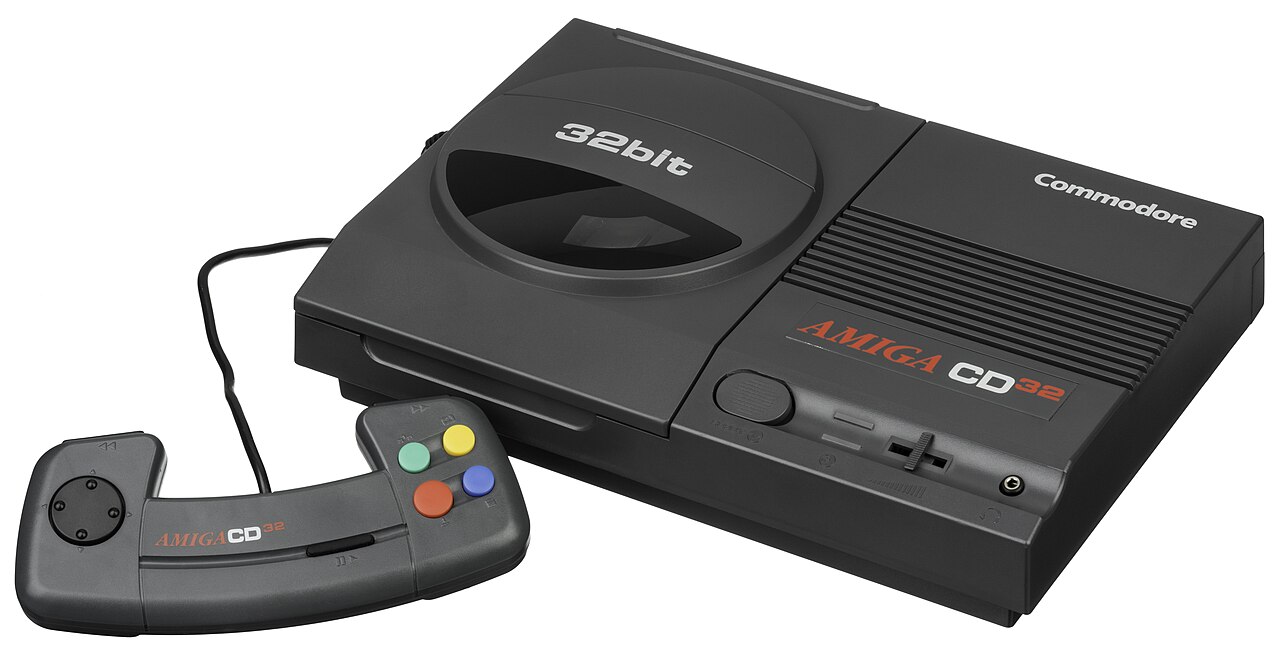
The Amiga CD32 is a fifth-generation home console released by Commodore in 1993.
Spec Table
| Spec | Value |
|---|---|
| Maker | Commodore |
| Type | Home console |
| Generation | 5th generation |
| Release Date | Europe: 1993 (initial); Australia: 1993; Canada: 1993; Brazil: 1993 |
| Launch Price | $399 USD |
| Units Sold | ~100,000 |
| Media | CD-ROM |
| CPU | Motorola 68EC020 @ 14.18 MHz (PAL) / 14.32 MHz (NTSC), 2 MB Chip RAM |
| Predecessor / Successor | Commodore CDTV / None |

History
Commodore unveiled the Amiga CD32 at London’s Science Museum in July 1993, positioning it as the successor to its earlier CDTV multimedia player. The machine reached shelves that September across Europe, Australia, Canada, and Brazil, built around a keyboard-less Amiga 1200 chassis with a CD-ROM drive in place of a floppy bay. Commodore promoted it heavily as the first 32-bit game console sold in Europe, even though Fujitsu’s FM Towns Marty had beaten it to Japanese shelves by roughly seven months.
Early sales were encouraging by Commodore’s standards. Industry estimates credited the CD32 with capturing well over a third of Britain’s CD-ROM drive sales during the crucial 1993 holiday season, and the console found niche institutional use as well; London’s transport museum installed well over a hundred units for interactive visitor displays. Across the wider European launch territories, however, total sales settled at roughly 100,000 units, a modest figure against the price tag and marketing push behind the machine.
Much of the CD32’s software came from ports of existing Amiga computer titles rather than games built to showcase disc-based media, so features like streamed audio or video were rarely used. That left the library looking more like a computer catalog squeezed onto disc than a purpose-built console lineup, a gap that limited how distinct the CD32 felt next to its Amiga computer siblings. It placed the machine squarely within the broader fifth console generation‘s early CD-based experiments, alongside contemporaries chasing the same disc-media promise.
Commodore’s finances collapsed before the CD32 could establish itself. A patent dispute over display-technology royalties triggered a federal import injunction that blocked American distribution, even though US-bound inventory had already been built and some stock ended up rerouted through the Philippines. Commodore filed for bankruptcy in April 1994, barely eight months after the CD32’s European debut, and the console was discontinued that same month. It stands as Commodore’s last piece of new hardware and the final chapter of the Amiga console lineage.
Library Highlights
Because so much of the CD32’s catalog was adapted from existing Amiga computer software, its highlights lean toward puzzle, platforming, and pinball titles already familiar to Amiga owners rather than console-exclusive showcases.
- Diggers
- Oscar
- Pinball Fantasies
- Sleepwalker

Variants
No major hardware variants are documented for the CD32. The console was never officially sold in North America, despite existing US-market inventory that ended up in the Philippines after the import injunction, so no distinct North American revision exists either. See the Commodore manufacturer hub for other systems the company released, including its CDTV predecessor.
Collector Value
The CD32’s short production run and limited European-only distribution make complete, working units a genuine find for collectors today, particularly in North America where the console never had an official retail presence. Condition and completeness drive price heavily: loose consoles with a working CD mechanism trade at moderate premiums over typical fifth-generation hardware, while boxed units with the original controller and cables command noticeably more. Sealed examples are rare enough that most collectors will never encounter one. Because the CD drive is the most failure-prone component after three decades, always ask whether a listed unit has been tested with a disc rather than simply powered on.
Buying Guide
Before buying a used CD32, confirm the seller includes the original power supply, since aftermarket units for this less common hardware can be inconsistent. Ask whether the CD-ROM drive has been tested with an actual disc, as belt and laser wear are the most frequent failure points on units this old. Check that the controller port and cartridge-style expansion slot show no corrosion, and if importing from Europe, verify the seller has accounted for PAL video output when shipping to an NTSC region.
FAQs
When did the Amiga CD32 come out?
The Amiga CD32 launched in 1993 across Europe, Australia, Canada, and Brazil.
How many units did the Amiga CD32 sell?
The CD32 sold approximately 100,000 units before Commodore’s bankruptcy cut its lifespan short.
How much did the Amiga CD32 cost at launch?
The console launched at $399 USD.
What CPU does the Amiga CD32 use?
It uses a Motorola 68EC020 processor running at 14.18 MHz in PAL regions or 14.32 MHz in NTSC regions, paired with 2 MB of Chip RAM.
Did the Amiga CD32 have a successor?
No. Commodore’s 1994 bankruptcy ended the Amiga console line, and the CD32 was never followed by another Commodore system.
Sources
- https://en.wikipedia.org/wiki/Amiga_CD32
- https://www.computinghistory.org.uk/det/4583/commodore-amiga-cd32/
Facts on this page last verified 2026-07-15.