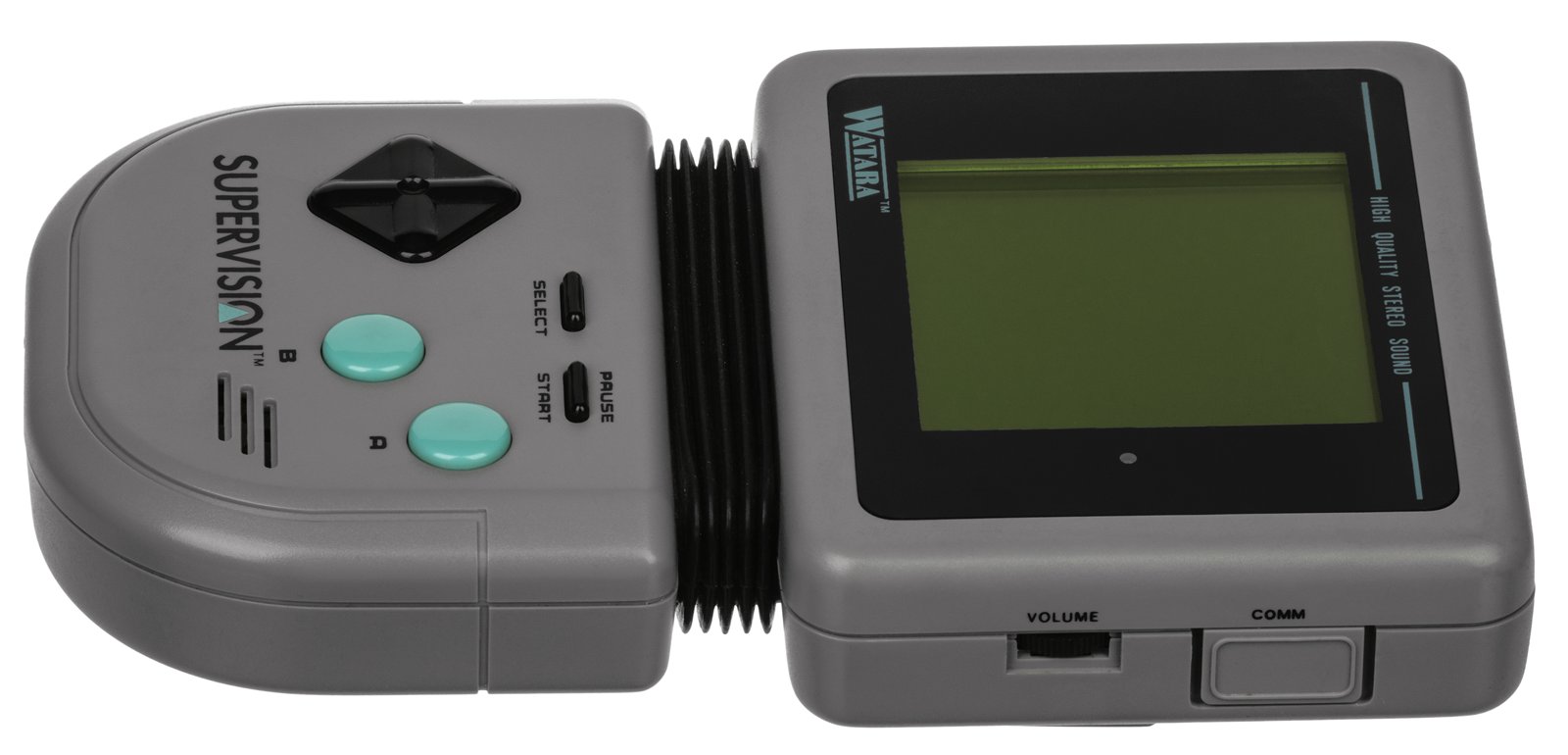
The Watara Supervision is a fourth-generation handheld console released by Watara in 1992.
Spec Table
| Spec | Value |
|---|---|
| Maker | Watara |
| Type | Handheld |
| Generation | 4th generation |
| Release Date | 1992 |
| Launch Price | $49.95 USD |
| Units Sold | Not documented |
| Media | ROM cartridge |
| CPU | 8-bit 65SC02 processor at 4 MHz |
| Predecessor / Successor | Not documented / Not documented |
History
Watara introduced the Supervision at the Winter Consumer Electronics Show in early 1992, then brought it to store shelves in time for that year’s holiday season. At $49.95, the console cost roughly half as much as Nintendo’s Game Boy, and its cartridge-based games undercut Nintendo’s pricing too, typically running $8.95 to $14.95 versus the Game Boy’s higher going rate. Watara leaned hard into a value pitch, branding it the affordable hand-held games machine.
However, Watara’s price advantage collapsed almost immediately. Not long after the Supervision reached stores, Nintendo introduced a stripped-down Game Boy Basic bundle priced only about ten dollars above the Supervision, closing the affordability gap the entire pitch depended on. Beyond price, the Supervision struggled against deeper structural disadvantages: an LCD panel prone to ghosting, a much smaller software catalog, and near-total absence of major Western and Japanese franchises like Zelda, Mario, or Castlevania that defined the era. The console’s library leaned on more than sixty titles built mostly by Taiwanese and Hong Kong studios, with only a handful of Western developers contributing games.
Watara also pursued a TV adapter that let Supervision games display in four colors on a television, a feature comparable to Nintendo’s later Super Game Boy. Despite its technical ambitions and aggressive pricing, the Supervision never carved out lasting market share, and is remembered today as one of several Japanese-designed handhelds of its generation that could not break the Game Boy’s near-monopoly.
Library Highlights
The Supervision’s catalog was built around simple, arcade-style genres rather than the sprawling franchises that powered its rivals, with puzzle, sports, and action titles making up the bulk of its more than sixty released games.
- Crystball
- Master Chess
- Insector
- Popeye
- Star Warrior
- Zig Zag
- Flipull
- Pocket Racing
Variants
Watara sold the same hardware under a variety of regional names rather than through distinct hardware revisions. In the United Kingdom, it was distributed as the QuickShot Supervision; other territories saw it marketed under names such as Hartung Supervision, VideoJet, and Tiger Boy, each backed by a different regional distributor that could customize its own branding and packaging on the same underlying hardware. Because of that arrangement, collectors today note that surviving units frequently differ from region to region in cosmetic details, cartridge labeling, and box art, to the point that no two examples are quite alike. An optional TV adapter accessory let the console output a four-color picture to a television screen, expanding on the handheld’s native monochrome display. A planned full-color version of that TV adapter was announced for late 1993 but was never released. No other major hardware revisions are documented. See the full Watara manufacturer hub for other systems the company released.
Collector Value
The Watara Supervision occupies a niche corner of retro handheld collecting: it is far less common in the secondhand market than the Game Boy it competed against, which keeps loose, working units and complete-in-box examples in steady demand among collectors of also-ran 1990s hardware. Cartridge condition and the presence of the original TV adapter accessory both meaningfully affect price, since the adapter shipped separately and is scarcer than the console itself. Sealed units are rarely seen for sale at all, making tested, functional loose systems the realistic target for most buyers.
Buying Guide
Before buying a used Supervision, check that the seller can confirm the console powers on and displays a picture, since the LCD screens on surviving units are prone to visible ghosting or blurring even when otherwise functional. Test the cartridge slot’s connector pins for corrosion, and ask whether a compatible AC adapter or a full set of four AA batteries is included, since period-correct power accessories are increasingly hard to find. If the listing includes the TV adapter accessory, verify it is present and working separately from the handheld itself, as this add-on is considerably rarer than the console.
FAQs
When did the Watara Supervision come out?
The Watara Supervision was released in 1992, following a prototype showing at the Winter Consumer Electronics Show earlier that year.
How many units did the Watara Supervision sell?
Sales figures for the Watara Supervision are not documented.
How much did the Watara Supervision cost at launch?
The console launched at $49.95 USD, roughly half the price of the Game Boy at the time.
What CPU does the Watara Supervision use?
It uses an 8-bit 65SC02 processor running at 4 MHz.
Was the Watara Supervision sold under a different name?
Yes. In the United Kingdom it was marketed as the QuickShot Supervision, and other regional distributors sold the same hardware under names including Hartung Supervision and Tiger Boy.
Sources
- https://en.wikipedia.org/wiki/Watara_Supervision
- https://retrohandhelds.gg/game-over-no-supervision/
Facts on this page last verified 2026-07-15.