This article contains Amazon affiliate links — as an Amazon Associate, RetroArcade earns from qualifying purchases.
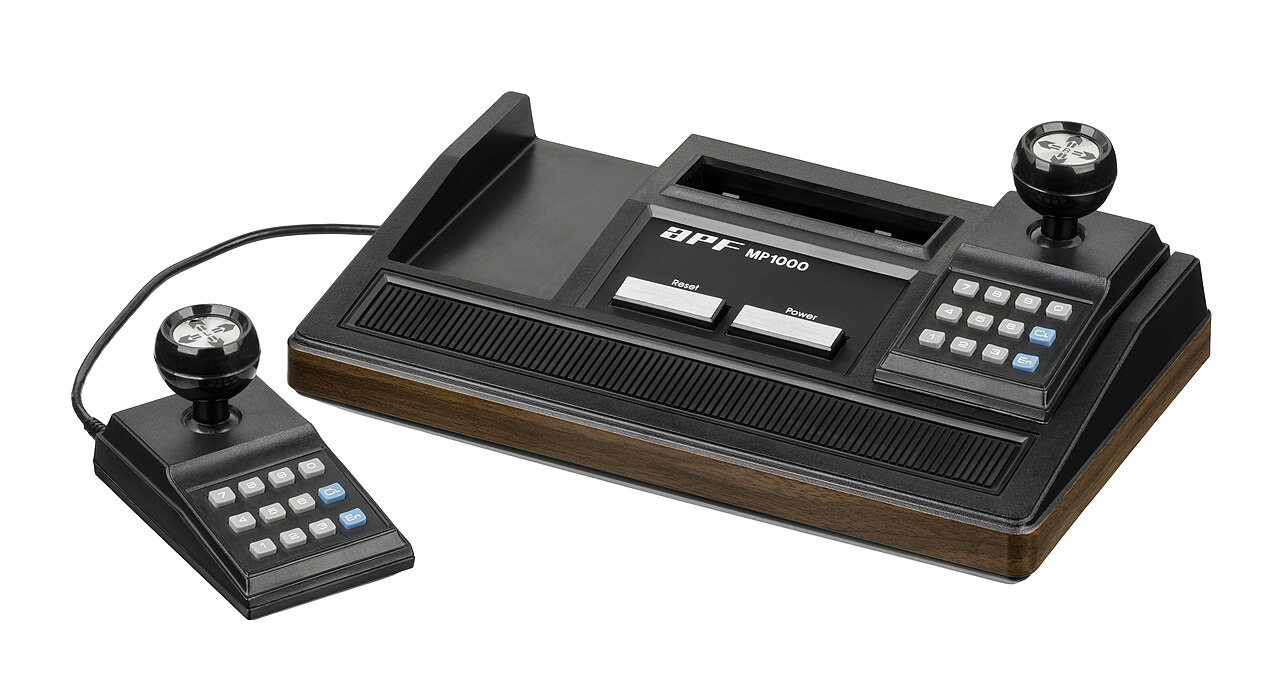
The APF Microcomputer System is a second-generation home console released by APF Electronics Inc. in 1978.
Spec Table
| Spec | Value |
|---|---|
| Maker | APF Electronics Inc. |
| Type | Home console |
| Generation | 2nd generation |
| Release Date | 1978 (initial) |
| Launch Price | Not documented |
| Units Sold | Around 50,000 at a minimum |
| Media | ROM cartridges |
| CPU | Motorola 6800 (8-bit, 0.895 MHz) |
| Predecessor / Successor | APF TV Fun series / APF Imagination Machine |
History
APF Electronics Inc. previously made the dedicated APF TV Fun series. In October 1978, they entered the cartridge-based console market with the APF-MP1000. The system also sold under the names M-1000 and MP-1000. It arrived roughly a year after the Atari 2600. The MP1000 competed in a crowded 1978 console field.
What set the MP1000 apart was its processor choice. Most peers used chips from various families. APF’s engineers selected the Motorola 6800 exclusively. This 8-bit design ran at 0.895 MHz. The MP1000 was the only console of its generation to use this architecture. The system achieved 256×192 resolution with 8 colors and 1 KB of RAM. For its era, the hardware was respectable.
The system launched with six cartridges including Rocket Patrol, Baseball, Blackjack, Bowling, and Boxing. Development work was carried out partly by engineer Ed Smith. Smith is remembered as a notable Black pioneer in computing. His contributions remain part of the console’s legacy.
Commercially, the MP1000 never matched market leaders. It moved an estimated 50,000 units minimum. This was modest versus Atari 2600’s millions eventually sold. APF followed it with the APF Imagination Machine as successor. Even with limited success, the MP1000 endures as a curious footnote. Its unusual processor choice and Smith’s role remain historically significant.
Library Highlights
The MP1000’s library was small but represented the sports- and casino-flavored variety typical of early cartridge consoles, mixing simple arcade action with tabletop game adaptations.
- Rocket Patrol
- Baseball
- Blackjack
- Bowling
- Boxing
- Catena
- Space Destroyers
- UFO
Variants
No major hardware revisions of the MP1000 itself are documented. The console is also known by the alternate model names M-1000 and MP-1000, which sometimes cause confusion in listings, and it should not be confused with its 1979 successor, the APF Imagination Machine, which added a full computer keyboard module and is considered a separate, expanded system rather than a revision of this console. See the APF Electronics Inc. manufacturer hub for the company’s other systems.
Collector Value
The APF Microcomputer System is a genuine rarity among second-generation consoles, and its low production numbers make complete, working units and factory-sealed cartridges considerably harder to find than equivalent Atari 2600 or Intellivision pieces. Collectors generally pay a premium for boxed systems with original packaging and manuals over loose, console-only examples, and functioning specimens with intact power supplies command the most interest given how few of these systems survive in testable condition. It belongs to the second console generation alongside far more common systems, which is part of what makes it appealing to generation-2 completists.
Buying Guide
Before buying an APF Microcomputer System, confirm the seller can supply the original AC power supply, since these are console-specific and difficult to replace with modern equivalents. Ask whether the unit has actually been tested with a cartridge inserted rather than just powered on, and inspect the cartridge slot’s contacts for corrosion or wear, as with any 1970s-era cartridge hardware. Given how uncommon this system is compared to its contemporaries, expect to pay well above typical Atari 2600 prices for a complete, working example.
FAQs
When did the APF Microcomputer System come out?
The APF Microcomputer System, also known as the APF-MP1000, launched in October 1978 as a second-generation home console.
How many units did the APF Microcomputer System sell?
Documented figures indicate around 50,000 units at a minimum, a modest total compared to the era’s best-selling consoles.
What CPU does the APF Microcomputer System use?
It uses a Motorola 6800 8-bit processor running at 0.895 MHz, making it the only second-generation console built around that chip.
What console followed the APF Microcomputer System?
APF’s next system was the APF Imagination Machine, which expanded the MP1000’s hardware with a keyboard and computer module.
How much did the APF Microcomputer System cost at launch?
No launch price is documented in available records.
Sources
- https://en.wikipedia.org/wiki/APF-MP1000
- https://en.wikipedia.org/wiki/Second_generation_of_video_game_consoles
Facts on this page last verified 2026-07-15.