This article contains Amazon affiliate links — as an Amazon Associate, RetroArcade earns from qualifying purchases.

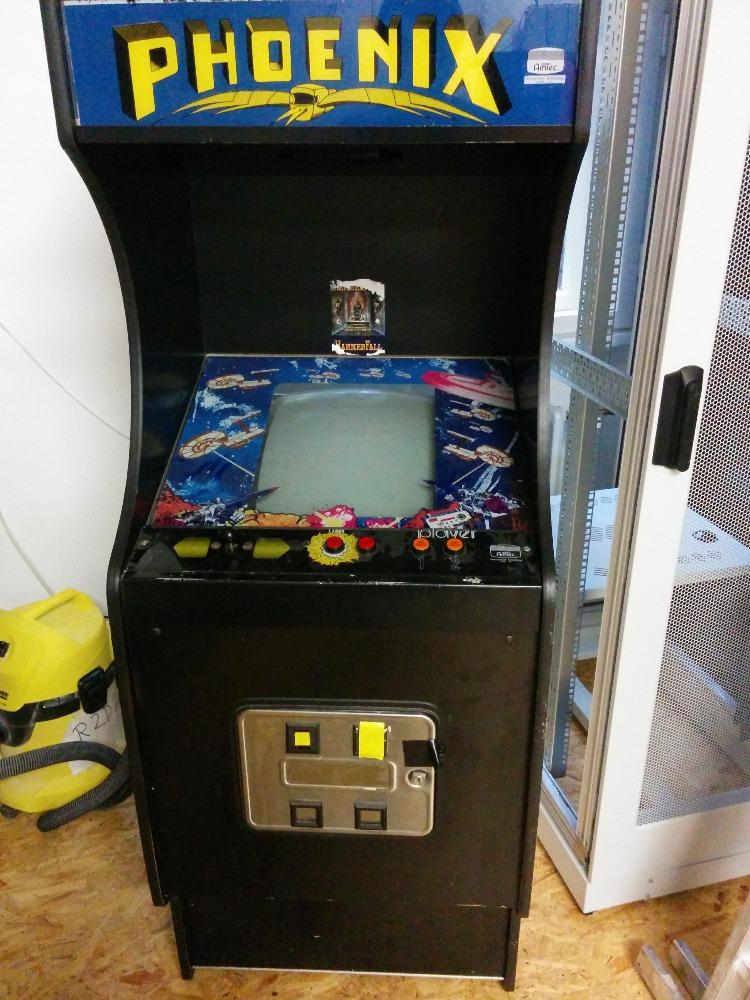
Phoenix is a 1980 fixed-screen shooter arcade game released in Japan by Taito and brought to the Americas by Amstar/Centuri.
Quick Facts
| Title | Phoenix |
| Year | 1980 |
| Manufacturer | Taito (Japan) / Amstar/Centuri (US) |
| Designer(s) | Unknown/uncredited |
| Genre | Fixed-screen shooter |
| Hardware | Arcade hardware. Ported to Atari 2600 (1983) with significant compression; the 8 KB cartridge version required removing over one-third of the original code, eliminating high score saves, music, starfield backgrounds, and reducing enemy counts. |
| Ports | 5 ports, including Atari 2600, Taito Legends (Xbox), and Taito Legends (PlayStation 2) — see Ports section |

History
Phoenix was developed in Japan and released there by Taito in December 1980; the identity of the original design team was never widely documented and remains uncertain to this day. Distribution outside Japan went through Amstar Electronics, a Phoenix, Arizona company that held the non-Japanese rights, which in turn licensed the game to Centuri for release across the United States, Canada, and Central and South America. Centuri unveiled the machine at a company promotional event in Miami in September 1980 before it reached American arcades in January 1981.
The timing could not have been better for Centuri. The company had posted a $4.5 million loss the prior year, and Phoenix reversed that fortune almost single-handedly, driving the business to roughly $7.5 million in profit by 1981 and accounting for close to half of Centuri’s total sales that year. A 1983 Atari 2600 conversion, built at General Computer Corporation by John Mraceck and Michael Feinstein, sold more than 600,000 cartridges despite having to strip out a third of the arcade code to fit an 8 KB ROM. Phoenix is also widely credited as one of the earliest shooters to build its final stage around a dedicated boss encounter, a structural choice that later shooters such as Gorf would echo.
Gameplay
Players pilot a single space vessel confined to left-right movement along the bottom of the screen, defending against waves of enemies that descend across five repeating stages. As the stages cycle, the waves grow tougher and more numerous, and the player’s only defensive tool is a temporary force field that can be raised to block incoming attacks before it needs time to reset. The fifth and final stage of each cycle culminates in a boss battle against a large enemy spaceship, an early implementation of a dedicated boss encounter in the arcade shooter genre.
- Left-right-only movement along the bottom of the screen
- Temporary force field for defense
- Five repeating stages of descending enemy waves
- Boss battle against a large enemy spaceship on the final stage

Cabinet & Hardware
Phoenix ran on dedicated arcade hardware distributed through Amstar and Centuri’s US cabinets. The most significant hardware story tied to the game is its 1983 Atari 2600 conversion, which had to compress the arcade experience into an 8 KB cartridge; the home programmers cut over a third of the original code, sacrificing high score saves, the in-game music, and the starfield backdrop while thinning out enemy counts to keep the action playable on far more limited console hardware.
Ports & Re-releases
| Platform | Year |
|---|---|
| Atari 2600 | 1983 |
| Taito Legends (Xbox) | 2005 |
| Taito Legends (PlayStation 2) | 2005 |
| Taito Legends (PSP) | 2005 |
| Taito Legends (Windows) | 2005 |
Phoenix’s most notable modern re-release came bundled across the 2005 Taito Legends compilation, which brought the original arcade version to Xbox, PlayStation 2, PSP, and Windows in one package. Check the Atari 2600 platform page for details on that earlier home conversion.

Where to Play Legally Today
- The Taito Legends compilation on Xbox, PlayStation 2, PSP, or Windows, which includes the original arcade version
- MAME, run only with legally owned ROM dumps from a cabinet or licensed source you own
- Arcade museums and retro arcade venues that keep a working Phoenix cabinet on their floor
Collector Value
Original Phoenix cabinets are a recognizable piece of Centuri’s history, having been the title that carried the company from a loss into profitability in the early 1980s, and surviving upright and cocktail cabinets with intact side art draw solid interest from golden-age collectors. Standalone PCBs circulate on the secondary market for owners who already have a compatible cabinet shell and want to swap in original hardware. The 1983 Atari 2600 cartridge is comparatively common and inexpensive, making it an accessible entry point for collectors who want a piece of the Phoenix legacy without pursuing a full-size arcade machine.
FAQs
Who made Phoenix?
Phoenix was released in Japan by Taito, with the game brought to the US, Canada, and Central and South America through a licensing agreement between Amstar and Centuri.
What year did Phoenix come out?
Phoenix came out in 1980.
What genre is Phoenix?
Phoenix is a fixed-screen shooter in which players defend a space vessel against descending waves of enemies across five repeating stages.
Does Phoenix have a boss fight?
Yes, the final of Phoenix’s five stages culminates in a boss battle against a large enemy spaceship, an early implementation of boss battles in the arcade shooter genre.
Has Phoenix been ported to home consoles?
Yes, Phoenix was ported to the Atari 2600 in 1983 and later included in the 2005 Taito Legends compilation for Xbox, PlayStation 2, PSP, and Windows.
See also the related Elevator Action and Front Line arcade pages from fellow Taito releases, and Galaxian among other fixed-screen shooters of the era.
Sources
- https://en.wikipedia.org/wiki/Phoenix_(1980_video_game)
- http://allincolorforaquarter.blogspot.com/2013/12/the-ultimate-so-far-history-of-allied.html
Facts on this page last verified 2026-07-15.