This article contains Amazon affiliate links — as an Amazon Associate, RetroArcade earns from qualifying purchases.
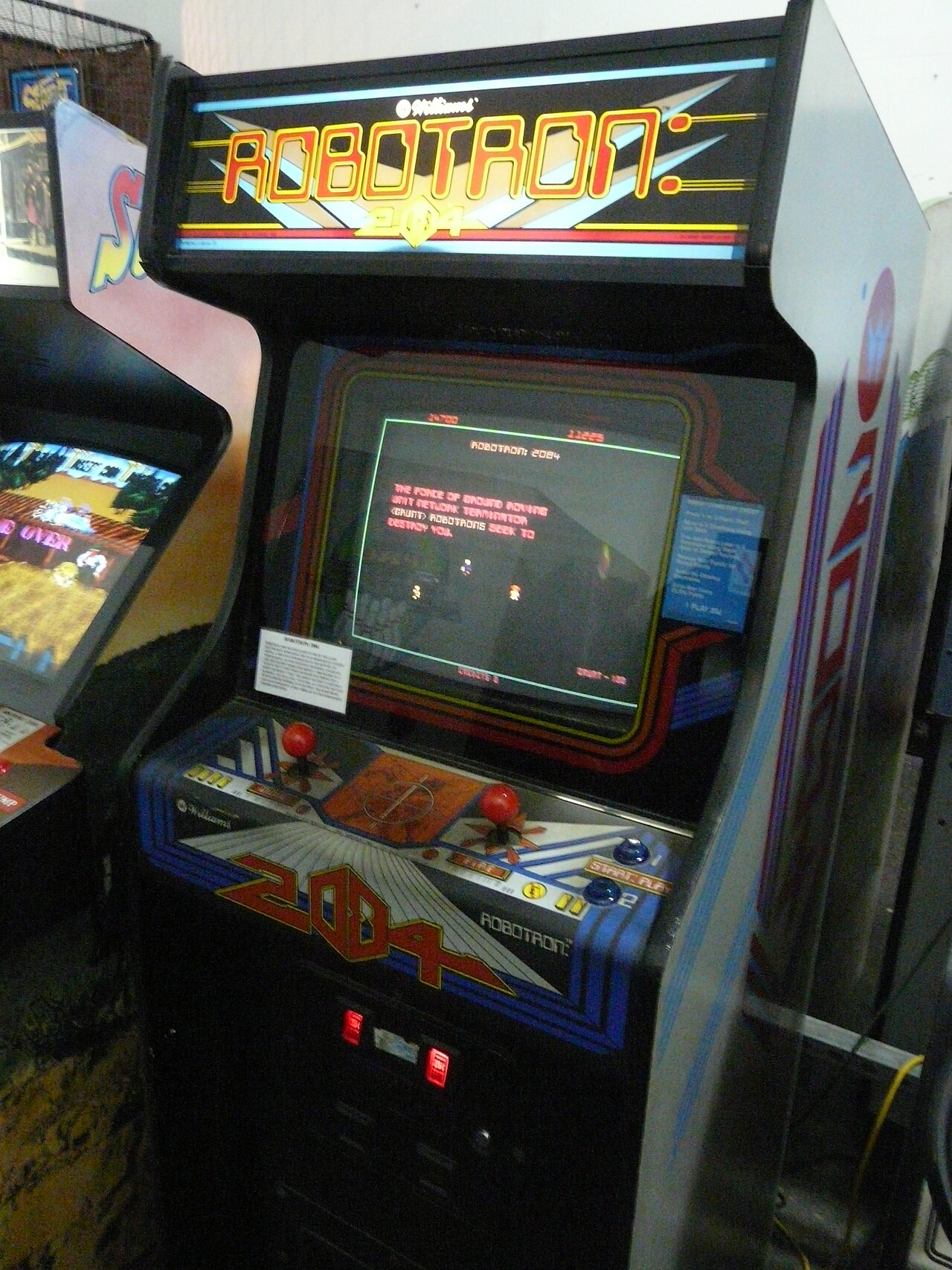
Robotron: 2084 is a 1982 twin-stick shooter arcade game by Williams Electronics.
Quick Facts
| Title | Robotron: 2084 |
| Year | 1982 |
| Manufacturer | Williams Electronics |
| Designer(s) | Eugene Jarvis, Larry DeMar |
| Genre | Twin-stick shooter |
| Hardware | Arcade cabinet featured a Motorola 6809E microprocessor and pioneering dual-joystick control interface. |
| Ports | 6 ports, including Atari 8-bit, VIC-20, and Commodore 64 — see Ports section |
History
Robotron: 2084 came out of Vid Kidz, the small Chicago studio Eugene Jarvis and Larry DeMar ran as outside contractors for Williams Electronics after finishing Defender and Stargate. Williams released the finished cabinet in 1982, registering the game’s artwork and program with the US Copyright Office that April. Jarvis and DeMar built the game in about six months on a Gimix 6809 development system, spending roughly four of those months balancing difficulty and enemy behavior rather than writing new code. Berzerk was a direct influence on the control layout, and Jarvis has said a broken wrist from a car accident pushed him toward splitting movement and firing across two separate joysticks instead of one stick and a button.
That dual-joystick scheme was not the first of its kind, but Robotron became its most influential example, and the layout spread through arcades across the 1980s. Williams sold close to 19,000 arcade cabinets of the game. The design saw a long dormancy before resurfacing prominently in Geometry Wars in 2003, and Robotron itself has resurfaced repeatedly through compilations such as Williams Arcade’s Greatest Hits in 1996 and Midway Arcade Treasures in 2003, keeping the original code playable well beyond its arcade run.
Gameplay
Robotron: 2084 puts players in a dystopian future where machines have turned against their creators. Viewed from directly above, the player’s lone human fighter must clear a single screen of attacking robots before the game advances to the next wave, with no scrolling and no room to retreat off-screen. One joystick moves the fighter in eight directions while a second, independent joystick aims and fires in any of the same eight directions, letting players run one way while shooting another. Survivors trapped in each wave, family members of the protagonist, can be walked into and rescued for bonus points, but doing so pulls the player away from safer ground and toward denser enemy fire. Different robot types demand different tactics: some merely block movement, some hunt the player directly, and others fire at range or reprogram rescued humans into hostiles, so scoring well means constantly weighing rescue attempts against survival.
- Independent dual-joystick control for simultaneous movement and firing in eight directions
- Single-screen waves of robots with no scrolling or escape off-screen
- Human rescue mechanic that trades bonus points for exposure to enemy fire
- Varied enemy types requiring different avoidance and targeting tactics
Cabinet & Hardware
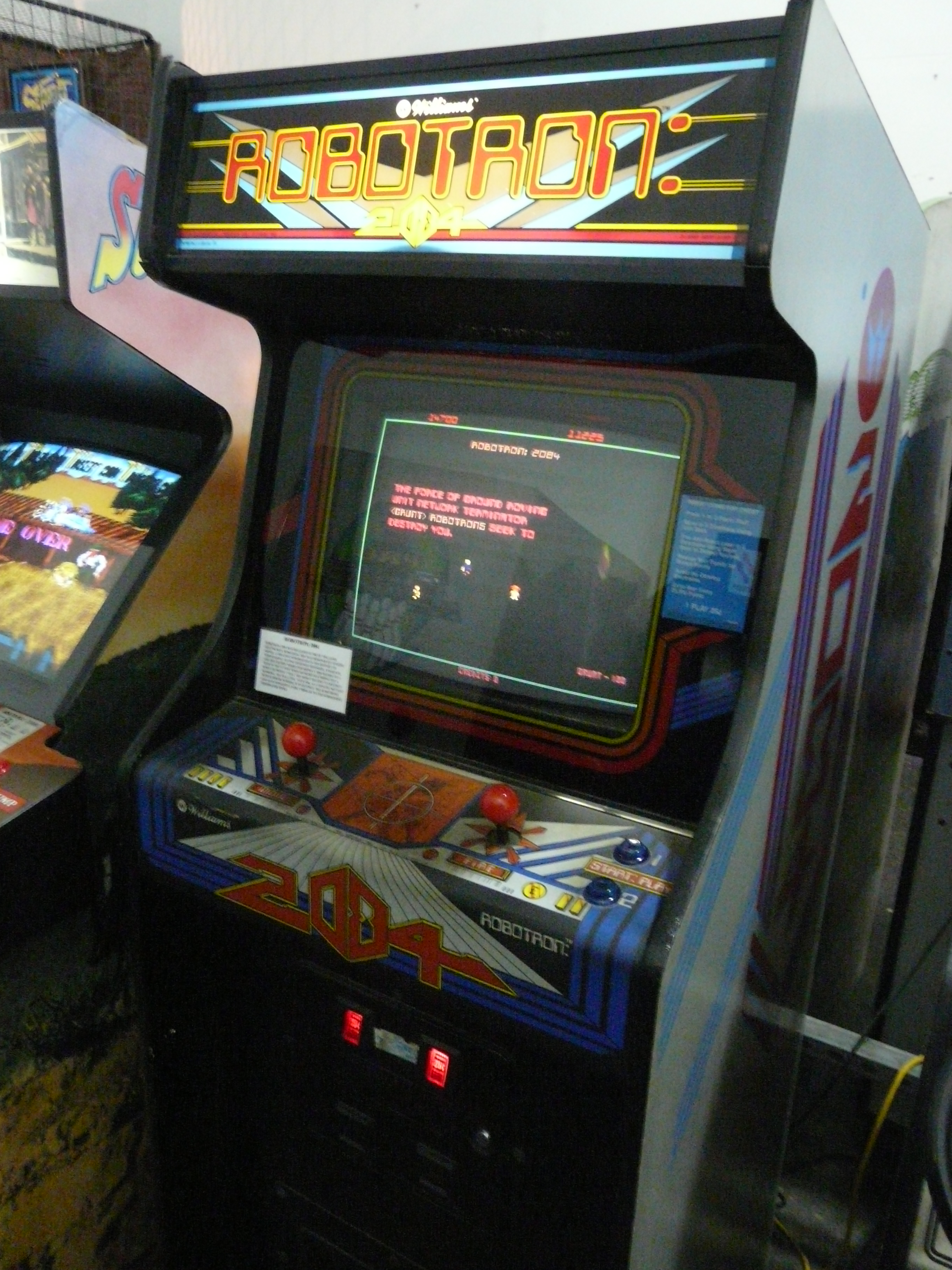
The arcade board runs on a Motorola 6809E microprocessor, the same family of chip Williams had used on Defender and Stargate, which let Jarvis and DeMar reuse code routines and sound work from those earlier titles. The cabinet’s defining hardware feature is its custom twin-joystick control panel, purpose-built so the left stick handles movement and the right stick handles independent aiming and fire, a physical layout that had no real precedent on Williams’ existing cabinets and had to be designed specifically for this game.
Ports & Re-releases
| Platform | Year |
|---|---|
| Atari 8-bit | 1984 |
| VIC-20 | 1984 |
| Commodore 64 | 1984 |
| Apple II | 1984 |
| Atari 7800 | 1986 |
| Atari Lynx | 1991 |
Beyond its individual home ports, Robotron: 2084 has stayed in circulation through compilation discs, appearing in Williams Arcade’s Greatest Hits in 1996 and Midway Arcade Treasures in 2003, both of which preserved the original arcade code for later console generations. See the Atari 7800 and Atari Lynx platform pages for details on those specific ports.
Where to Play Legally Today
- Official compilation releases such as Williams Arcade’s Greatest Hits and Midway Arcade Treasures, where the original arcade code is preserved on later hardware
- MAME, run only with legally owned ROM dumps from a cabinet or licensed source you own
- Arcade museums and retro arcade venues that keep a working Robotron: 2084 cabinet on their floor
Collector Value
Original Robotron: 2084 cabinets are sought after by collectors for their unique twin-joystick control panel, a feature that cannot be easily replicated on a standard single-stick cabinet and that adds to their value compared to more common contemporaries. With close to 19,000 units originally produced, complete and unmodified cabinets are less common on the secondary market than mass-produced hits of the era, and working control panels with both original joysticks intact command a particular premium. Home ports on cartridge-based systems like the Commodore 64 and Atari 7800 remain comparatively inexpensive and offer a lower-cost way to experience the game without the control panel these versions inevitably compromise on.
FAQs
Who made Robotron: 2084?
Robotron: 2084 was designed by Eugene Jarvis and Larry DeMar and manufactured for arcades by Williams Electronics.
What year did Robotron: 2084 come out?
Robotron: 2084 came out in 1982, released to arcades by Williams Electronics.
What genre is Robotron: 2084?
Robotron: 2084 is a twin-stick shooter, in which the player uses one joystick to move and a second joystick to aim and fire independently while clearing waves of robots and rescuing humans.
What hardware did Robotron: 2084 run on?
Robotron: 2084 ran on an arcade board built around a Motorola 6809E microprocessor, paired with a custom dual-joystick control interface designed specifically for the game.
Has Robotron: 2084 been ported to home consoles and computers?
Yes, Robotron: 2084 has been ported to at least six platforms since 1984, including the Atari 8-bit line, VIC-20, Commodore 64, Apple II, Atari 7800, and Atari Lynx.
See also the related Defender and Joust arcade pages, both from Williams Electronics, plus the Berzerk page that influenced Robotron’s control scheme, and browse the Golden Age of Arcade Games hub for more classic shooters.
Sources
- https://en.wikipedia.org/wiki/Robotron:_2084
- https://arcadeblogger.com/2020/06/27/the-development-of-robotron/
Facts on this page last verified 2026-07-15.