This article contains Amazon affiliate links — as an Amazon Associate, RetroArcade earns from qualifying purchases.

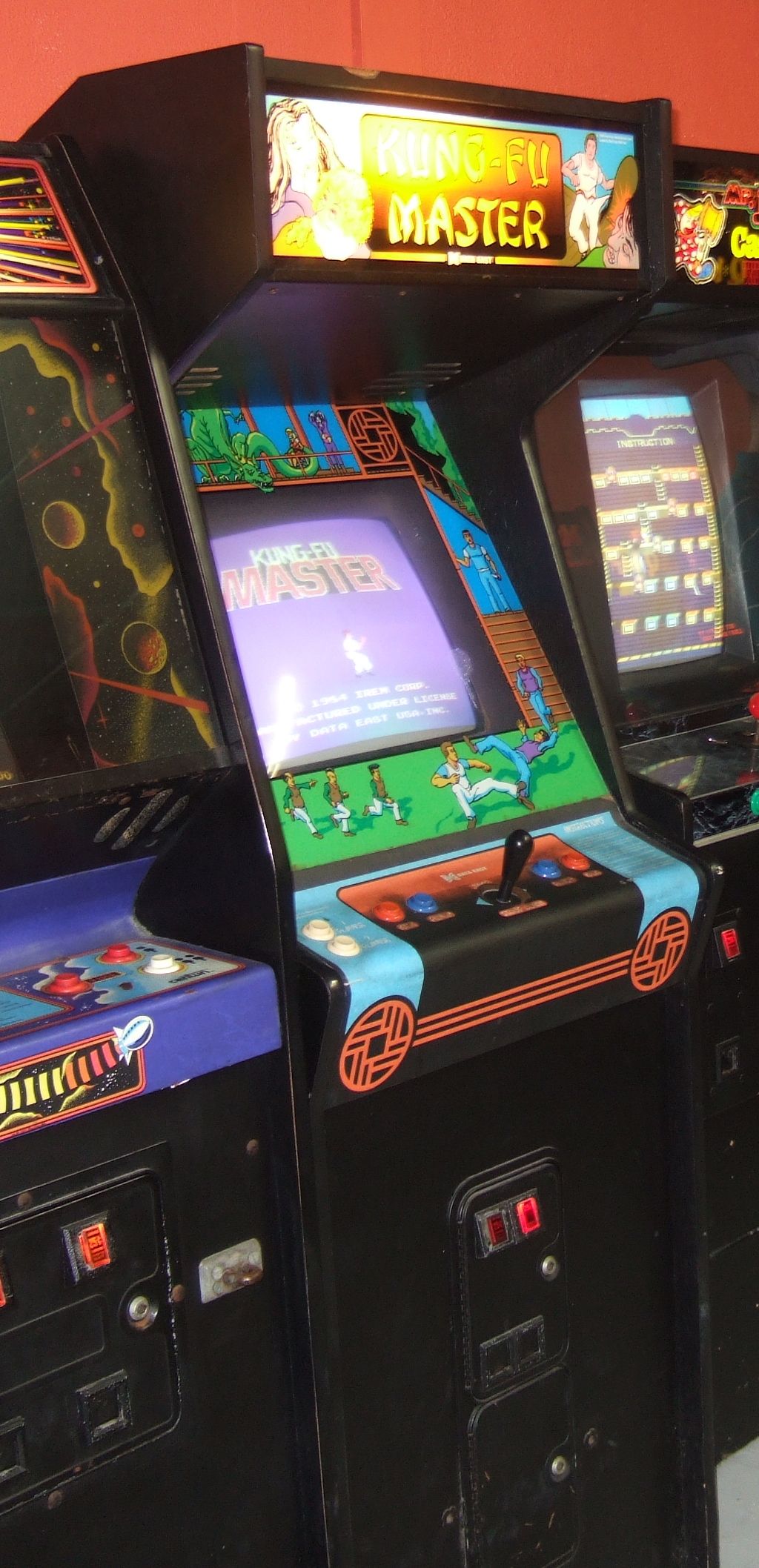
Kung-Fu Master is a 1984 beat ’em up arcade game by Irem, released in North America by Data East.
Quick Facts
| Title | Kung-Fu Master |
| Year | 1984 |
| Manufacturer | Irem (Japan) / Data East (US) |
| Designer(s) | Takashi Nishiyama |
| Genre | Beat ’em up |
| Hardware | Original arcade cabinet released on Irem’s arcade platform |
| Ports | 9 ports, including NES/Famicom, Atari 2600, and Commodore 64 — see Ports section |
History
Irem released Kung-Fu Master in Japanese arcades in December 1984 under the title Spartan X, borrowing its name from the Japanese release title of the 1984 Hong Kong martial arts film Wheels on Meals, starring Jackie Chan, Sammo Hung, and Yuen Biao. Designer Takashi Nishiyama built the game’s core structure, ascending a multi-story building to face a themed boss on each floor, around a similar sequence from Bruce Lee’s Game of Death, a film built on the same premise. Data East brought the cabinet to North American arcades under the Kung-Fu Master title later that year, and it quickly climbed the charts on both continents.
The game is widely credited as the first true beat ’em up, establishing the end-of-level boss fight and the visible health meter as fixtures of the genre. Nintendo published a home conversion for the Famicom and NES in 1985 that eventually sold 3.5 million copies worldwide; Shigeru Miyamoto worked on that port and later said the experience shaped ideas he carried into Super Mario Bros. Nishiyama himself left Irem before the arcade original was finished, moved to Capcom, and later drew on Kung-Fu Master’s one-on-one boss encounters while co-creating Street Fighter.
Gameplay
Players guide martial artist Thomas up through five floors of an enemy pagoda to rescue his kidnapped girlfriend, fighting off waves of attackers with an eight-way joystick and dedicated punch and kick buttons. Basic enemies can be dispatched with a single well-timed hit, but each floor ends with a tougher, named boss who requires more sustained offense and better spacing to defeat. Punches and kicks differ in range and damage, so players have to pick the right attack for how close an enemy is standing, while ducking and jumping help avoid thrown weapons and low or high attacks. A shared health meter tracks Thomas’s condition through the floor, and running out of health costs a life and sends the fight back to the start of that section.
- Five distinct pagoda floors, each ending in a unique boss encounter
- Separate punch and kick attacks with different range and damage values
- Ducking and jumping to avoid thrown objects and high/low enemy attacks
- A depletable health meter that governs how much punishment Thomas can take per floor
Cabinet & Hardware
Kung-Fu Master originally shipped on Irem’s own arcade hardware platform, built specifically to run the game rather than adapted from an earlier title. No additional cabinet or control-panel detail beyond the base hardware platform has been verified for this page.
Ports & Re-releases
| Platform | Year |
|---|---|
| NES/Famicom | 1985 |
| Atari 2600 | — |
| Commodore 64 | — |
| Apple II | — |
| Amstrad CPC | — |
| Atari 7800 | — |
| MSX | — |
| ZX Spectrum | — |
| Game Boy | — |
The NES/Famicom version was the highest-profile re-release, going on to sell 3.5 million copies worldwide and introducing a generation of home players to the pagoda-climbing formula. Check the NES/Famicom, Atari 2600, Atari 7800, and Game Boy platform pages for details on those specific ports.
Where to Play Legally Today
- Official arcade and NES compilation re-releases where currently available on modern digital storefronts
- MAME, run only with legally owned ROM dumps from a cabinet or licensed source you own
- Arcade museums and retro arcade venues that keep a working Kung-Fu Master cabinet on their floor
Collector Value
Original Kung-Fu Master arcade cabinets are a recognizable piece of mid-1980s beat ’em up history and turn up periodically in the collector market, with condition of the artwork and monitor driving most of the price variation. Bare PCBs circulate for collectors who already own a compatible cabinet shell and want to swap boards rather than buy a complete machine. The 1985 NES cartridge, given its multi-million-unit print run, remains one of the more affordable and easy-to-find ways to own a piece of the game’s history.
FAQs
Who made Kung-Fu Master?
Kung-Fu Master was designed by Takashi Nishiyama and manufactured by Irem in Japan, with Data East handling its release in the US.
What year did Kung-Fu Master come out?
Kung-Fu Master came out in 1984.
What genre is Kung-Fu Master?
Kung-Fu Master is a beat ’em up, a genre it is regarded as having originated, in which the player fights through waves of enemies and floor bosses using punches and kicks.
Did Kung-Fu Master influence other games?
Yes. It established the end-of-level boss battle structure and health meter mechanics now standard in action games, and it influenced Shigeru Miyamoto’s development of Super Mario Bros.
Has Kung-Fu Master been ported to home consoles?
Yes, Kung-Fu Master has been ported to at least nine platforms, including NES/Famicom, Atari 2600, Commodore 64, Apple II, Amstrad CPC, Atari 7800, MSX, ZX Spectrum, and Game Boy. The NES/Famicom version, released in 1985, sold 3.5 million copies worldwide.
See also the related Karate Champ arcade page, another 1984 Data East release, and browse the Golden Age of Arcade Games hub for more classic action titles.
Sources
- https://en.wikipedia.org/wiki/Kung-Fu_Master_(video_game)
- https://www.onemillionpower.com/spartan-x-arcade/
Facts on this page last verified 2026-07-15.