This article contains Amazon affiliate links — as an Amazon Associate, RetroArcade earns from qualifying purchases.
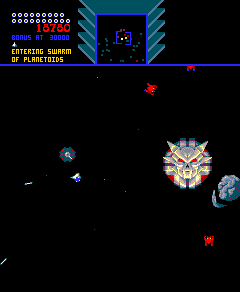
Sinistar is a 1983 multidirectional shooter arcade game by Williams Electronics.
Quick Facts
| Title | Sinistar |
| Year | 1983 |
| Manufacturer | Williams Electronics |
| Designer(s) | Sam Dicker, Jack Haeger, Noah Falstein, RJ Mical, Python Anghelo, Richard Witt |
| Genre | Multidirectional Shooter |
| Hardware | Featured a unique 49-way optical joystick designed specifically for this title. Audio utilized digitized speech through an HC-55516 CVSD decoder, with dialogue voiced by radio personality John Doremus. |
| Ports | 3 ports, including Williams Arcade’s Greatest Hits, Midway Arcade Treasures, and Multiple platforms (Midway Arcade Treasures compilations) — see Ports section |
History
Williams Electronics released Sinistar to arcades on February 8, 1983, following the studio’s earlier hit Defender. Designer Noah Falstein led the project alongside John Newcomer, who contributed the original concept of a space station that grows more dangerous the longer a match runs. Programmers Sam Dicker, RJ Mical, Ken Graham, and Richard Witt split the coding work, with Mical building the attract mode and high score systems while Falstein handled enemy AI, asteroid behavior, and the villain’s speech triggers. Python Anghelo and Jack Haeger contributed additional design and artwork to round out the cabinet’s presentation.
The game’s signature feature was its digitized speech, produced through an HC-55516 CVSD decoder and voiced by radio personality John Doremus, whose lines like “I hunger” gave the antagonist a menace that few 1983 cabinets could match. Williams paired that audio with a custom 49-way optical joystick built specifically for the title, though the stick’s feel drew some criticism for not matching the inertia-driven movement of rival titles like Asteroids. Sinistar never received a standalone home console port, appearing only in later compilations, yet its difficulty and voice work left it with a lasting reputation among Williams’ catalog. A 3D sequel, Sinistar: Unleashed, arrived for Windows in 1999, extending the brand more than fifteen years after the original release.
Gameplay
Players pilot a lone spacecraft through open asteroid fields, mining crystals from rocks and combining them into Sinibombs, the only weapon capable of harming the towering Sinistar boss. Enemy drones and gunships patrol the field and must be cleared or evaded while the player gathers resources, and the Sinistar itself grows steadily more active as it assembles from its component pieces elsewhere in the level. Once enough Sinibombs are stockpiled, the player can confront the fully formed Sinistar directly, though waiting too long lets the creature roam freely and hunt the ship down. The 49-way optical joystick allows movement in any direction independent of the ship’s firing angle, demanding constant attention to both resource management and evasive maneuvering.
- Crystal mining from asteroids to build Sinibombs
- Evading and destroying patrolling drones and gunships
- Confronting the Sinistar boss once enough Sinibombs are stockpiled
- Digitized voice cues that signal the Sinistar’s escalating threat level
Cabinet & Hardware
Sinistar’s control panel centered on the 49-way optical joystick Williams engineered specifically for the game, a departure from the standard eight-way sticks common on most contemporary cabinets. Sound came from an HC-55516 CVSD decoder driving the game’s digitized speech, recorded with radio host John Doremus, alongside a separately sourced roar effect for the Sinistar itself.
Ports & Re-releases
| Platform | Year |
|---|---|
| Williams Arcade’s Greatest Hits | 1990 |
| Midway Arcade Treasures | 2003 |
| Multiple platforms (Midway Arcade Treasures compilations) | Various |
Sinistar was never issued as a standalone home cartridge or disk release; every home appearance has come bundled inside a Williams or Midway arcade compilation, starting with Williams Arcade’s Greatest Hits in 1990 and continuing through the Midway Arcade Treasures series in the 2000s.
Where to Play Legally Today
- Official compilation releases such as Midway Arcade Treasures on PS2, Xbox, and GameCube
- MAME, run only with legally owned ROM dumps from a cabinet or licensed source you own
- Arcade museums and retro arcade venues that keep a working Sinistar cabinet on their floor
Collector Value
Original Sinistar cabinets are relatively scarce compared to other early-1980s Williams titles, and the game’s unique 49-way optical joystick makes complete, working examples especially prized since replacement parts for that control are hard to source. Standalone PCBs occasionally circulate for collectors who already own a compatible cabinet shell. Because Sinistar was never sold as a standalone home port, collectors seeking it on original hardware must rely on used compilation discs like Midway Arcade Treasures rather than a dedicated cartridge or disk release.
FAQs
Who made Sinistar?
Sinistar was designed by Sam Dicker, Jack Haeger, Noah Falstein, RJ Mical, Python Anghelo, and Richard Witt, and was manufactured by Williams Electronics.
What year did Sinistar come out?
Sinistar came out in 1983.
What genre is Sinistar?
Sinistar is a multidirectional shooter arcade game in which the player mines crystals to build weapons capable of destroying the pursuing Sinistar boss.
What hardware did Sinistar run on?
Sinistar used a custom 49-way optical joystick built specifically for the game, along with an HC-55516 CVSD decoder for its digitized speech, voiced by radio personality John Doremus.
Was Sinistar ever ported to home consoles?
Sinistar was never released as a standalone home console port. It has only appeared inside arcade compilations, including Williams Arcade’s Greatest Hits in 1990 and Midway Arcade Treasures in 2003 and later compilations.
See also the related Robotron: 2084 and Asteroids arcade pages, and browse the Golden Age of Arcade Games hub for more classic shooters.
Sources
Facts on this page last verified 2026-07-15.