This article contains Amazon affiliate links — as an Amazon Associate, RetroArcade earns from qualifying purchases.
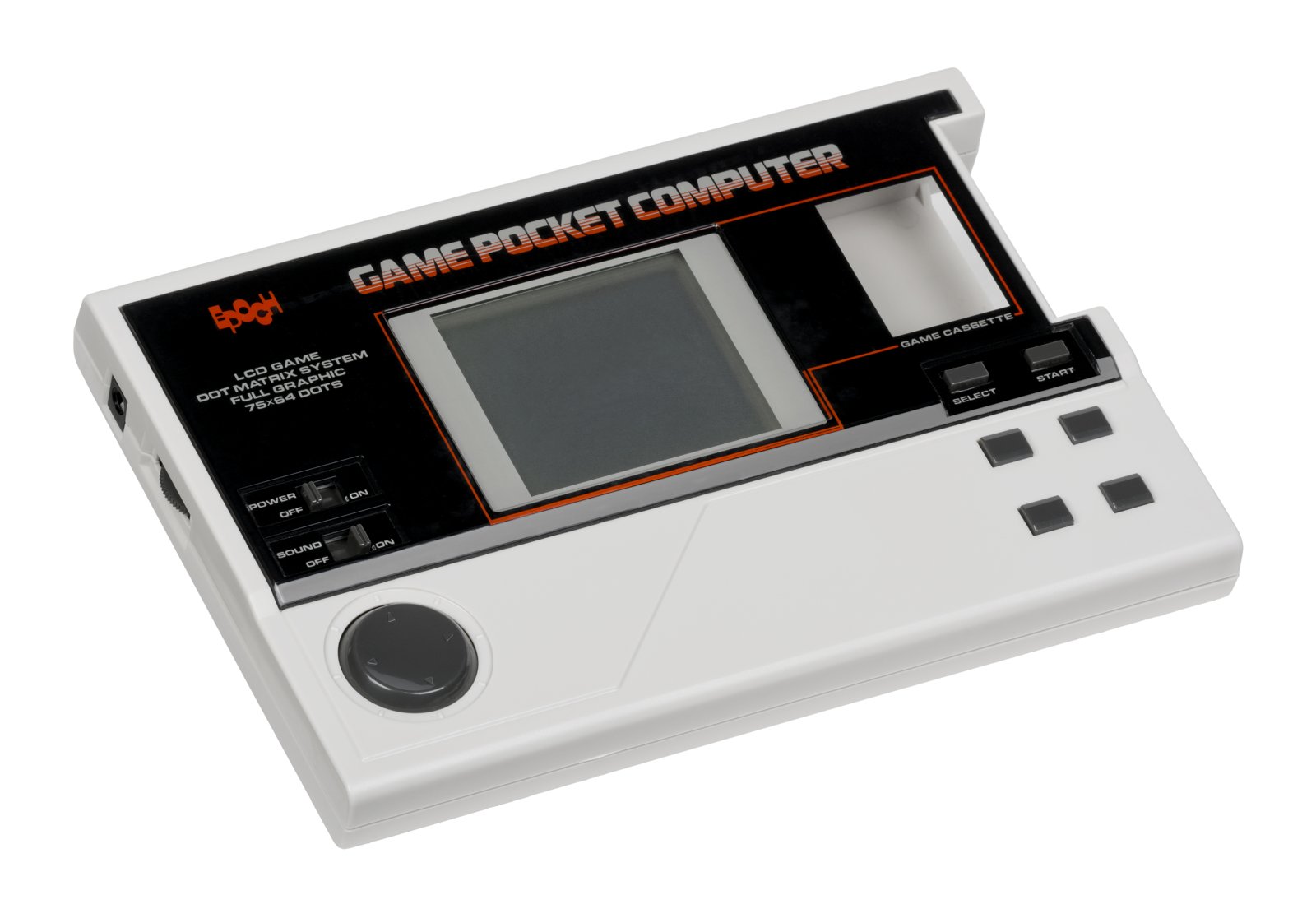
The Epoch Game Pocket Computer is a second-generation handheld console released by Epoch Co. in Japan in 1984.
Spec Table
| Spec | Value |
|---|---|
| Maker | Epoch Co. |
| Type | Handheld |
| Generation | 2nd generation |
| Release Date | Japan: 1984 |
| Launch Price | Not documented |
| Units Sold | Not documented |
| Media | ROM cartridge |
| CPU | NEC μPD78C06 @ 6 MHz |
| Predecessor / Successor | Not documented |

History
Epoch Co. released the Game Pocket Computer in Japan in 1984, a full five years before Nintendo’s Game Boy would define the handheld category. Only Milton Bradley’s Microvision preceded it as a true cartridge-based pocket system, making Epoch’s machine one of the earliest attempts at portable console gaming. Priced at 12,800 yen according to independent sourcing, it arrived with a monochrome LCD panel and a dummy cartridge filling the slot in the box rather than an included game.
The hardware itself was reasonably ambitious for its era. An NEC μPD78C06 processor drove a 75-by-64-pixel LCD capable of graphics roughly comparable to early Atari 2600 output, and the unit shipped with two programs built directly into the system: an 11-tile sliding puzzle and a simple paint editor. Four AA batteries powered the device, and a physical dial let players adjust screen contrast, a practical touch given how washed-out early LCD panels could look under indoor lighting. An 8-way joypad plus four face buttons rounded out the control layout.
Where the console struggled was software. Only five cartridges reached store shelves beyond the two built-in programs: Astro Bomber, a Scramble-style shooter; Block Maze, a Pac-Man-influenced chase game; the puzzle-block title known outside Japan as Sokoban and catalogued by some retailers under the literal translation “Store Keepers”; and the board-game adaptations Mahjong and Reversi. That thin lineup gave Japanese shoppers little reason to choose the Game Pocket Computer over more established home systems, and it is the console’s status as part of the second console generation that places it alongside contemporaries also fighting for shelf space in the early-to-mid 1980s.
Commercial failure followed quickly, and Epoch discontinued the system without expanding its library further. The company had entered the handheld space earlier through the same generation of hardware as its Cassette Vision home console, and would later return to portable and home hardware with other machines under the Epoch name, but the Game Pocket Computer itself remains one of the more obscure footnotes of the era: a technically capable machine remembered today mainly by handheld-collecting circles rather than the mainstream gaming public.
Library Highlights
With only seven total programs across the system’s lifetime, the Game Pocket Computer’s library was defined by variety within a small footprint rather than depth, ranging from an arcade-style shooter to board-game ports.
- Astro Bomber
- Block Maze
- Pocket Computer Mahjong
- Pocket Computer Reversi
- Sokoban

Variants
No major hardware variants are documented for the Game Pocket Computer. Epoch Co. did not issue a redesigned model or regional rebrand of the system before discontinuing it. The company released the console alongside other early hardware bearing the Epoch name, including the Cassette Vision and, later, the Super Cassette Vision, though none of these shared components or software compatibility with the Game Pocket Computer. See the full Epoch manufacturer hub for the rest of the company’s console lineup.
Collector Value
The Game Pocket Computer’s small library and Japan-only release make complete, working examples genuinely scarce outside Japan, and collectors pay a premium for units that still power on and hold contrast adjustment. Loose consoles missing their dummy cartridge or manual are more common than complete-in-box sets, and cartridges such as the hard-to-find board-game titles command higher prices than the shooter or maze games. Because the system is decades old and untested units are common on the secondary market, functional condition matters more here than for better-documented consoles.
Buying Guide
Before buying a Game Pocket Computer, confirm the seller has tested it with a real cartridge rather than just powered it on, since the LCD’s contrast dial can mask a dead screen at certain settings. Check that the battery compartment is free of corrosion, as leaked AA batteries are a common source of damage on units this old. Because so few cartridges were ever produced, verify which specific titles are included before paying a premium for a “complete” bundle.
FAQs
When did the Epoch Game Pocket Computer come out?
The Epoch Game Pocket Computer was released in Japan in 1984.
What CPU does the Epoch Game Pocket Computer use?
It uses an NEC μPD78C06 processor running at 6 MHz.
How many games were released for the Epoch Game Pocket Computer?
Only seven programs exist for the system in total, including the two built-in titles and five separate cartridges: Astro Bomber, Block Maze, Pocket Computer Mahjong, Pocket Computer Reversi, and Sokoban.
Why did the Epoch Game Pocket Computer fail commercially?
Despite innovative features like an adjustable-contrast LCD and an 8-way joypad, the console became a commercial failure in the Japanese market, and its thin software library of just seven titles gave shoppers little incentive to choose it over established home systems, leading to its quick discontinuation.
What type of display does the Epoch Game Pocket Computer have?
It uses a monochrome LCD screen with a resolution of 75 by 64 pixels and a manual dial for adjusting contrast.
Sources
- https://en.wikipedia.org/wiki/Epoch_Game_Pocket_Computer
- https://www.handheldmuseum.com/Epoch/GamePock.htm
Facts on this page last verified 2026-07-15.