This article contains Amazon affiliate links — as an Amazon Associate, RetroArcade earns from qualifying purchases.
The GP32 is a sixth-generation handheld console released by Game Park in South Korea in 2001.
Spec Table
| Spec | Value |
|---|---|
| Maker | Game Park |
| Type | Handheld |
| Generation | 6th generation |
| Release Date | South Korea: 2001 (initial); Portugal, Spain, Italy, United Kingdom, Sweden: 2004 |
| Launch Price | $270 USD |
| Units Sold | 30,000-32,000 |
| Media | SmartMedia cards (2-128 MB) |
| CPU | Samsung S3C2400X01 (ARM920T, 133 MHz, overclockable to 166+ MHz) |
| Predecessor / Successor | Not documented / GP2X |

History
Game Park launched the GP32 in South Korea on November 23, 2001, priced around 179,000 won, roughly $270 USD. It was the company’s first handheld, built around a 3.5-inch, 320×240 TFT display, 8 MB of SDRAM, and a Samsung S3C2400X01 processor (ARM920T core) running at 133 MHz stock but popular for overclocking to 166 MHz or beyond.
Game Park revised the hardware twice after the original “No-Light Unit,” which needed external lighting to see the screen: a “Front-Light Unit” in late 2002, then a “Back-Light Unit” in mid-2004 with a proper backlit LCD, later refined as the BLU+. The BLU model was the one that finally reached Europe, launching June 15, 2004 in Portugal, Spain, and Italy via distributor Virgin Play, with the United Kingdom and Sweden also gaining official distribution that year. The console never launched in North America.
Commercially, the GP32 struggled against its high price relative to rival sixth-generation handhelds, ending its run with roughly 28 commercial titles, closing out in December 2004 with Blue Angelo. What it lacked in retail software it made up for in homebrew: Game Park released free development tools, and an international community used the hardware’s open approach to build original games, ports, and emulators far beyond official offerings.
Sales never approached the console’s ambitions, with cumulative totals landing around 30,000 to 32,000 units by 2007, a niche outcome even by handheld-collector standards. Even so, the GP32 built a lasting reputation for encouraging open development at a time when most handheld makers locked their hardware down, and its open-architecture approach carried forward into Game Park Holdings’ direct successor, the GP2X, and is cited as an influence on later open-source handhelds like the Pandora and Pyra.
Library Highlights
Commercial software for the GP32 was scarce, so its library is remembered as much for ported arcade and console classics as for original titles, alongside the homebrew scene that filled the gaps.
- Blue Angelo
- Puzzle Bobble Mini 2
- Puyo Puyo Sun
- Gundam vs Zeon
- Astal
- Zaxxon
- Pitfall
- DogFighter

Variants
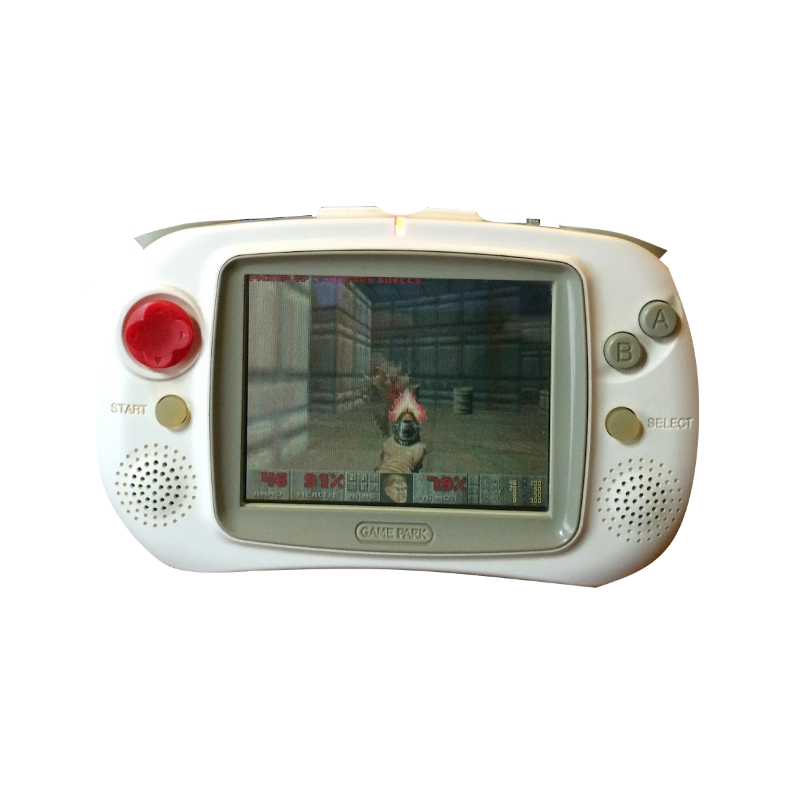
The GP32 shipped in three main hardware revisions. The original “No-Light Unit” (NLU) had no display illumination and required external light to see the screen. A “Front-Light Unit” (FLU) followed in late 2002, adding an integrated frontlight over the same LCD. The final “Back-Light Unit” (BLU), released in mid-2004 and later refined as the BLU+, replaced the panel with a proper backlit LCD and was the version distributed in Europe. No console-generation redesign or regional rebrand beyond these lighting revisions is documented.
Collector Value
With total production estimated at only 30,000 to 32,000 units, the GP32 is a genuinely scarce piece of handheld history, and complete units with original packaging, SmartMedia cards, and cables are hard to find outside South Korea and the small European import market. Condition matters most on the display: NLU and FLU units are worth less to buyers who want a usable screen without external lighting, while BLU and BLU+ units command a premium for their backlit panels. Working SmartMedia cards, now a discontinued format, add further value when included.

Buying Guide
Before buying a GP32, confirm which lighting revision you are getting: NLU and FLU units need external light or an aftermarket mod to be readable, while BLU and BLU+ units have a usable backlit screen out of the box. Check that the SmartMedia card slot reads cleanly, since the format is obsolete and replacement cards are increasingly scarce. Ask whether the unit has been tested with a card and original software rather than just powered on, and confirm the battery compartment is free of corrosion.
FAQs
When did the GP32 come out?
The GP32 launched in South Korea in 2001, with a limited European release following in 2004 in Portugal, Spain, Italy, the United Kingdom, and Sweden.
How many units did the GP32 sell?
The GP32 sold approximately 30,000 to 32,000 units in total, making it one of the rarer handhelds of its generation.
How much did the GP32 cost at launch?
The console launched at around $270 USD.
What CPU does the GP32 use?
It uses a Samsung S3C2400X01 processor built on the ARM920T core, running at 133 MHz stock and commonly overclocked to 166 MHz or higher.
What console followed the GP32?
Game Park’s next handheld was the GP2X, which built directly on the GP32’s homebrew-friendly design philosophy.
Sources
- https://en.wikipedia.org/wiki/GP32
- https://diversedaily.com/gamepark-gp32-a-deep-dive-into-the-korean-handheld-console-known-for-its-homebrew-scene-and-emulation-capabilities/
Facts on this page last verified 2026-07-15.