This article contains Amazon affiliate links — as an Amazon Associate, RetroArcade earns from qualifying purchases.
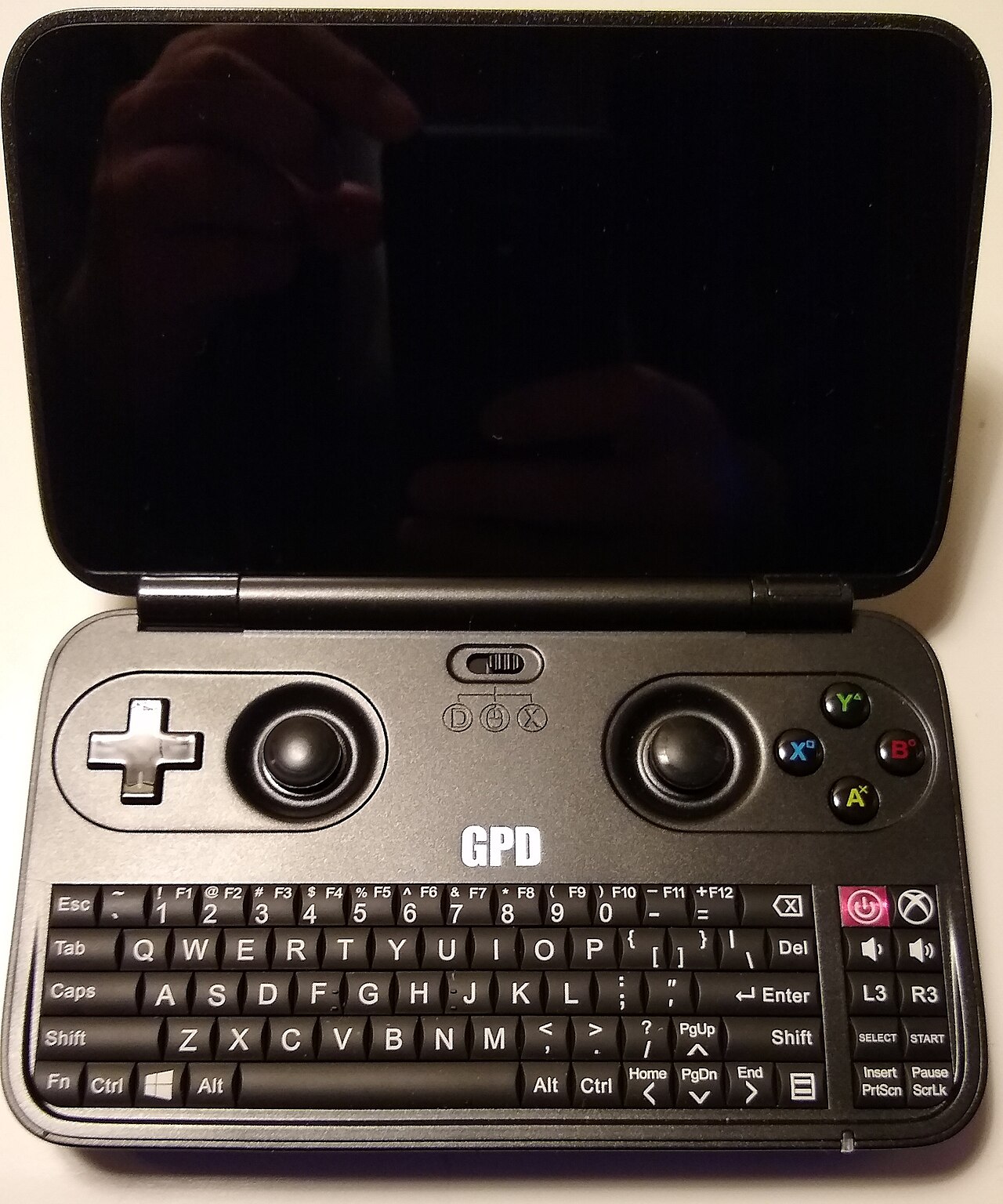
The GPD Win is an eighth-generation handheld released by GamePad Digital in 2016, notable for running full Windows 10 on pocket-sized hardware instead of a mobile or console operating system.
Spec Table
| Spec | Value |
|---|---|
| Maker | GamePad Digital |
| Type | Handheld |
| Generation | 8th generation |
| Release Date | 2016 |
| Launch Price | $499 USD |
| Units Sold | Not documented |
| Media | eMMC storage with microSD expansion |
| CPU | Intel Atom x7-Z8700 (first model) or x7-Z8750 (second model) |
| Predecessor / Successor | None documented / GPD Win 2 |

History
GamePad Digital released the GPD Win in October 2016 as a clamshell handheld running full Windows 10 rather than Android or console-specific OS. Built around an Intel Atom x7-Z8700 processor with a 5.5-inch 1280×720 touchscreen, physical QWERTY keyboard, and gamepad layout, the device let owners install and run ordinary PC software alongside games. That x86 architecture set it apart from ARM-based Android handhelds dominating the category, proving a pocket-sized machine could run unmodified Windows titles at all.
Reviewers including Liliputing praised the 6.1 x 3.8 x 0.9-inch frame for fitting USB 3.0, mini HDMI, headphone jack, and microSD expansion, but flagged inconsistent build quality, a mono speaker awkwardly placed under the palm, and battery life falling short of manufacturer claims. The keyboard’s tiny keys suited passwords or short text rather than serious typing, though the gaming buttons and 720p screen proved comfortable. Performance held up for older titles and emulators, though the cooling fan needed engagement to prevent thermal throttling.
Despite rough edges, the GPD Win proved there was a real market for x86 handheld PCs, a category barely existing before its release. Linux support followed by April 2017, broadening appeal beyond Windows-only buyers. Its commercial success led GamePad Digital to release the Win 2, Win Max, Win 3, and Win 4 in subsequent years, each refining the keyboard, chassis, and performance the original had introduced.
Library Highlights
The GPD Win has no fixed game library of its own; its appeal was running the entire Windows PC catalog and classic-system emulators on hardware small enough to fit in a jacket pocket. Reviewers highlighted a mix of native Windows titles and emulated classics as proof of concept for the device.
- Batman: Arkham Asylum (native Windows PC game)
- NES emulation
- SNES emulation
- Nintendo 64 emulation
- PlayStation emulation
- PSP emulation

Variants
The GPD Win shipped in two hardware revisions: a first model built around the Intel Atom x7-Z8700 processor, and a later second model upgraded to the slightly faster x7-Z8750. Beyond that CPU refresh, no other major hardware variants, regional re-brands, or bundle editions are documented for the original GPD Win. See the GamePad Digital manufacturer hub for the rest of the Win and XD lineup the company went on to release.
Collector Value
Original GPD Win units are a niche collectible today, sought mainly by handheld-PC enthusiasts and collectors tracing the lineage of the modern gaming-handheld market back to its first x86 entry. Because GamePad Digital produced it in relatively limited numbers compared to mainstream consoles, complete units with original packaging, charger, and documentation command more interest than loose units, and working examples with intact keyboards and undamaged hinges are harder to find given the well-documented build-quality issues of the era. As with any aging small-batch electronics, functional condition matters far more than cosmetic wear when assessing value.
Buying Guide
Before buying a used GPD Win, confirm the seller includes the original charger, since the device uses USB Type-C for power and not every third-party cable and adapter combination charges it reliably. Test the keyboard and gamepad buttons thoroughly, as the small keys and analog stick were common wear points, and ask whether the unit has been run under load long enough to confirm the cooling fan still engages, since thermal throttling was a known issue even on new units. Given the documented build-quality inconsistency across the production run, a unit that has already been verified working is a safer buy than an untested one.
FAQs
When did the GPD Win come out?
The GPD Win was released by GamePad Digital in October 2016.
How many units did the GPD Win sell?
Total unit sales for the GPD Win are not documented.
How much did the GPD Win cost at launch?
The GPD Win launched at $499 USD.
What CPU does the GPD Win use?
The first model used an Intel Atom x7-Z8700 processor, while the later second model was upgraded to the Intel Atom x7-Z8750.
What came after the GPD Win?
The GPD Win was followed by the GPD Win 2, the first of several sequels in a product line that later expanded to include the Win Max, Win 3, and Win 4.
Sources
- https://en.wikipedia.org/wiki/GPD_Win
- https://liliputing.com/gpd-win-handheld-gaming-pc-quick-review/
Facts on this page last verified 2026-07-15.