This article contains Amazon affiliate links — as an Amazon Associate, RetroArcade earns from qualifying purchases.
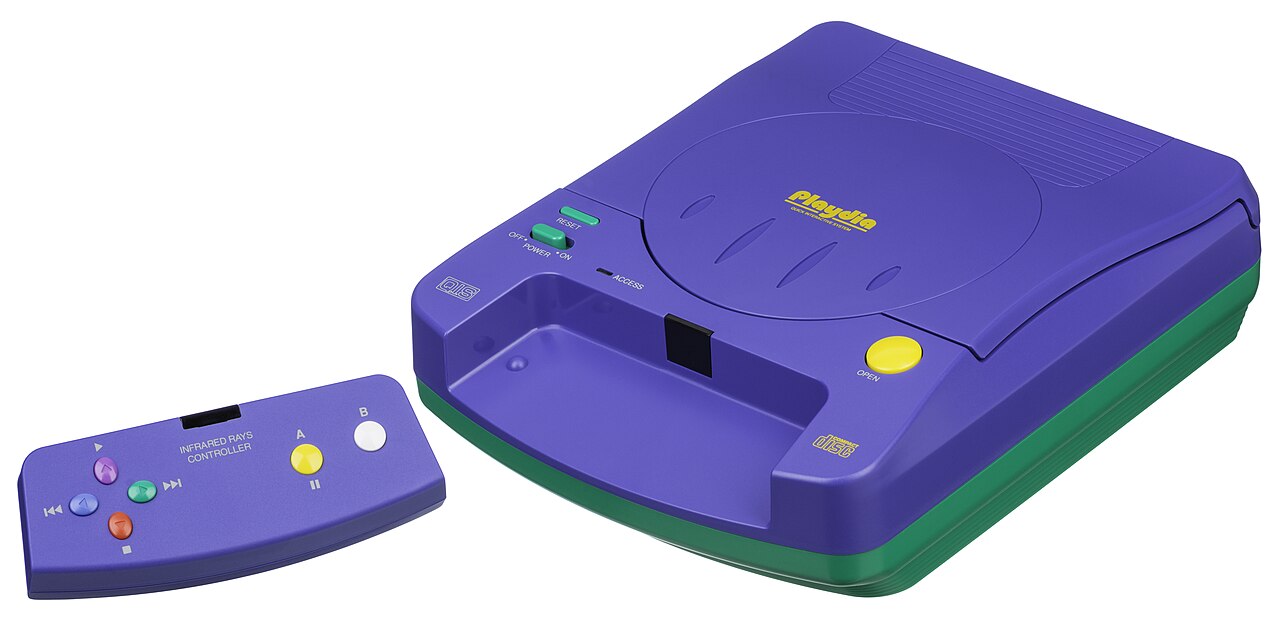
The Playdia is a fifth-generation home console released by Bandai in Japan in 1994.
Spec Table
| Spec | Value |
|---|---|
| Maker | Bandai |
| Type | Home console |
| Generation | 5th generation |
| Release Date | Japan: 1994 (initial; no international release) |
| Launch Price | Not documented in dataset (Wikipedia cites approximately ¥24,800, roughly $230 USD at 1994 exchange rates) |
| Units Sold | Not documented |
| Media | CD-ROM |
| CPU | NEC µPD78214GC (8-bit, 12 MHz) + Toshiba TMP87C800F (8-bit Z80 derivative, 8 MHz) |
| Predecessor / Successor | Bandai RX-78 / Apple Bandai Pippin |

History
Bandai released the Playdia in Japan on September 23, 1994, positioning it as a multimedia entertainment appliance rather than a conventional video game system. The company’s target buyer was an elementary-school-age child, not the hobbyist gamers courted by Sony, Sega, and Nintendo’s competing fifth-generation hardware. Where those rivals raced toward 32-bit and 64-bit processing power, Bandai built the Playdia around a pair of modest 8-bit chips, making it the only 8-bit machine among its fifth-generation peers.
That hardware choice reflected the software Bandai intended to sell alongside it. Rather than commissioning action games or platformers, the company filled the catalog with quiz shows, trivia discs, and interactive learning software built around characters children already recognized from anime and tokusatsu television. Titles built around Gundam, Sailor Moon, Ultraman, and Dragon Ball leaned on full-motion CD-ROM video and simple button-press interactions, closer in spirit to an educational toy than to the Super Famicom or Mega Drive libraries selling in the same stores.
The strategy did not connect with buyers. Retail interest stayed thin through 1995, and Bandai never expanded distribution beyond Japan, leaving the Playdia without the export markets that might have offset weak domestic sales. Bandai discontinued the console in 1996, only two years after launch, and the underperformance fed directly into the company’s next hardware bet: a joint venture with Apple Computer that became the Apple Bandai Pippin, a system that repeated many of the Playdia’s commercial mistakes on a larger and more expensive scale.
Rather than scrap the leftover hardware, Bandai’s arcade subsidiary Banpresto repurposed unsold Playdia units into coin-operated kiosks placed in Japanese retail locations and arcades, giving the console an unusual second life playing looping anime clips even after retail sales ended. Today the Playdia survives mainly as a curiosity within the fifth console generation, notable for having reached Japanese shelves before either the PlayStation or Saturn while ultimately chasing a completely different audience than either of them.
Library Highlights
Rather than competing on traditional gameplay, the Playdia’s roughly 30-title library leaned entirely on licensed anime characters and quiz-show formats aimed at young fans.
- Gundam Quiz
- Sailor Moon edutainment titles
- Ultraman quiz software
- Dragon Ball quiz games

Variants
No major hardware variants are documented. The Playdia shipped as a single Japan-only model throughout its short production run, sold with an infrared wireless joypad rather than a corded controller. See the full Bandai manufacturer hub for other systems the company released, including its later Pippin collaboration with Apple.
Collector Value
Because the Playdia was never sold outside Japan and its library skewed toward children’s licensed software, it remains a niche pickup for collectors rather than a mainstream one. Complete-in-box units with the original infrared controller and discs command the highest prices, since loose consoles are relatively easy to find within Japan but the anime-licensed discs are comparatively scarce outside it. Import shipping and the console’s Japan-only power and video output add extra friction for overseas buyers, which keeps demand—and therefore prices—lower than better-known fifth-generation systems despite the hardware’s genuine rarity.

Buying Guide
No dedicated Playdia value guide or best-of listicle is published yet on RetroArcade. Before buying, confirm the seller includes the original infrared wireless controller, since replacements are hard to find outside Japan, and ask whether the AC adapter matches Japanese voltage and plug standards. Test any included discs for read errors, as CD-ROM media from this era is prone to degradation, and check the cartridge-style disc tray mechanism for smooth operation before committing to a purchase.
FAQs
When did the Playdia come out?
The Playdia launched in Japan in 1994 and was never released internationally.
How many units did the Playdia sell?
No verified sales total is documented for the Playdia.
What kind of media did the Playdia use?
The Playdia used CD-ROM discs, in line with other fifth-generation multimedia consoles of the era.
What CPU does the Playdia use?
It uses a dual-processor setup: an NEC µPD78214GC 8-bit chip at 12 MHz paired with a Toshiba TMP87C800F 8-bit Z80 derivative at 8 MHz.
What console followed the Playdia?
Bandai’s next hardware effort was the Apple Bandai Pippin, developed jointly with Apple Computer.
Sources
- https://en.wikipedia.org/wiki/Playdia
- https://myretrogamehub.com/retro-gaming-history/the-bandai-playdia/
Facts on this page last verified 2026-07-15.