
This article contains Amazon affiliate links — as an Amazon Associate, RetroArcade earns from qualifying purchases.
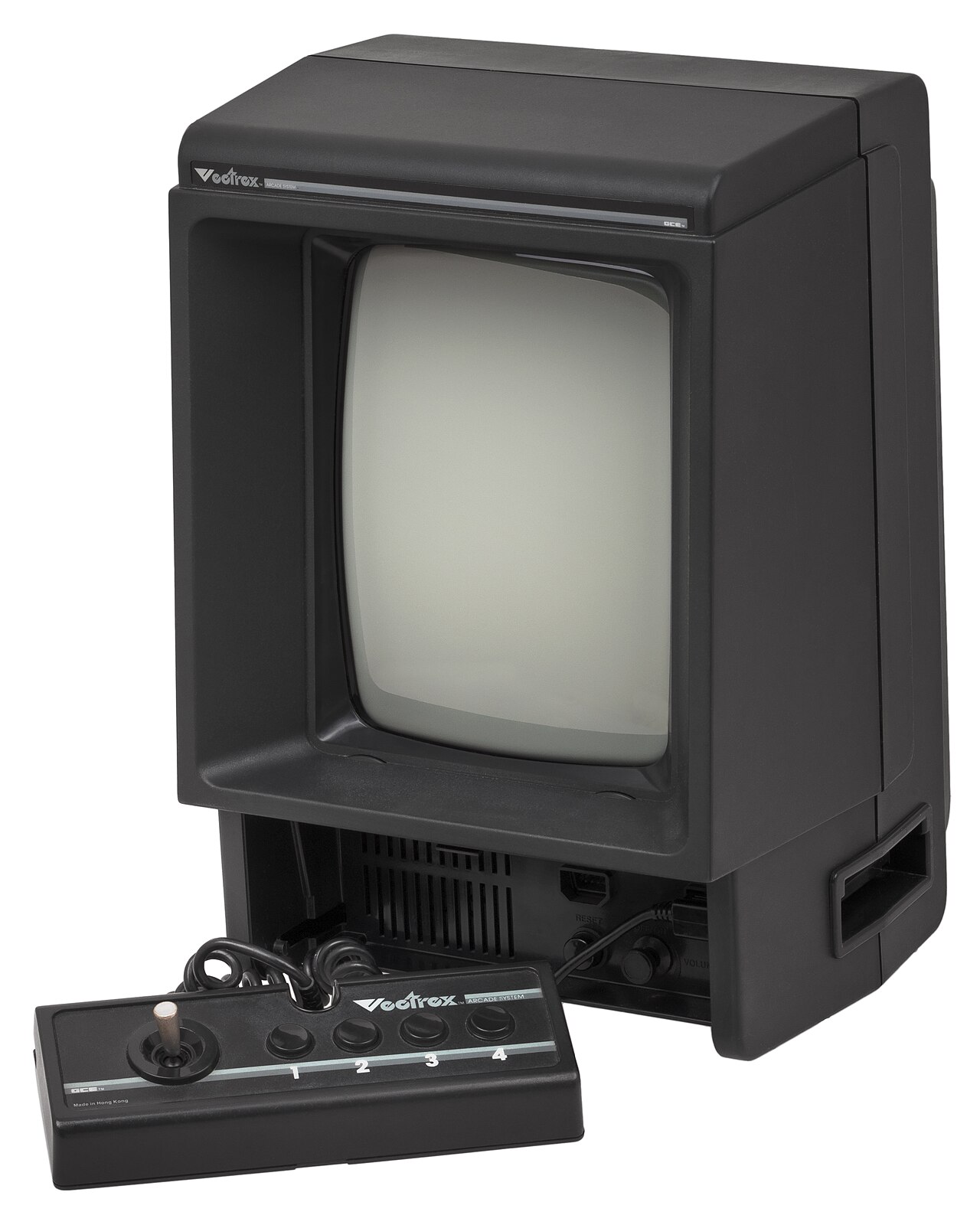
The Vectrex is a home console released by GCE (later Milton Bradley) in 1982, distinguished as the only home system ever built with vector graphics and an integrated monitor.
Spec Table
| Spec | Value |
|---|---|
| Maker | GCE/Milton Bradley |
| Type | Home console |
| Generation | Not documented |
| Release Date | North America: 1982 (initial); Europe: 1983; Japan: 1983 |
| Launch Price | $199 USD |
| Units Sold | Not documented |
| Media | ROM cartridges |
| CPU | Motorola MC68A09 @ 1.5 MHz |
| Predecessor / Successor | None documented / None documented |

History
Smith Engineering designed the Vectrex as an audacious bet: bring arcade-style vector graphics, previously confined to expensive coin-op cabinets, directly into the living room. General Consumer Electronics (GCE) unveiled the finished console at the Summer Consumer Electronics Show in June 1982 and began shipping it to North American retailers that October. Rather than rely on a television, the Vectrex built its own crisp 9-inch CRT monitor directly into the cabinet, drawing sharp monochrome line art instead of the blocky sprites typical of contemporary home hardware.
Early sales were strong enough that Milton Bradley, the century-old toy and game company, acquired GCE in early 1983 and took over manufacturing and distribution. Milton Bradley expanded the library and pushed the console into European and Japanese markets that same year. The company also released the 3D Imager, a spinning-disc visor accessory synchronized to the display that produced genuine stereoscopic 3-D effects and crude color overlays, a first for any home console peripheral.
That momentum collapsed almost as quickly as it built. The North American video game crash of 1983 gutted retailer demand across the industry, and the Vectrex was not spared. Milton Bradley discontinued the system in February 1984 after the platform had cost the company roughly $31.6 million in losses, and planned cartridges already in development were shelved. Despite its brief eighteen-month commercial run, the Vectrex’s singular vector-graphics approach and unusual peripheral earned it a lasting cult following among collectors, who still prize it as one of the era’s most distinctive home systems.
Library Highlights
The Vectrex’s built-in library leaned into its vector strengths, offering sharp-lined riffs on arcade hits alongside games designed specifically to show off the hardware’s unique display.
- Mine Storm
- Arcade
- Clean Sweep
- Battlezone
- Cosmic Chasm
- Tail Gunner
- Fortress
- Asteroids

Variants
No major hardware variants are documented. The console’s most notable accessory was the 3D Imager, the visor-style peripheral bundled with a small run of stereoscopic-compatible cartridges, but the base Vectrex hardware itself was not substantially revised during its production run. See the full GCE/Milton Bradley manufacturer hub for other systems the company released.
Collector Value
Because the Vectrex had such a short commercial life, complete and working units carry real weight with collectors today, especially examples with the built-in monitor still displaying a clean, bright image and no screen burn. Loose consoles missing cables or the light overlays that shipped with certain cartridges sell for less, while boxed units and the 3D Imager accessory command a premium given how few survive in good condition. Buyers should also expect to pay more for rarer late-era cartridges, several of which were never widely distributed before the platform’s 1984 discontinuation.

Buying Guide
Before buying a used Vectrex, confirm the seller has powered it on and tested the built-in CRT for brightness, focus, and burn-in, since the monitor is not user-replaceable the way a separate TV would be. Check that the original AC adapter is included, as replacements can be hard to match safely, and inspect the cartridge slot’s connector pins for corrosion. If buying a cartridge that includes a plastic overlay, make sure it is present and undamaged, since these are easy to lose and are specific to each title.
FAQs
When did the Vectrex come out?
The Vectrex launched in North America in 1982, followed by Europe and Japan in 1983.
How many units did the Vectrex sell?
Total lifetime sales figures for the Vectrex are not documented.
How much did the Vectrex cost at launch?
The console launched at $199 USD.
What made the Vectrex’s graphics different from other consoles?
The Vectrex used vector graphics, drawing sharp monochrome lines directly on its built-in 9-inch CRT monitor rather than rendering pixel-based sprites on an external television, a display technology otherwise found only in arcade cabinets of the era.
Why was the Vectrex discontinued?
Milton Bradley discontinued the Vectrex in February 1984 after the video game crash of 1983 sank sales and left the company with an estimated $31.6 million loss on the platform.

Sources
- https://en.wikipedia.org/wiki/Vectrex
- https://dfarq.homeip.net/how-the-vectrex-game-console-sunk-a-124-year-old-company/
Facts on this page last verified 2026-07-15.