This article contains Amazon affiliate links — as an Amazon Associate, RetroArcade earns from qualifying purchases.
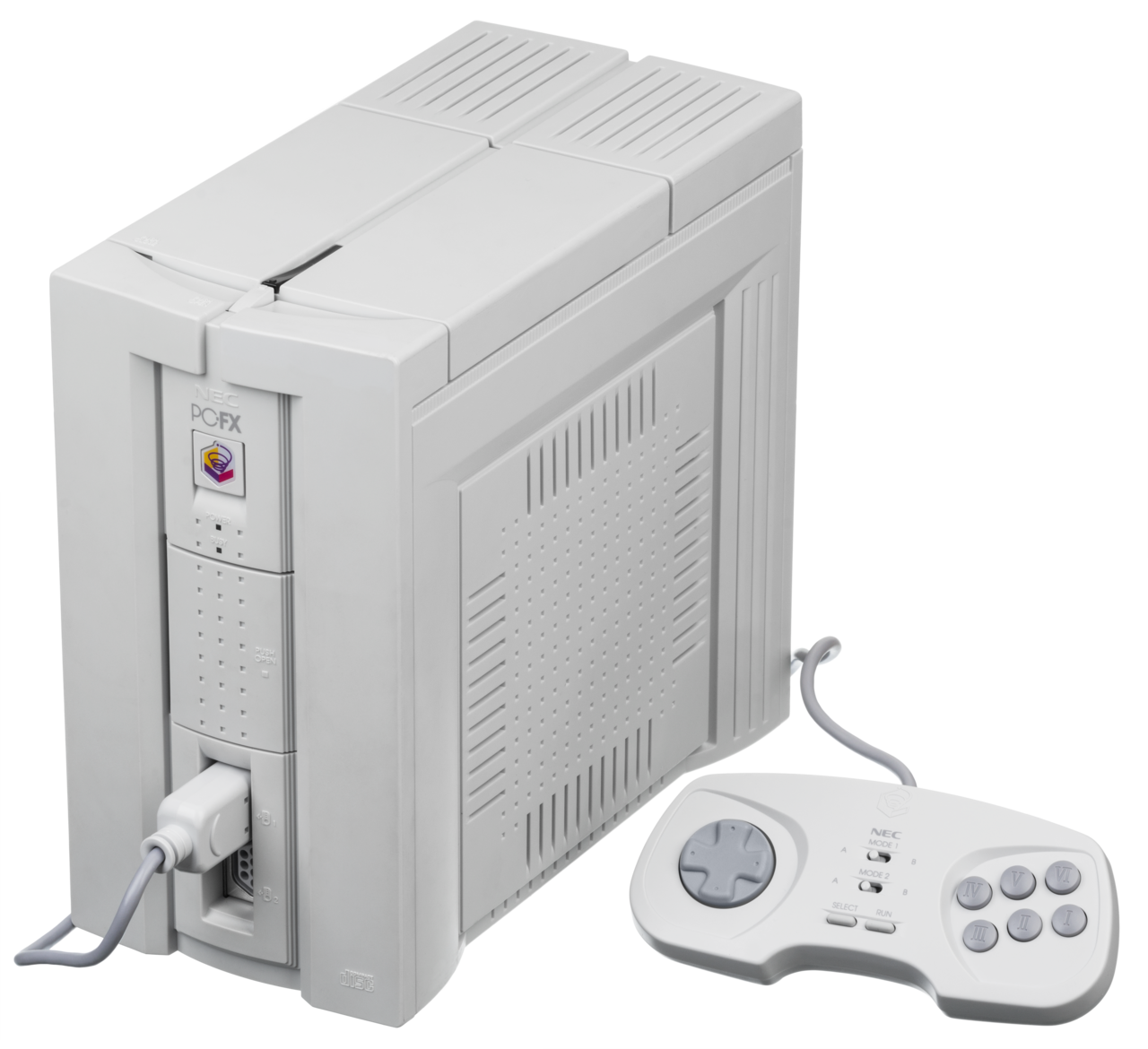
The PC-FX is a fifth-generation home console released by NEC and Hudson Soft exclusively in Japan in December 1994.
Spec Table
| Spec | Value |
|---|---|
| Maker | NEC, Hudson Soft |
| Type | Home console |
| Generation | 5th generation |
| Release Date | Japan: 1994 |
| Launch Price | Not documented |
| Units Sold | 300,000 |
| Media | CD-ROM |
| CPU | NEC V810 @ 21.475 MHz |
| Predecessor / Successor | TurboDuo / None |

History
NEC and Hudson Soft began planning a true successor to the PC Engine as early as 1990, building a prototype board internally nicknamed “Tetsujin.” The console was originally slated to ship around 1992 or 1993, but dates slipped as the PC Engine remained profitable. By December 1994, when the PC-FX finally launched, rivals were already shipping fifth-generation hardware built around 3D polygon rendering.
NEC and Hudson deliberately rejected the polygon trend. Hudson engineer Hiromasa Iwasaki later said 3D hardware was never planned; the companies simply judged early-1990s polygon graphics too “blocky” and “jerky” to be worth including. The PC-FX instead leaned on two HuC6270 graphics chips, CD-ROM media for full-motion video, and 16.77 million colors, betting that anime-style prerendered visuals would outshine crude polygons. Sega’s Virtua Fighter and the 1994 launches of the Sega Saturn and Sony PlayStation quickly proved that bet wrong.
Commercial results never recovered. NEC directed Hudson to focus on anime licenses and visual novels rather than broad action games, and the PC-FX sold roughly 300,000 units before discontinuation in 1998. Support limped along until First Kiss Story shipped in April 1998, after which NEC exited home console manufacturing entirely, ending a hardware lineage stretching back to the original PC Engine.
Library Highlights
With NEC steering development toward anime tie-ins and visual novels rather than action or platforming games, the PC-FX library became known for narrative-driven titles that showcased its CD-ROM full-motion video rather than fast-paced arcade action.
- Angelique

Variants
No major hardware variants are documented. The console’s EXT3 expansion port was designed for a RAM expansion accessory that was never released, so the base tower-style unit remained NEC’s only production configuration. See the full NEC/Hudson Soft manufacturer hub for other systems the companies released, including its predecessor line.
Collector Value
Because the PC-FX was sold only in Japan and moved just 300,000 units, complete-in-box examples are scarce outside Japan and typically command import premiums, while loose consoles turn up more often through Japanese resellers. Condition of the CD-ROM drive belt and laser lens matters more for this system’s long-term value than case cosmetics, since CD-based hardware of this era is prone to drive wear. Sealed units are rare enough that most collectors instead prioritize tested, working examples bundled with a composite or RGB cable, since period-correct AV cables are hard to source separately.

Buying Guide
Before buying a used PC-FX, confirm the seller can test it with a disc, since drive belts and laser assemblies on CD-ROM consoles this old commonly need service. Check that the original AC adapter and an appropriate AV cable are included, as third-party Japanese-market replacements are uncommon outside Japan. Because every game is Japanese-language only, buyers unfamiliar with the library should research individual titles before purchasing, as there is no regional lockout to worry about but also no official translations.
FAQs
When did the PC-FX come out?
The PC-FX launched exclusively in Japan in December 1994.
How many units did the PC-FX sell?
The PC-FX sold approximately 300,000 units before NEC discontinued it in 1998, making it a commercial failure by fifth-generation console standards.
Why didn’t the PC-FX have 3D graphics?
NEC and Hudson Soft deliberately left out a polygon graphics chip, judging early-1990s 3D hardware too visually crude, and instead built the console around CD-ROM full-motion video and 2D graphics.
What CPU does the PC-FX use?
It uses a NEC V810 processor running at 21.475 MHz.
What console came before the PC-FX?
The PC-FX succeeded the TurboDuo, the integrated CD-ROM version of NEC’s PC Engine/TurboGrafx-16 line. The PC-FX had no direct successor, as NEC exited the home console market after its discontinuation.

Sources
- https://en.wikipedia.org/wiki/PC-FX
- https://www.timeextension.com/features/pure-fx-appeal-unpicking-the-history-of-the-pc-fx-one-of-japans-biggest-90s-console-flops
Facts on this page last verified 2026-07-15.