This article contains Amazon affiliate links — as an Amazon Associate, RetroArcade earns from qualifying purchases.
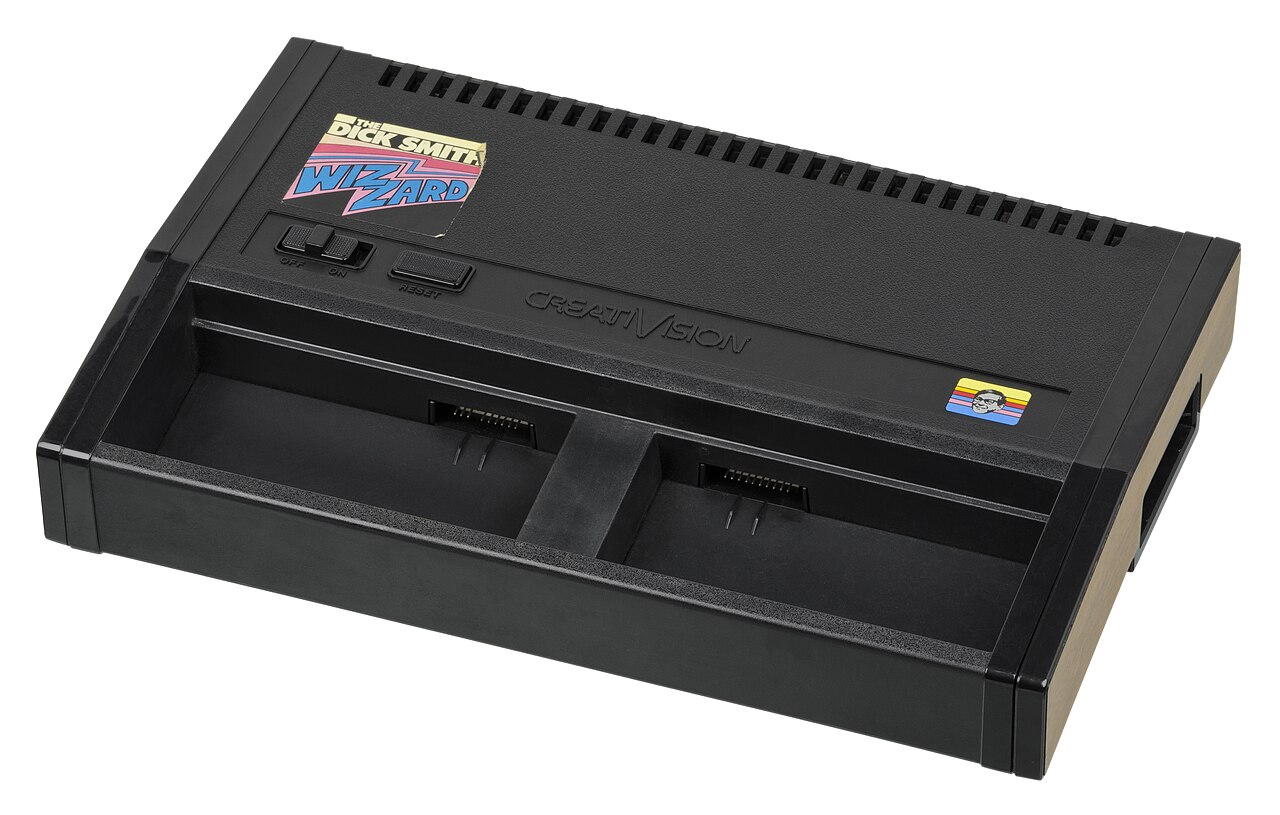
The VTech CreatiVision is a second-generation home console released by VTech in Hong Kong in 1982.
Spec Table
| Spec | Value |
|---|---|
| Maker | VTech |
| Type | Home console |
| Generation | 2nd generation |
| Release Date | Hong Kong: 1982 (initial); Europe: 1983; Australia: 1983 |
| Launch Price | Not documented |
| Units Sold | Not documented |
| Media | ROM cartridges and cassette tapes |
| CPU | Rockwell 6502 @ 2 MHz, 1 KB RAM, 16 KB VRAM, 256×192 resolution, 15 colors, TI SN76489 sound chip |
| Predecessor / Successor | None / VTech Socrates |

History
VTech introduced the CreatiVision in Hong Kong in 1982 as a hybrid console-computer, featuring a pair of convertible joystick/keyboard controllers. The system reached Europe and Australia in 1983 under regional brand names: Educat 2002 in West Germany, Austria, Switzerland, and Italy; and The Dick Smith Wizzard in Australia and New Zealand. This distributed approach to international marketing reflected VTech’s reliance on local partners rather than direct sales.
The CreatiVision competed in a crowded field of hybrid systems that struggled to convince consumers a game console could also serve as a serious computer. It faced direct competition with the APF Imagination Machine and drew comparisons to the VideoBrain Family Computer, Intellivision, and Coleco Adam. Like its rivals, the CreatiVision’s educational positioning never resonated with buyers; contemporary accounts describe its sales as weak relative to dedicated gaming consoles like the ColecoVision.
VTech maintained production through the mid-1980s, discontinuing the line in early 1986 as the company pivoted to the VTech Socrates, its next-generation system that retained educational focus but abandoned the convertible-controller design.
Library Highlights
The CreatiVision’s catalog leaned heavily on compact arcade-style action games designed to show off the console’s sprite-based graphics, rather than the ambitious educational software VTech had originally envisioned for the platform.
- Air/Sea Attack
- Astro Pinball
- Auto Chase
- Crazy Chicky
- Police Jump
- Sonic Invader
- Tank Attack
- Tennis
Variants
The CreatiVision was not revised through distinct hardware generations, but it was marketed under multiple regional brand names, including CreatiVision, Educat 2002, and The Dick Smith Wizzard, depending on the territory. Its most notable design feature carried across every regional version: the pair of controllers that converted between joystick and keyboard form. See the full VTech manufacturer hub for other systems the company released.
Collector Value
The CreatiVision is a niche find for collectors today, since its limited regional distribution and modest sales left far fewer surviving units than mainstream second-generation rivals. Complete-in-box examples with both convertible controllers intact and working command the highest prices, while loose consoles missing a controller or cartridges are comparatively easier to source. Regional rebrands like the Dick Smith Wizzard and Educat 2002 units can carry added premiums for collectors chasing specific market variants.
Buying Guide
Before buying a CreatiVision, confirm the seller can demonstrate that both convertible joystick/keyboard controllers work, since this is the console’s most failure-prone component and replacements are scarce. Check the cartridge slot for corrosion or bent contacts, and ask whether the correct regional power supply is included, since CreatiVision units sold under different brand names sometimes used different plugs and voltage ratings. Test any included cassette-based software separately, as tape media degrades faster than cartridges.
FAQs
When did the VTech CreatiVision come out?
The CreatiVision launched in Hong Kong in 1982, followed by European and Australian releases in 1983 under various regional brand names.
How many units did the VTech CreatiVision sell?
Total sales figures for the CreatiVision are not documented.
How much did the VTech CreatiVision cost at launch?
A launch price for the CreatiVision is not documented.
What CPU does the VTech CreatiVision use?
It uses a Rockwell 6502 processor running at 2 MHz, paired with 1 KB of RAM, 16 KB of video RAM, and a Texas Instruments SN76489 sound chip.
What console followed the VTech CreatiVision?
VTech’s next system was the VTech Socrates, which succeeded the CreatiVision as the company moved further into educational home gaming.
Sources
- https://en.wikipedia.org/wiki/VTech_CreatiVision
- https://en.wikibooks.org/wiki/History_of_video_games/Platforms/VTech_CreatiVision
Facts on this page last verified 2026-07-15.