
This article contains Amazon affiliate links — as an Amazon Associate, RetroArcade earns from qualifying purchases.
Centipede is a 1981 fixed shooter arcade game by Atari, designed by Dona Bailey and Ed Logg.
Quick Facts
| Title | Centipede |
| Year | 1981 |
| Manufacturer | Atari |
| Designer(s) | Dona Bailey, Ed Logg |
| Genre | Fixed Shooter |
| Hardware | Original arcade cabinet release; utilized trackball control mechanism |
| Ports | 15 ports, including Atari 2600, Atari 5200, and Atari 7800 — see Ports section |

History
Atari released Centipede in 1981, designed by programmer Dona Bailey together with veteran designer Ed Logg, who had recently worked on Asteroids. Bailey was one of the first women to design a commercially released arcade game, and she and Logg deliberately aimed the project at a broader audience than the shooters that dominated arcades at the time. Bailey later said she was convinced her game was made for women, and the pair chose bright pastel colors and a less aggressive tone than typical space shooters to draw new players, including women, into arcade spaces that had previously skewed heavily male.
That approach paid off commercially. Centipede became the third-highest-grossing arcade game in the United States in 1982, and its trackball-driven action helped it stand out on crowded arcade floors alongside contemporaries like Defender and Galaga. The game’s cultural reach extended beyond arcades: a Centipede cabinet appeared in the 1983 James Bond film Never Say Never Again, cementing its status as a recognizable emblem of the era. Decades later, in 2020, the World Video Game Hall of Fame formally inducted Centipede, citing both its design innovations and its unusually broad appeal across genders and age groups, a legacy the game’s original creators had aimed for from the start.
Gameplay
Players control the Bug Blaster, a small cannon confined to the bottom of the screen, aiming and firing with a trackball as a segmented centipede winds its way downward through a field of mushrooms. Shooting a body segment turns it into a new mushroom obstacle, while a hit on any segment other than the head splits the centipede into two shorter, independently moving centipedes that keep descending toward the player. Clearing every segment ends the wave and starts a fresh, faster centipede on a mushroom field reshaped by the battle before it. Beyond the centipede itself, players must track spiders that bounce erratically across the lower playfield, fleas that drop new mushrooms when they reach the bottom, and scorpions that poison mushrooms they cross, turning any centipede segment that touches a poisoned mushroom into a fast dive straight at the player.
- Trackball-controlled cannon restricted to the bottom of the play area
- Segmented centipede that splits into independent pieces when hit in the middle
- Mushroom field that regenerates from destroyed centipede segments and reshapes each wave
- Secondary enemies (spiders, fleas, scorpions) that each interact with the mushroom field differently

Cabinet & Hardware
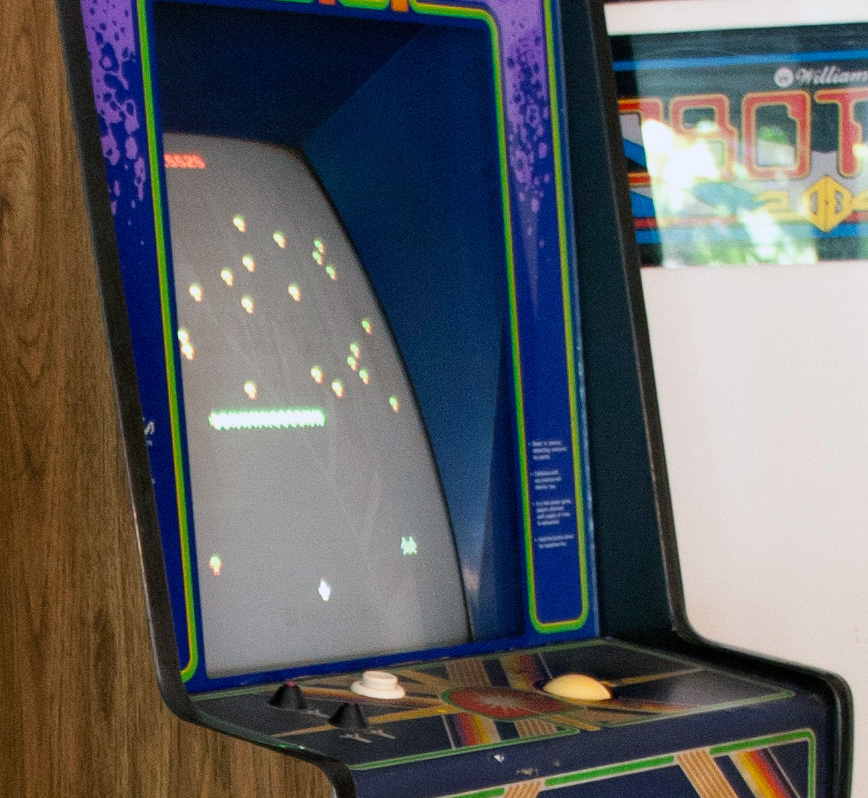
Centipede shipped as a standard upright arcade cabinet built around a trackball control mechanism rather than the joysticks common to most fixed shooters of the period, giving players finer, more continuous control over the Bug Blaster’s horizontal and limited vertical movement. The trackball became one of the game’s defining hardware traits, distinguishing its cabinet on sight from joystick-driven contemporaries and shaping how later trackball-based Atari titles, including Missile Command, were received by arcade operators.
Ports & Re-releases
| Platform | Year |
|---|---|
| Atari 2600 | 1982 |
| Atari 5200 | — |
| Atari 7800 | — |
| Atari 8-bit computers | — |
| Commodore 64 | — |
| Apple II | — |
| BBC Micro | — |
| IBM PC | — |
| ColecoVision | — |
| Intellivision | — |
| TI-99/4A | — |
| VIC-20 | — |
| Game Boy | — |
| Game Boy Color | — |
| Game.com | — |
Centipede has also reappeared in modern compilations and digital storefronts over the years, keeping the trackball-driven original playable well outside its original 1981 cabinets. Check the Atari 2600, ColecoVision, and Game Boy platform pages for details on those specific ports.

Where to Play Legally Today
- Official compilation releases, such as Atari-published anthology collections on current-generation consoles and PC
- MAME, run only with legally owned ROM dumps from a cabinet or licensed source you own
- Arcade museums and retro arcade venues that keep a working Centipede cabinet on their floor
Collector Value
Original Centipede cabinets are common enough on the secondary market that they remain an accessible entry point for arcade collectors, though units with intact trackball assemblies, unmodified side art, and working monitors bring higher prices than worn or heavily converted examples. Standalone PCBs circulate for collectors who already own a compatible cabinet shell, and cartridge-based home ports like the Atari 2600 version are widely available and inexpensive, making the game approachable for collectors not ready to commit to a full-size cabinet.

FAQs
Who made Centipede?
Centipede was designed by Dona Bailey and Ed Logg and manufactured by Atari.
What year did Centipede come out?
Centipede was released in 1981.
What genre is Centipede?
Centipede is a fixed shooter, in which the player’s cannon stays at the bottom of the screen while a segmented centipede and other enemies descend through a field of mushrooms.
What control scheme did Centipede use?
Centipede’s original arcade cabinet used a trackball control mechanism rather than a joystick, letting players aim the Bug Blaster with fine, continuous movement.
Has Centipede been ported to home consoles?
Yes, Centipede has been ported to at least fifteen platforms since 1982, including the Atari 2600, Atari 5200, Atari 7800, Commodore 64, Apple II, ColecoVision, Intellivision, Game Boy, and Game Boy Color.
See also the related Missile Command arcade page, another Atari trackball-controlled title from the same era, and browse the Golden Age of Arcade Games hub for more classic fixed shooters.
Sources
- https://en.wikipedia.org/wiki/Centipede_(video_game)
- https://www.worldvideogamehalloffame.org/games/centipede
Facts on this page last verified 2026-07-15.