
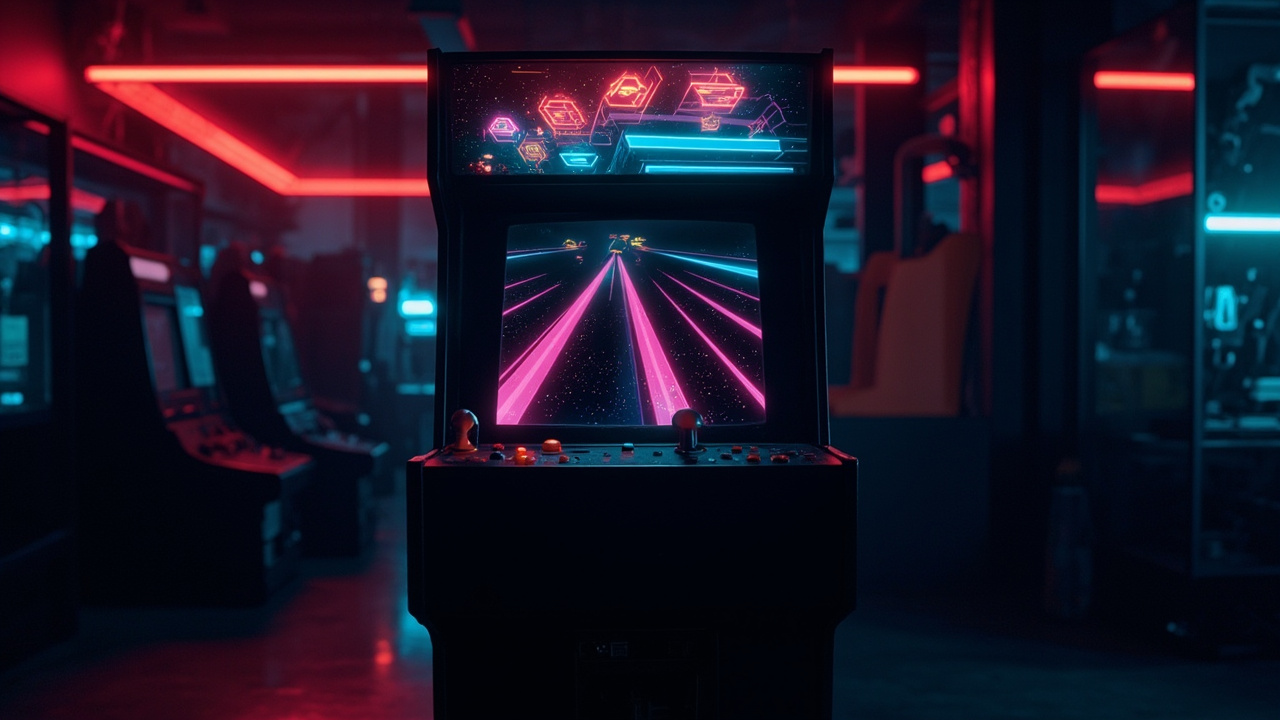
This article contains Amazon affiliate links — as an Amazon Associate, RetroArcade earns from qualifying purchases.
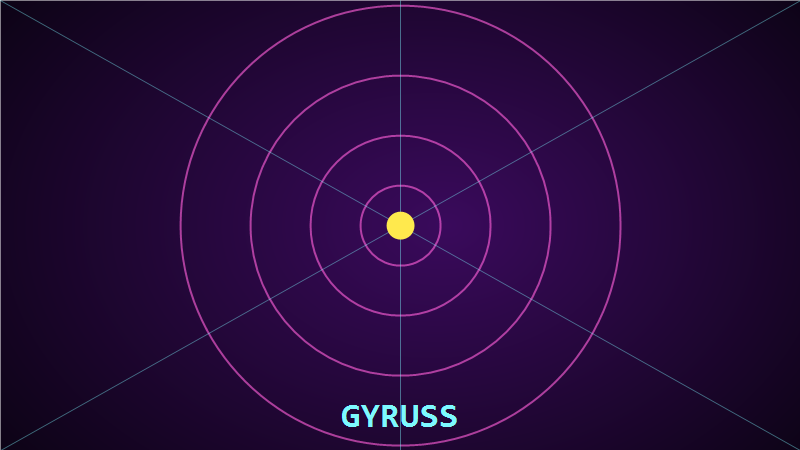
Gyruss is a 1983 tube shooter arcade game by Konami, released in North America through Centuri.
Quick Facts
| Title | Gyruss |
| Year | 1983 |
| Manufacturer | Konami (Japan) / Centuri (US) |
| Designer(s) | Yoshiki Okamoto |
| Genre | Tube shooter |
| Hardware | Original arcade cabinet used five 3-voice General Instrument AY-3-8910A sound chips. The soundtrack remixes Johann Sebastian Bach’s Toccata and Fugue in D minor in an uptempo electronic style with stereo sound. |
| Ports | 8 ports, including Atari 2600, Atari 5200, and Atari 8-bit computers — see Ports section |

History
Gyruss was designed by Yoshiki Okamoto, marking his second and final project at Konami after 1982’s Time Pilot. Konami released the arcade original in Japan and North America in 1983, distributing the US cabinet through Centuri rather than selling it directly. According to the Museum of the Game’s Killer List of Videogames, Gyruss has been described as a cross between Namco’s Galaga and Atari’s Tempest, swapping a flat shooting gallery for a circular tunnel that pulls the player’s ship toward a vanishing point at screen center. That framing helps explain why Gyruss reads so differently from the era’s other fixed shooters despite sharing their wave-based structure.
Okamoto left Konami for Capcom not long after Gyruss shipped, reportedly over a pay dispute, and went on to design 1942 and later produce the Street Fighter series. Gyruss outlived his departure as a Konami property, resurfacing in home ports across nearly every major platform of the mid-1980s and later in compilations such as Konami 80’s Arcade Gallery. Its arrangement of Bach’s Toccata and Fugue in D minor became one of the more recognizable soundtracks of the period, and the game continues to draw competitive attention: a documented world record of 70,736,950 points was set in 2019, decades after the cabinet’s original run.
Gameplay
Gyruss puts the player’s ship on a circular track running along the outer edge of the screen, using one-point perspective so that enemies, asteroids, and satellites appear to emerge from a distant vanishing point and rush outward toward the player. The objective is to fight through a sequence of planetary levels, starting at Neptune and working inward through the solar system toward Earth, clearing waves of enemy formations and dedicated boss encounters such as laser generators along the way. Movement is confined to the rim of the tunnel, so positioning is really about tracking where incoming fire will cross that ring rather than free roaming in open space. A joystick or dial-style control slides the ship around the circle while a single fire button handles shooting.
- Circular one-point-perspective tunnel in place of a flat playfield
- Progression through named planetary levels from Neptune to Earth
- Mixed enemy types including spaceships, satellites, asteroids, and laser generators
- Bach’s Toccata and Fugue in D minor rescored as a continuous electronic soundtrack
Cabinet & Hardware
The arcade board built the game’s signature audio around five General Instrument AY-3-8910A sound chips, each a 3-voice chip, giving Gyruss enough simultaneous channels to carry its uptempo take on Bach’s Toccata and Fugue in D minor in stereo while sound effects played over it. That amount of dedicated sound hardware was unusual for a 1983 cabinet and is one of the main reasons the game’s music is still singled out decades later.
Ports & Re-releases
| Platform | Year |
|---|---|
| Atari 2600 | 1984 |
| Atari 5200 | 1984 |
| Atari 8-bit computers | 1984 |
| ColecoVision | 1984 |
| Commodore 64 | 1984 |
| Famicom Disk System | 1988 |
| Nintendo Entertainment System | 1989 |
| Game Boy Advance | 2002 |
The 2002 Game Boy Advance version arrived as part of Konami Collector’s Series: Arcade Advanced, a compilation re-release rather than a standalone cartridge, and the game has also appeared in Konami 80’s Arcade Gallery. Check the Atari 2600, Atari 5200, ColecoVision, and NES platform pages for details on those specific ports.
Where to Play Legally Today
- Official compilations such as Konami 80’s Arcade Gallery and Konami Collector’s Series: Arcade Advanced
- MAME, run only with legally owned ROM dumps from a cabinet or licensed source you own
- Arcade museums and retro arcade venues that keep a working Gyruss cabinet on their floor
Collector Value
Original Gyruss upright cabinets are less common on the secondary market than mass-market hits from the same year, which keeps well-preserved units with intact side art and marquees fetching solid prices from collectors focused on Konami’s early-1980s output. Standalone PCBs circulate for buyers who already own a compatible cabinet shell, while home ports on cartridge systems like the Atari 2600, Atari 5200, and ColecoVision remain inexpensive and easy to source, making them a practical way to experience the game without pursuing an arcade cabinet.
FAQs
Who made Gyruss?
Gyruss was designed by Yoshiki Okamoto and manufactured by Konami in Japan, with Centuri handling distribution in the US arcade market.
What year did Gyruss come out?
Gyruss came out in 1983 as an arcade cabinet from Konami.
What genre is Gyruss?
Gyruss is a tube shooter, sending the player’s ship around a circular track while enemies emerge from a central vanishing point in one-point perspective.
What music does Gyruss use?
Gyruss features an uptempo electronic arrangement of Johann Sebastian Bach’s Toccata and Fugue in D minor, played in stereo through the cabinet’s five AY-3-8910A sound chips.
Has Gyruss been ported to home consoles?
Yes, Gyruss has been ported to at least eight platforms since 1984, including the Atari 2600, Atari 5200, Atari 8-bit computers, ColecoVision, Commodore 64, Famicom Disk System, Nintendo Entertainment System, and Game Boy Advance.
See also the related Time Pilot and Scramble arcade pages for more of Konami’s early shooter output, and browse the Golden Age of Arcade Games hub for more classic shooter titles.
Sources
Facts on this page last verified 2026-07-15.