This article contains Amazon affiliate links — as an Amazon Associate, RetroArcade earns from qualifying purchases.
Star Trek: Strategic Operations Simulator is a 1983 space combat simulation arcade game released by Sega.
Quick Facts
| Title | Star Trek: Strategic Operations Simulator |
| Year | 1983 |
| Manufacturer | Sega |
| Designer(s) | Sam Palahnuk |
| Genre | Space combat simulation |
| Hardware | G80 vector arcade system board with color vector graphics and synthesized speech |
| Ports | 8 ports, including Atari 2600, Atari 5200, and Atari 8-bit — see Ports section |
History
Sega released Star Trek: Strategic Operations Simulator to arcades in 1983, licensing the Star Trek television and film property for a dedicated vector cabinet built around the starship Enterprise. Designer Sam Palahnuk built the game on Sega’s G80 hardware, the same vector board family behind several of the company’s early-1980s titles. Rather than a single reflex-driven shooter, the design paired a tactical overview with real-time first-person combat, a structure the Internet Archive’s cataloging of the machine credits partly to memory limits that pushed the team toward synthesized speech instead of sampled sound. Sega distributed roughly 500 cabinets through a Halfsies cereal promotion running from 1982 into 1983, an unusual marketing tie-in for an arcade machine of the era.
Trade press took notice before the year was out. Electronic Games magazine’s August 1983 issue predicted the cabinet would rank among the arcades’ top grossers that year. Sega backed the release with both a standard upright cabinet and a premium sit-down model featuring bridge-style seating, then extended the game to eight home computer and console platforms. The dual cabinet strategy and broad porting reflected confidence in the Star Trek license beyond a single arcade run. Decades later, Den of Geek’s 2016 retrospective ranked it among the four best Star Trek video games ever made, crediting its ambition in blending strategic resource management with vector-graphic space combat during an era when most arcade competitors relied on straightforward shooting mechanics.
Gameplay
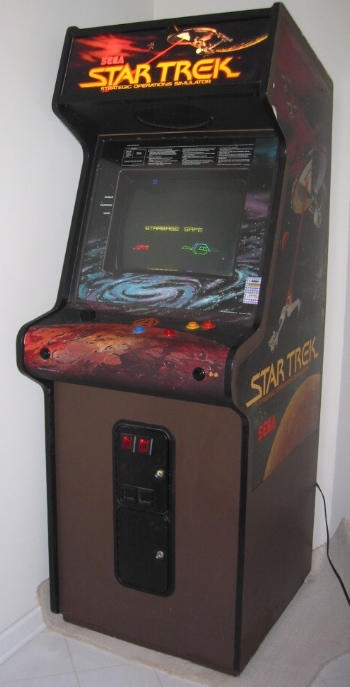
Players command the Enterprise across a series of sector-based missions, defending Federation space from Klingon attack while managing three finite resources: shield energy, a limited stock of photon torpedoes, and warp power. All three deplete with use and must be restored by docking at a starbase before they run out entirely. Combat plays out from a first-person cockpit perspective rendered in color vector graphics, while the underlying campaign structure asks players to plan which sectors to defend and when to break off and resupply. A weighted spinner sets the ship’s heading, and separate buttons trigger the impulse and warp engines, phasers, and photon torpedoes. Synthesized speech delivers status updates and warnings during combat, reinforcing the bridge-command feel the cabinet design was built around.
- Resource management across shield energy, photon torpedoes, and warp power
- Starbase docking to replenish resources between engagements
- First-person vector-graphic combat perspective with weighted spinner heading control
- Synthesized speech feedback during play
Cabinet & Hardware
The game runs on Sega’s G80 vector arcade system board, rendering color vector graphics for its 2D tactical display and 3D first-person combat perspective, paired with synthesized speech rather than sampled audio. Sega manufactured two distinct cabinet styles: a standard upright with the spinner and weapons controls mounted on a conventional panel, and a premium sit-down deluxe cabinet with seating modeled on the Enterprise bridge chairs from the Star Trek film series, integrating the same controls directly into the chair itself.
Ports & Re-releases
| Platform | Year |
|---|---|
| Atari 2600 | Unknown |
| Atari 5200 | Unknown |
| Atari 8-bit | Unknown |
| Apple II | Unknown |
| Commodore 64 | Unknown |
| ColecoVision | Unknown |
| TI-99/4A | Unknown |
| VIC-20 | Unknown |
Exact release years for the individual home ports are not confirmed in current sourcing, though all eight versions followed the 1983 arcade debut on early-1980s home computers and consoles. Check the Atari 2600, Atari 5200, and ColecoVision platform pages for details on those specific systems.
Where to Play Legally Today
- Original hardware preserved by arcade museums and private collectors who maintain working G80 cabinets
- MAME, run only with legally owned ROM dumps from a cabinet or licensed source you own
- Original home computer and console cartridges for the Atari 2600, Atari 5200, ColecoVision, and other supported systems, played on period hardware or through legally licensed emulation
Collector Value
Surviving Star Trek: Strategic Operations Simulator cabinets are scarcer than mass-market titles of the same era, a legacy of the limited production run of roughly 500 machines tied to the Halfsies cereal promotion. The sit-down deluxe version with its Enterprise-style bridge chair commands particular interest among collectors and Star Trek memorabilia enthusiasts, generally trading at a premium over the standard upright. Home ports on systems like the Atari 2600, Commodore 64, and ColecoVision are comparatively easy to find and inexpensive, offering a lower-cost way to own a piece of the game’s history without pursuing an original G80 cabinet.
FAQs
Who made Star Trek: Strategic Operations Simulator?
Star Trek: Strategic Operations Simulator was designed by Sam Palahnuk and manufactured by Sega.
What year did Star Trek: Strategic Operations Simulator come out?
The arcade game was released in 1983.
What genre is Star Trek: Strategic Operations Simulator?
It is a space combat simulation game in which the player commands the Starship Enterprise against Klingon attackers.
What hardware did Star Trek: Strategic Operations Simulator run on?
It ran on Sega’s G80 vector arcade system board, using color vector graphics for its 2D and 3D first-person displays along with synthesized speech.
Was Star Trek: Strategic Operations Simulator ported to home systems?
Yes, it was ported to eight home platforms: the Atari 2600, Atari 5200, Atari 8-bit computers, Apple II, Commodore 64, ColecoVision, TI-99/4A, and VIC-20.
See also the related Sega arcade titles Zaxxon and Champion Baseball, the 1983 release Star Wars, and the Golden Age of Arcade Games hub for more early space combat titles.
Sources
- https://en.wikipedia.org/wiki/Star_Trek:_Strategic_Operations_Simulator
- https://archive.org/details/arcade_startrek
Facts on this page last verified 2026-07-15.