This article contains Amazon affiliate links — as an Amazon Associate, RetroArcade earns from qualifying purchases.
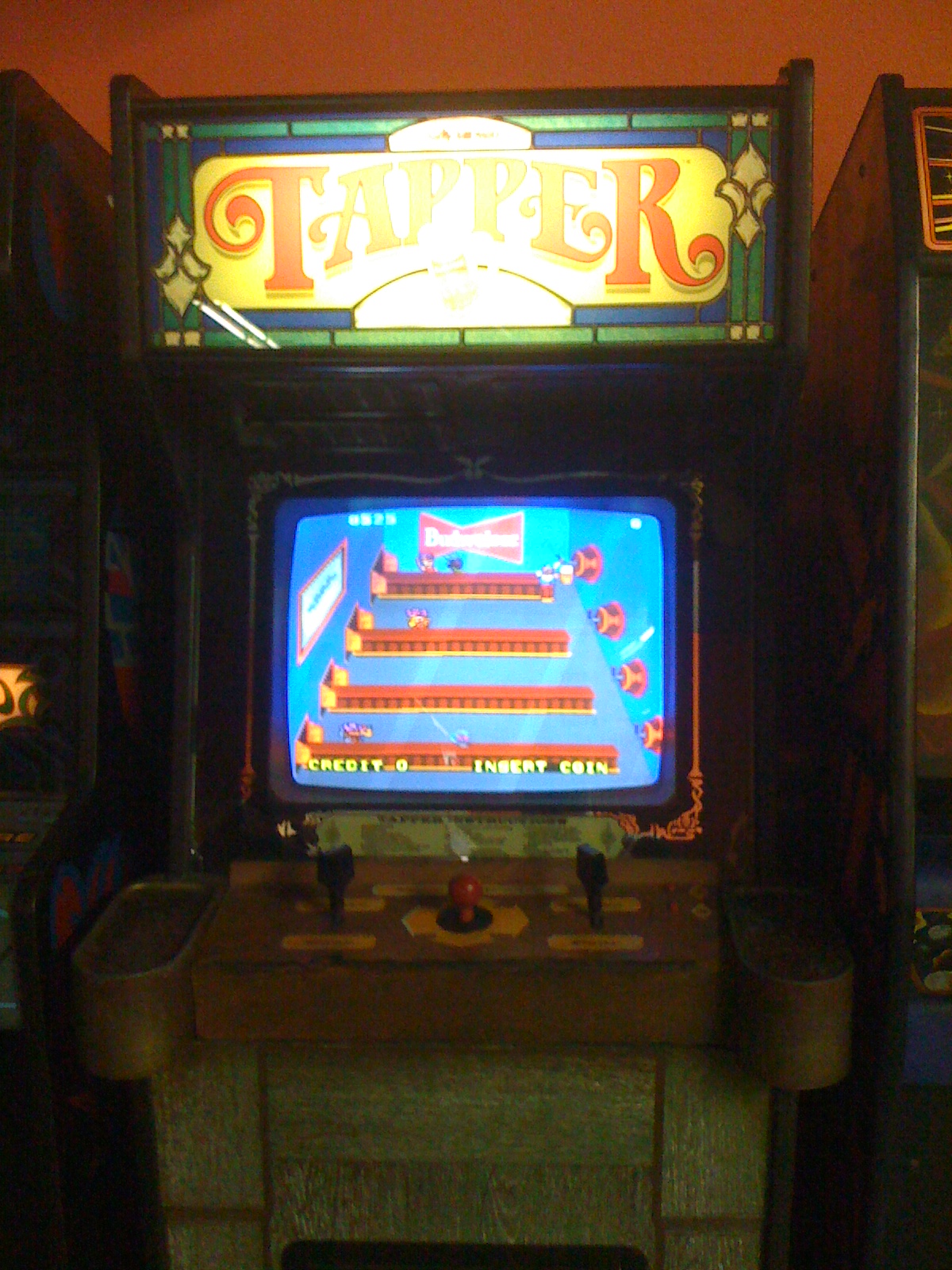
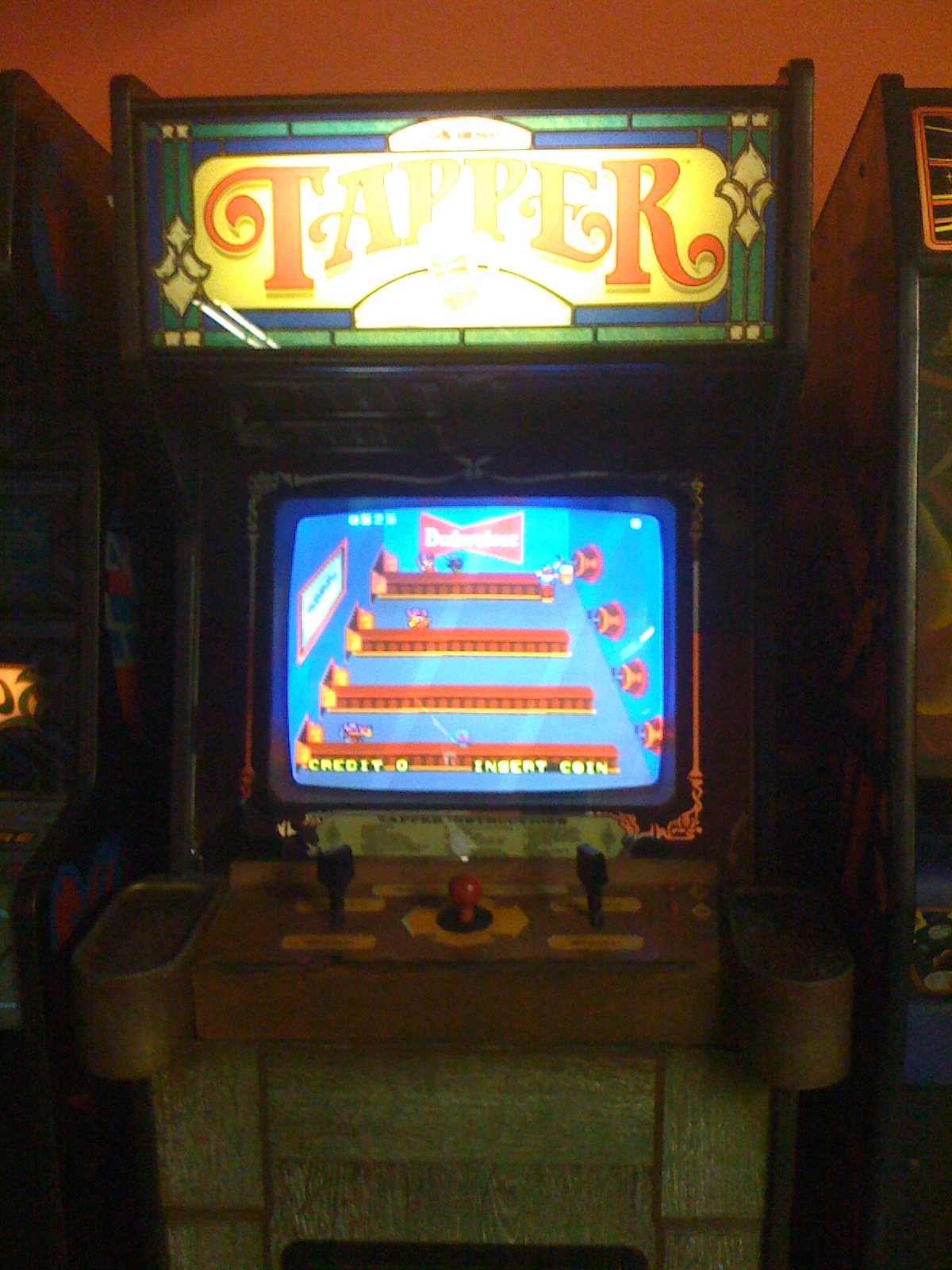
Tapper is a 1984 action arcade game by Bally Midway that casts the player as a bartender racing to serve a crowded room of thirsty customers.
Quick Facts
| Title | Tapper |
| Year | 1984 |
| Manufacturer | Bally Midway |
| Designer(s) | Steve Meyer, Elaine Ditton, Scott Morrison |
| Genre | Action |
| Hardware | Bally Midway MCR III arcade system board |
| Ports | 9 ports, including Apple II, Atari systems, and ColecoVision — see Ports section |

History
Tapper arrived in arcades in 1984 carrying sponsorship from Anheuser-Busch, a rare instance of a real beverage brand fronting a coin-op release. The American cabinets used a Budweiser motif throughout, down to bar-style brass footrests, built-in drink holders, and joystick handles modeled directly on actual beer tap levers rather than a conventional stick, reinforcing the illusion that operators had installed a working bar rather than a video game (Internet Archive Software Collection, “Tapper,” archive.org/details/arcade_tapper).
Because advertising alcohol to a largely underage arcade crowd drew scrutiny, Bally Midway produced a parallel Root Beer Tapper cabinet that swapped the bartender setting for a soda counter, letting operators choose the version appropriate for their location. The redesign did not slow the game’s momentum: industry trade coverage in Japan named it among the country’s best-performing table-cabinet units within weeks of release. Tapper’s home conversions carried the same core mechanic across computers and consoles for the rest of the decade, keeping the license active well past the arcade’s initial run. Its bar-themed premise later resurfaced in mainstream pop culture, most visibly as a background cabinet referenced in Disney’s Wreck-It Ralph films, cementing Tapper’s place among the recognizable arcade icons of its era even for audiences who never played the original machine.
Gameplay
Tapper puts the player behind the bar as a lone bartender responsible for four horizontal serving lanes at once. Customers file in from the right side of each lane and grow steadily more impatient the longer they wait, so the core loop is about triage: deciding which lane needs a drink slid down it first before a patron reaches the counter and storms off (or worse). A four-position joystick handles all the action, letting the bartender step between lanes and send a full mug skidding down the bar with a flick of the stick. Empty mugs and tip glasses left behind by satisfied customers have to be caught and collected before they fall off the end of the bar, adding a second stream of things to track alongside the drink orders themselves.
- Managing four simultaneous bar lanes with a single bartender
- Sliding mugs down the bar to reach waiting customers before their patience runs out
- Catching returned empty mugs and tips for bonus points
- Difficulty that escalates as rounds progress, demanding faster reflexes and timing
Cabinet & Hardware
Tapper runs on the Bally Midway MCR III arcade system board, the same family of hardware the company used across several of its mid-1980s releases. The arcade version’s control panel was distinctive even by MCR III standards: early production cabinets used real Budweiser tap handles as the joystick, later replaced with cheaper molded-plastic versions carrying the same branding once the novelty proved costly to maintain in the field (Internet Archive Software Collection, “Tapper,” archive.org/details/arcade_tapper).
Ports & Re-releases
| Platform | Year |
|---|---|
| Apple II | — |
| Atari systems | — |
| ColecoVision | — |
| Commodore 64 | — |
| ZX Spectrum | — |
| MSX | — |
| Amstrad CPC | — |
| BBC Micro | — |
| IBM PC | — |
Most home versions carried soft-drink branding such as Mountain Dew or Pepsi rather than the arcade’s Budweiser theme, and Root Beer Tapper has since resurfaced in Bally Midway/Midway compilation packages for later console generations. Check the ColecoVision platform page for details on that specific port.
Where to Play Legally Today
- Official Bally Midway/Midway arcade compilation releases on current-generation consoles and PC that include Tapper or Root Beer Tapper
- MAME, run only with legally owned ROM dumps from a cabinet or licensed source you own
- Arcade museums and retro arcade venues that keep a working Tapper or Root Beer Tapper cabinet on their floor
Collector Value
Original Tapper cabinets are sought after in part because of their oddball control panel: complete machines with intact Budweiser tap-handle controllers command a real premium over units where the handles were lost, swapped for the plastic replacement, or removed entirely during a Root Beer Tapper conversion. Because both a Budweiser and a Root Beer version were produced, collectors distinguish carefully between cabinet variants when buying, and PCB-only listings appeal to those who already own compatible MCR III-era hardware. Home computer and console ports are widely available and inexpensive, offering a low-cost way to experience the gameplay without pursuing a full cabinet.
FAQs
Who made Tapper?
Tapper was designed by Steve Meyer, Elaine Ditton, and Scott Morrison, and was manufactured for arcades by Bally Midway.
What year did Tapper come out?
Tapper came out in 1984.
What genre is Tapper?
Tapper is an action arcade game in which the player serves drinks to customers across four bar lanes while collecting empty mugs and tips.
What hardware did Tapper run on?
Tapper ran on the Bally Midway MCR III arcade system board.
Has Tapper been ported to home computers or consoles?
Yes, Tapper has been ported to at least nine platforms, including Apple II, Atari systems, ColecoVision, Commodore 64, ZX Spectrum, MSX, Amstrad CPC, BBC Micro, and IBM PC.
See also the related Spy Hunter and Tron arcade pages from fellow Bally Midway releases, the same-year Kung-Fu Master, and browse the Golden Age of Arcade Games hub for more classic action titles.
Sources
Facts on this page last verified 2026-07-15.