This article contains Amazon affiliate links — as an Amazon Associate, RetroArcade earns from qualifying purchases.
The 3DO is a fifth-generation home console released by The 3DO Company and manufactured under license by Panasonic, Sanyo, and GoldStar, launching in North America in 1993.
Spec Table
| Spec | Value |
|---|---|
| Maker | Panasonic, Sanyo, GoldStar, The 3DO Company |
| Type | Home console |
| Generation | 5th generation |
| Release Date | North America: 1993 (initial); Japan: 1994; Europe: 1994; South Korea: 1994 |
| Launch Price | $699.99 USD |
| Units Sold | 1.38 to 2 million |
| Media | CD-ROM (double-speed) |
| CPU | 32-bit ARM60 RISC processor @ 12.5 MHz |
| Predecessor / Successor | None documented |

History
Electronic Arts co-founder Trip Hawkins launched The 3DO Company in 1991 with an unusual pitch: instead of building a console itself, the company would design the hardware specification and license it out to whichever manufacturers wanted to build it. Panasonic became the first licensee, releasing the FZ-1 REAL 3DO Interactive Multiplayer in North America in 1993, with Japanese, European, and South Korean launches from Panasonic, Sanyo, and GoldStar following in 1994. The pitch to publishers was equally unconventional: rather than the steep per-cartridge royalties charged by Nintendo and Sega, 3DO charged a flat licensing fee of roughly three dollars per game sold.
That openness came at a steep cost to consumers. Because The 3DO Company collected only modest licensing revenue rather than subsidizing hardware the way console makers typically did, manufacturers had to price the machine to actually turn a profit on the box itself. The result was a launch price of $699.99, making the 3DO one of the most expensive game consoles ever sold at retail. Early software struggled to justify that price too; the system launched with just a handful of titles, and quality was inconsistent even as the library grew to include acclaimed games like Myst and Alone in the Dark.
The 3DO’s timing made a difficult situation worse. Sony’s PlayStation arrived in 1994 and 1995 at a fraction of the 3DO’s price while offering comparable or better 3D graphics, and Sega’s Saturn launched the same year with a similar value proposition and stronger first-party support. Both rivals were backed by a single company controlling hardware, marketing, and software strategy together, an advantage the fragmented, multi-manufacturer 3DO could never match. Trip Hawkins later acknowledged that the licensing model, while innovative, left no single company driving a coordinated push against better-funded competitors, and it remains a defining case study of the fifth console generation.
Panasonic began developing a successor codenamed M2, built around dual PowerPC 602 processors and touted as one of the first consoles to use PowerPC silicon, but The 3DO Company sold the M2 technology to Matsushita (Panasonic’s parent) for roughly $100 million in 1996 rather than bring it to market itself. Matsushita ultimately shelved the M2 entirely in 1997, and The 3DO Company exited the hardware business for good, later becoming a third-party game publisher before its 2003 bankruptcy. Today, Piko Interactive owns the 3DO trademark and continues to license aftermarket releases for the platform.
Library Highlights
Despite its commercial struggles, the 3DO built a respectable catalog anchored by ambitious CD-ROM titles that leaned on the format’s extra storage for full-motion video and richer worlds than cartridge-based rivals could easily match.
- Gex
- Myst
- Alone in the Dark
- Star Control II
- Jurassic Park Interactive
- The Need for Speed

Variants
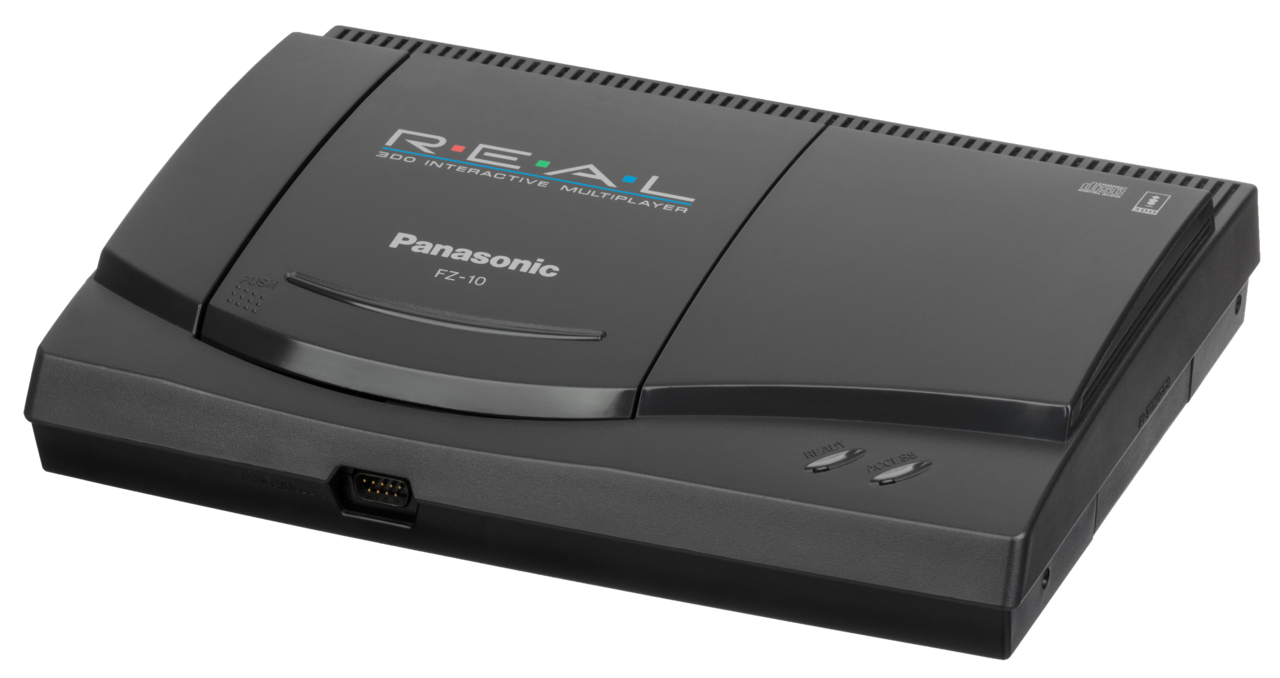
Because The 3DO Company licensed its hardware specification rather than manufacturing consoles itself, the 3DO exists in several distinct manufacturer versions rather than the usual single-maker hardware revisions. Panasonic’s original FZ-1 was followed by its own redesigned FZ-10, while Sanyo and GoldStar each released their own licensed models to their respective markets. No single company-issued hardware revision line (analogous to a “Jr.” or slim redesign) beyond these separate manufacturer builds is documented. See the The 3DO Company manufacturer hub for other systems associated with the brand.
Collector Value
The 3DO’s high original price and modest sales numbers make complete, well-preserved units a genuine rarity today, and collector interest is amplified by the console’s status as a curious dead end in gaming history. Condition and completeness (original box, AC adapter, and controller) drive most of the price gap between loose and boxed units, and Panasonic’s FZ-1 tends to command more collector attention than the rarer Sanyo and GoldStar variants. Sealed units are scarce and priced accordingly, while the console’s aging CD-ROM drive belts and lasers make working, tested units more desirable than untested loose examples.

Buying Guide
Before buying a used 3DO, confirm the seller has tested it with a disc rather than just powered it on, since the CD-ROM drive’s laser and belts are prone to age-related failure after three decades. Check that the correct AC adapter is included, as 3DO power supplies vary by manufacturer (Panasonic, Sanyo, and GoldStar units are not always interchangeable) and original units are increasingly hard to replace. Inspect the disc tray and controller port for wear, and ask which manufacturer’s model you’re buying, since collector demand and parts availability differ between the Panasonic, Sanyo, and GoldStar versions.
FAQs
When did the 3DO come out?
The 3DO launched in North America in 1993, followed by Japan, Europe, and South Korea in 1994.
How many units did the 3DO sell?
The 3DO sold an estimated 1.38 to 2 million units worldwide across all licensed manufacturers before being discontinued in 1996.
How much did the 3DO cost at launch?
The 3DO launched at $699.99 USD, making it one of the most expensive home consoles ever sold at retail.
What CPU does the 3DO use?
It uses a 32-bit ARM60 RISC processor running at 12.5 MHz.
Did the 3DO have a successor?
The 3DO Company had no direct successor console reach the market; the planned M2 project was sold to Matsushita and ultimately cancelled in 1997.
Sources
Facts on this page last verified 2026-07-15.