This article contains Amazon affiliate links — as an Amazon Associate, RetroArcade earns from qualifying purchases.
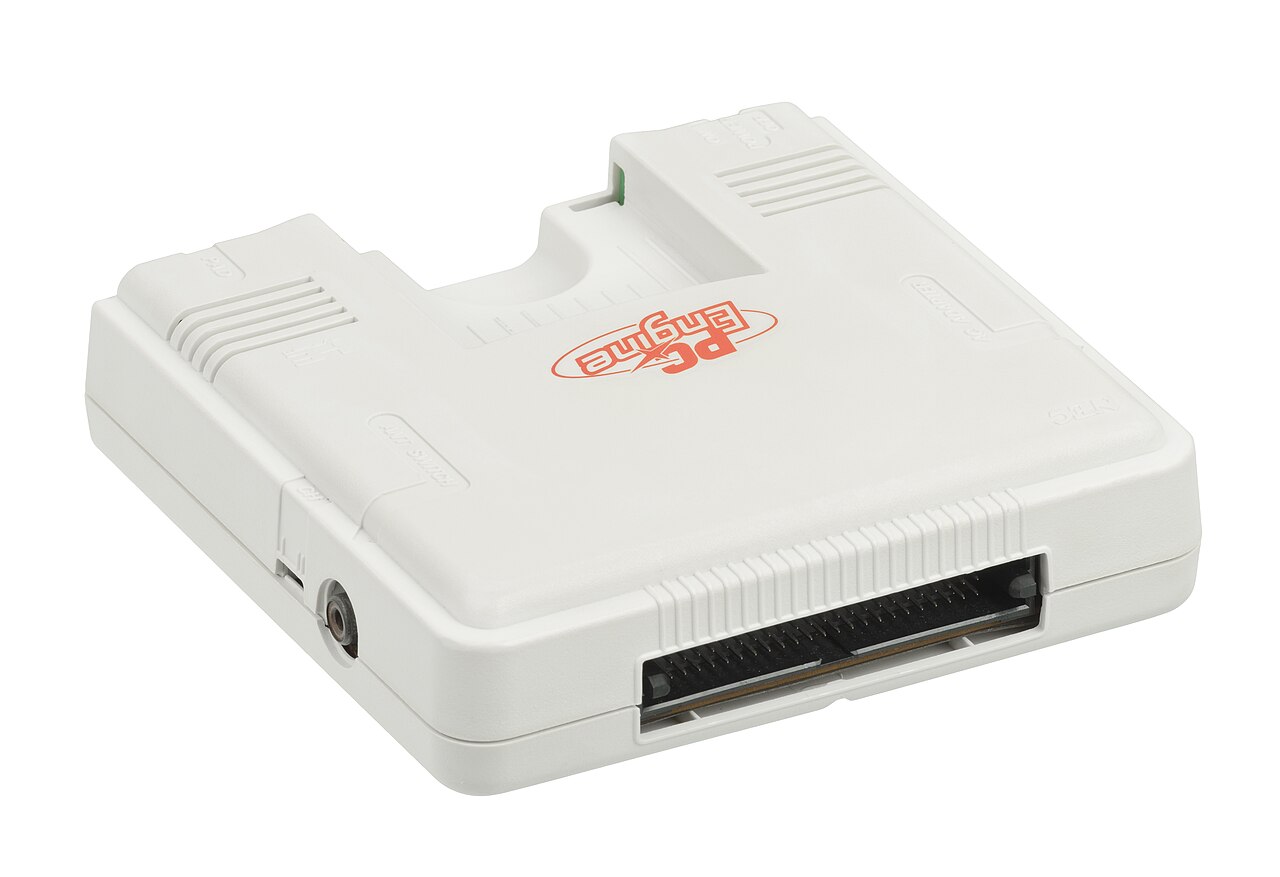
The PC Engine/TurboGrafx-16 is a fourth-generation home console released by NEC and Hudson Soft, debuting in Japan in 1987 before reaching North America as the TurboGrafx-16 in 1989.
Spec Table
| Spec | Value |
|---|---|
| Maker | NEC/Hudson Soft |
| Type | Home console |
| Generation | 4th generation |
| Release Date | Japan: 1987 (initial); North America: 1989; France: 1989; UK: 1989; Spain: 1990 |
| Launch Price | .99 USD |
| Units Sold | 5.84 million |
| Media | HuCard, CD-ROM |
| CPU | HuC6280 @ 7.16 MHz |
| Predecessor / Successor | None / PC-FX |

History
Hudson Soft had approached Nintendo in the mid-1980s hoping to sell advanced graphics-chip designs for use in a Famicom add-on, but Nintendo turned the proposal down. Hudson instead partnered with NEC, an electronics manufacturer with little gaming experience but the resources to build and market a console around Hudson’s chip work. The resulting machine, the PC Engine, launched in Japan on October 30, 1987, undercutting the aging Famicom with a compact case and arcade-caliber graphics for the era.
The PC Engine’s Japanese debut was an immediate hit, and NEC followed up in December 1988 with the CD-ROM² add-on, the first CD-based add-on ever released for a home console, arriving years ahead of Sega’s competing CD peripheral. Strong third-party support and a steady stream of shooters and role-playing games, including early entries in the Ys series, let the PC Engine family hold its own in Japan throughout the fourth console generation, eventually finishing as Japan’s second-best-selling system of the era behind the Super Famicom.
North America told a different story. NEC redesigned and rebranded the console as the TurboGrafx-16 for its August 1989 U.S. launch, a decision one industry account attributed to “Atari mind-think,” the belief that a bulkier machine looked more impressive to shoppers. The launch arrived only two weeks after Sega’s Genesis, and NEC compounded the timing problem by packing in Keith Courage in Alpha Zones, an unfamiliar title, rather than the arcade-proven R-Type that Hudson already had ready for release. Sega, by contrast, bundled the arcade hit Altered Beast and reportedly outspent NEC on marketing by a wide margin.
NEC’s American division also overproduced hardware, manufacturing roughly 750,000 launch units on the expectation of Nintendo-style scarcity-driven demand that never materialized. Combined with a thinner localized library than Sega or Nintendo offered, the TurboGrafx-16 never caught on with North American players despite the underlying hardware’s technical strengths. Worldwide, the PC Engine/TurboGrafx-16 family sold approximately 5.84 million units, a figure driven overwhelmingly by its Japanese success, before NEC moved on to its ill-fated successor, the PC-FX.
Library Highlights
The PC Engine’s library leaned heavily on shooters, action-platformers, and early console RPGs, with several franchises making their home-console debut on the system.
- Bomberman
- Bonk
- Gradius
- R-Type
- Street Fighter II: Champion Edition
- Ys series
- Castlevania
- Devil Crash

Variants
The CD-ROM² add-on introduced in 1988 (released in North America as the TurboGrafx-CD in 1989) let the base console play CD-based games alongside its native HuCard cartridges, and later all-in-one models combined both media types into a single unit. No other major hardware revisions are documented beyond the regional rebrand from PC Engine to TurboGrafx-16 and its CD-capable variants. See the full NEC/Hudson Soft manufacturer hub for other systems tied to this partnership.
Collector Value
PC Engine hardware and HuCard games in good cosmetic condition, especially the compact original Japanese units, draw solid interest from collectors, while the bulkier North American TurboGrafx-16 tends to be more affordable due to weaker brand recognition in the West. CD-ROM² and TurboGrafx-CD setups command a premium since the discs and interface units are harder to find complete, and sealed or boxed examples of either region’s hardware are comparatively scarce compared to loose, tested units.

Buying Guide
Before buying a used PC Engine or TurboGrafx-16, confirm the seller can supply a working, region-appropriate AC adapter and AV cables, since original power supplies are scarce and third-party replacements vary in quality. If buying a CD-ROM² or TurboGrafx-CD setup, test that the laser still reads discs reliably, as aging CD mechanisms are the most common failure point on these units. Also inspect the HuCard slot’s connector pins for corrosion, and ask whether the console has actually been tested with media rather than simply powered on.
FAQs
When did the PC Engine/TurboGrafx-16 come out?
The PC Engine launched in Japan in 1987, followed by the TurboGrafx-16 in North America, France, and the UK in 1989, and in Spain in 1990.
How many units did the PC Engine/TurboGrafx-16 sell?
The console family sold approximately 5.84 million units worldwide, with the vast majority of that total coming from its strong performance in Japan.
How much did the PC Engine/TurboGrafx-16 cost at launch?
The console launched at .99 USD.
What CPU does the PC Engine/TurboGrafx-16 use?
It uses a HuC6280 processor running at 7.16 MHz.
What console followed the PC Engine/TurboGrafx-16?
NEC’s next home console was the PC-FX, which succeeded the PC Engine as the company’s flagship system.
Sources
- https://en.wikipedia.org/wiki/TurboGrafx-16
- https://www.gamedeveloper.com/business/stalled-engine-the-turbografx-16-turns-25
Facts on this page last verified 2026-07-15.