This article contains Amazon affiliate links — as an Amazon Associate, RetroArcade earns from qualifying purchases.
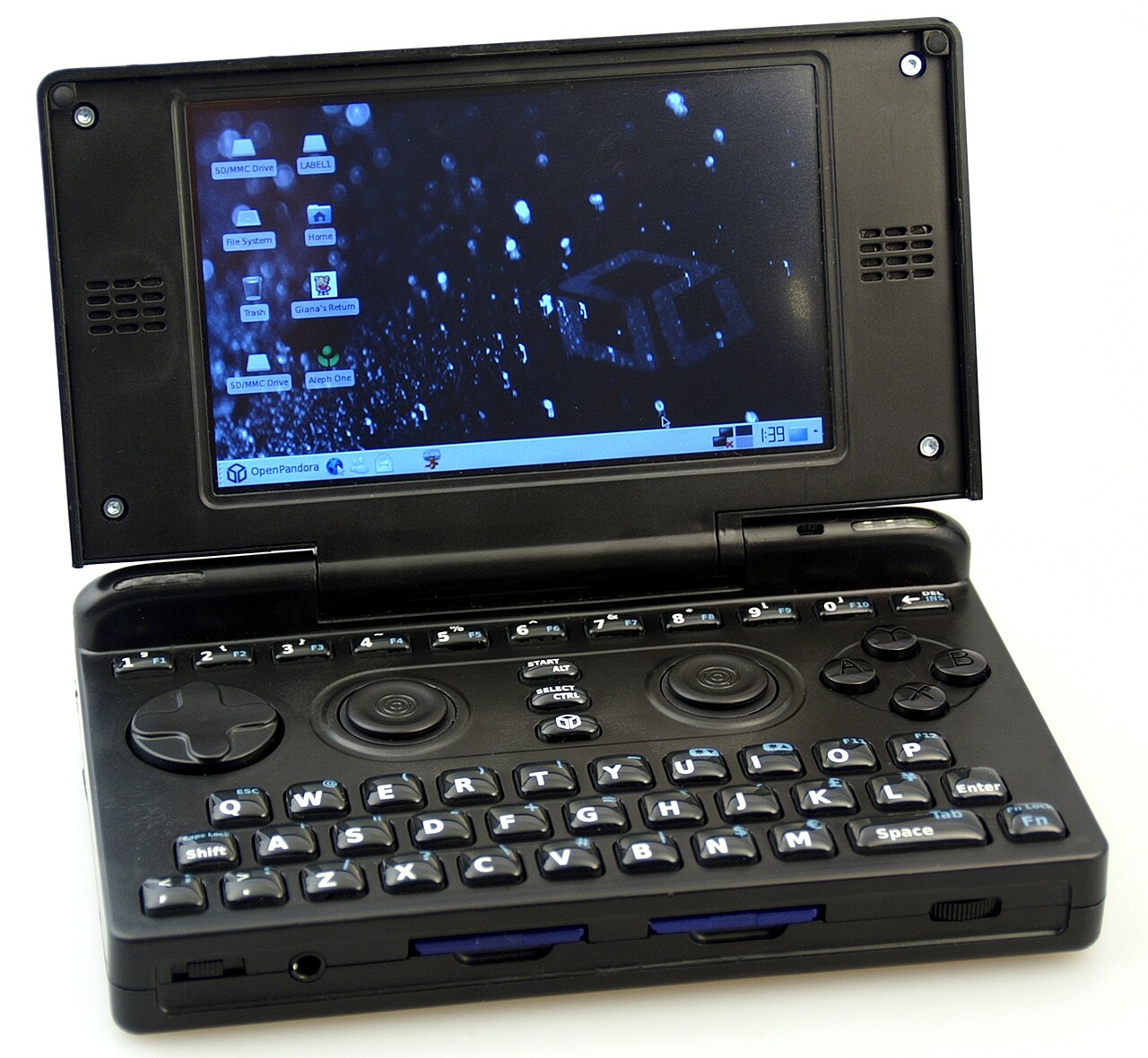
The Pandora is an eighth-generation handheld console released by OpenPandora in 2010.
Spec Table
| Spec | Value |
|---|---|
| Maker | OpenPandora |
| Type | Handheld |
| Generation | 8th generation |
| Release Date | 2010 (initial) |
| Launch Price | Not documented |
| Units Sold | ~7,500 |
| Media | Dual SDHC card slots (up to 64GB each) + 512MB internal NAND flash |
| CPU | OMAP 3530 (600+ MHz Cortex-A8 32-bit) with TMS320C64x+ coprocessor |
| Predecessor / Successor | GP2X / DragonBox Pyra |

History
OpenPandora GmbH built the Pandora as an open-source, community-driven handheld meant to succeed the GP2X, whose own forum community directly shaped the new device’s design. Pre-orders opened in September 2008, well ahead of any finished hardware, and backers waited nearly two years through repeated schedule slips before units began shipping in May 2010.
Manufacturing proved harder than the small team anticipated. Early assembly ran through a Texas-based partner, but cost overruns and supply problems forced a relocation of production to Germany in late 2011. Output remained slow afterward; by September 2012, barely over 4,600 units had reached buyers, leaving hundreds of early backers still waiting years after their original order. OpenPandora announced a final production batch in November 2013, and by 2014 a shortage of Wi-Fi chips helped cap total output at roughly 7,500 units, a run too small for any mainstream retail distribution.
What the Pandora lacked in volume it made up for in software ambition. Its OMAP 3530 processor, paired with a TMS320C64x+ DSP coprocessor, gave hobbyist developers enough headroom to build working emulators for consoles far more powerful than the Pandora itself, including the Dreamcast, PlayStation, and Nintendo 64. Its open Linux-based operating system also enabled full native ports rather than just emulation, most notably commercial PC titles like Jagged Alliance 2 and Homeworld running directly on the handheld’s ARM architecture, cementing its reputation within the broader eighth generation of consoles as a tinkerer’s platform rather than a mass-market one.
OpenPandora eventually began work on a successor, the DragonBox Pyra, starting development in 2014 and opening pre-orders in May 2016, though first production units did not reach even the development team until August 2020. OpenPandora’s own site described the device as “designed by gamers, for gamers,” built specifically so that emulated titles would “feel right” thanks to physical controls matched to each classic system’s original input scheme rather than generic on-screen buttons. Despite its limited run, the Pandora is remembered as one of the more influential open-source handhelds, having proven that a community could design, fund, and ship its own gaming hardware outside the traditional console industry.
Library Highlights
Rather than a conventional game catalog, the Pandora’s library was built almost entirely by its own user community, centered on multi-system emulation and a handful of notable native ports.
- Dreamcast emulator
- PlayStation emulator
- Nintendo 64 emulator
- Amiga emulator
- SNES emulator
- Atari Jaguar emulator
- Jagged Alliance 2
- Homeworld

Variants
OpenPandora sold the console in two main hardware configurations. The original “Pandora Classic” shipped with a 600 MHz-class OMAP 3530 processor, 256MB of RAM, and 512MB of internal NAND storage. A later revision replaced the SoC with a DM3730 chip clocked at 1GHz and doubled RAM to 512MB, while keeping the same case and controls. No regional re-brands or retail bundle variants beyond these hardware revisions are documented. See the full OpenPandora manufacturer hub for other systems the company released.
Collector Value
With roughly 7,500 units ever produced, the Pandora is a genuinely scarce piece of handheld history, and complete, working examples command real interest among retro and homebrew collectors. Condition matters enormously here: the clamshell hinge and membrane keyboard are common wear points, so listings that specifically confirm a functioning keyboard, working analog nubs, and an intact hinge tend to sell for more than untested units. Because the Pandora was sold directly to backers rather than through retail channels, original boxes and paperwork are uncommon, making loose-but-tested units the norm rather than the exception in the secondary market.

Buying Guide
Before buying a used Pandora, ask the seller to demonstrate the clamshell hinge, membrane keyboard, and both analog nubs working, since these mechanical parts see the most wear on units that have been carried and used for years. Confirm the original charger is included, as the console’s specific barrel connector can be hard to replace. Check that at least one SDHC card slot reads reliably, since most Pandora software and emulator files load from SD storage rather than internal memory.
FAQs
When did the Pandora come out?
The Pandora began shipping to backers in May 2010, following pre-orders that had opened in 2008.
How many units did the Pandora sell?
OpenPandora produced approximately 7,500 units in total before manufacturing ended in 2014.
How much did the Pandora cost at launch?
A launch price is not documented; the Pandora was sold directly to pre-order backers rather than through standard retail pricing.
What CPU does the Pandora use?
It uses a Texas Instruments OMAP 3530 system-on-chip with a 600+ MHz ARM Cortex-A8 core, paired with a TMS320C64x+ DSP coprocessor.
What console followed the Pandora?
OpenPandora’s next handheld was the DragonBox Pyra, which began development in 2014 as the Pandora’s successor.
Sources
Facts on this page last verified 2026-07-15.