The Super NES/Super Famicom is a fourth-generation home console released by Nintendo, debuting in Japan in 1990 before arriving in North America in 1991.
Spec Table
| Spec | Value |
|---|---|
| Maker | Nintendo |
| Type | Home console |
| Generation | 4th generation |
| Release Date | Japan: 1990 (initial); North America: 1991; Europe: 1992; Australia: 1992; Brazil: 1993 |
| Launch Price | $199 USD |
| Units Sold | 49.1 million |
| Media | ROM cartridges (Game Pak) |
| CPU | Ricoh 5A22 @ 3.58 MHz (16-bit WDC 65C816 derivative) |
| Predecessor / Successor | Nintendo Entertainment System (NES) / Nintendo 64 |
History
Nintendo launched the Super Famicom in Japan on November 21, 1990, following the runaway success of the original Famicom/NES. Demand was so intense that early Japanese retailers reportedly sold out within hours. The console reached North America on August 23, 1991, rebranded as the Super Nintendo Entertainment System, with European and Australian releases following in 1992 and a later Brazilian launch in 1993 through licensed local manufacturing.
By the time the SNES arrived stateside, Sega’s Genesis already held a two-year head start and a firm grip on the American 16-bit market. Sega’s marketing team, led by Tom Kalinske, ran combative campaigns built around the slogan “Genesis does what Nintendon’t,” pushing an edgier image than Nintendo’s family-friendly reputation. The rivalry escalated further when Sonic the Hedgehog debuted in 1991, giving Sega a mascot with genuine attitude to match its advertising.
Nintendo answered with hardware advantages rather than slogans. The SNES’s Mode 7 graphics mode let cartridges rotate and scale background layers to fake three-dimensional perspective, a trick used to dramatic effect in launch title F-Zero and later in Super Mario Kart. Coprocessor chips embedded directly in cartridges, such as the Super FX chip used in Star Fox, extended the base hardware well beyond its stock capabilities. A strong first-party lineup throughout 1992, including Street Fighter II and Super Mario Kart, helped the SNES claw back market share that Sega had built up early. It stands among the defining systems of the fourth console generation.
The console war’s most contentious flashpoint arrived with 1993’s Mortal Kombat, when Nintendo’s more heavily censored port (replacing blood with “sweat”) sold far worse than Sega’s uncut Genesis version, a rare loss for Nintendo in the fight for player loyalty. Despite that stumble, the SNES ultimately outsold the Genesis worldwide, moving roughly 49.1 million units against Sega’s estimated 30.75 million, and it remains one of the most critically acclaimed consoles ever released.
Library Highlights
The SNES library is frequently cited as one of the strongest of any console, spanning genre-defining platformers, role-playing games, and fighting games that still influence game design today.
- Super Mario World
- Street Fighter II: The World Warrior
- The Legend of Zelda: A Link to the Past
- Final Fantasy VI
- Donkey Kong Country
- Super Metroid
- Chrono Trigger
- Kirby Super Star
Variants
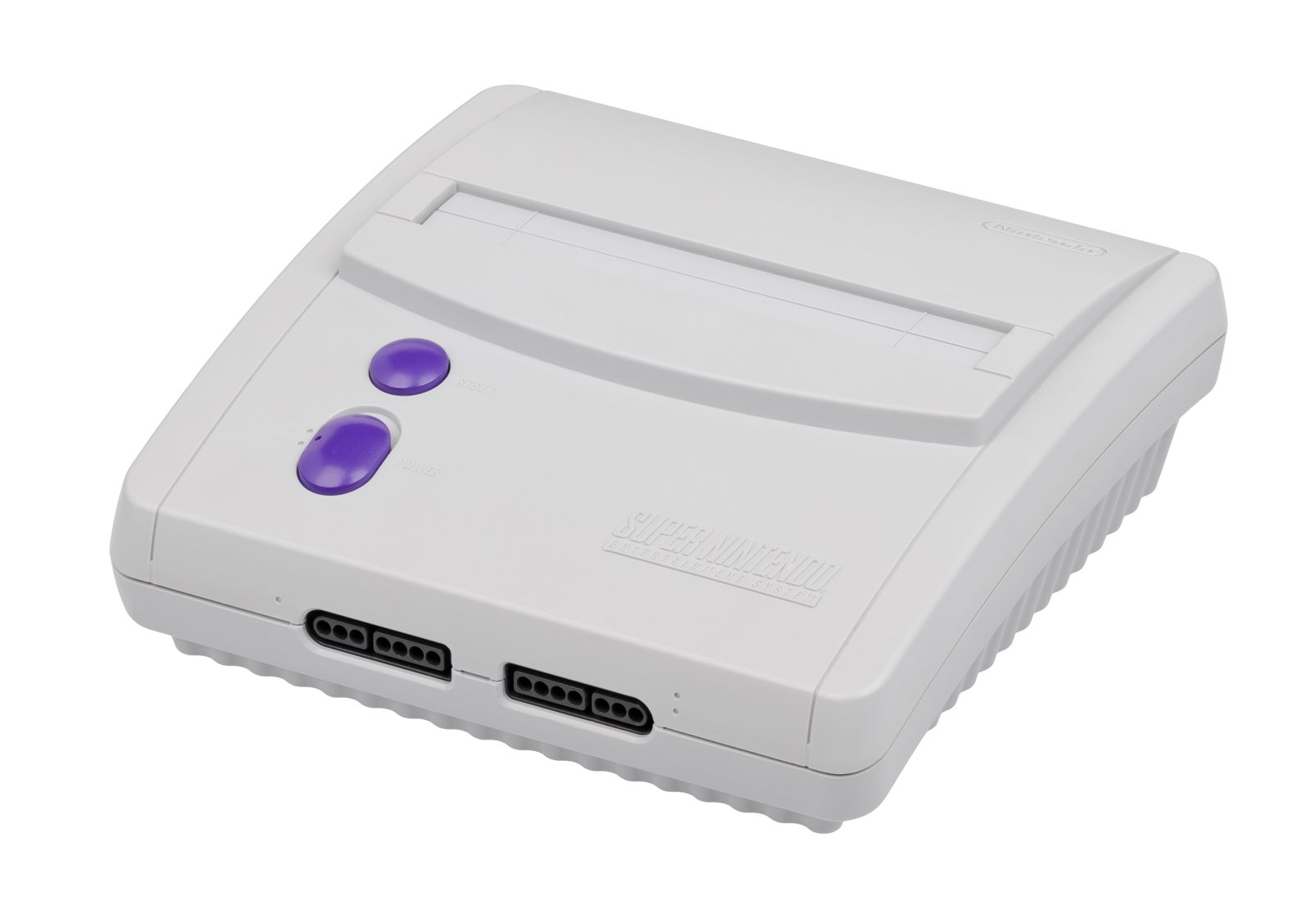
Nintendo revised the console’s case partway through its life, producing a redesigned, more compact model (SNS-101, sometimes called the “SNES Jr.” by collectors) that shipped without the original’s protective cartridge door. Regional variants included cosmetic differences between the North American, Japanese Super Famicom, and PAL European/Australian units, and Brazil received a locally licensed unit manufactured by Playtronic. No other major hardware revisions beyond these regional and cosmetic changes are documented. See the full Nintendo manufacturer hub for other systems the company released.
Collector Value
Complete-in-box SNES consoles in good condition command a steady premium among collectors, with pricing driven heavily by cosmetic condition (yellowing, case cracks) and whether original packaging and manuals are present. Loose, tested consoles remain widely available and affordable, while sealed units and rare regional variants can fetch significantly more. Cartridge-based games generally hold up well physically, but always test the cartridge slot’s connector pins for corrosion before buying, since a worn slot is the most common repair issue on this hardware.
Buying Guide
Before buying a used SNES, check that the seller includes the original AC adapter and RF or composite cables, since third-party replacements vary widely in quality and period-correct cables are increasingly hard to source. Inspect the cartridge slot for bent or corroded connector pins, and ask whether the unit has been tested with a cartridge rather than just powered on. Watch for yellowed plastic on North American units, which is cosmetic only but affects resale value.
FAQs
When did the Super NES/Super Famicom come out?
The Super Famicom launched in Japan in 1990, followed by the Super Nintendo Entertainment System in North America in 1991, Europe and Australia in 1992, and Brazil in 1993.
How many units did the Super NES/Super Famicom sell?
The SNES sold approximately 49.1 million units worldwide over its lifetime, making it one of the best-selling consoles of the 16-bit era.
How much did the Super NES/Super Famicom cost at launch?
The console launched at $199 USD.
What CPU does the Super NES/Super Famicom use?
It uses a Ricoh 5A22 processor running at 3.58 MHz, a 16-bit derivative of the WDC 65C816 architecture.
What console followed the Super NES/Super Famicom?
Nintendo’s next home console was the Nintendo 64, which succeeded the SNES as the company’s flagship system.
Sources
- https://en.wikipedia.org/wiki/Super_Nintendo_Entertainment_System
- https://www.denofgeek.com/games/the-moments-that-defined-the-snes-vs-sega-genesis-console-war/
Facts on this page last verified 2026-07-15.