This article contains Amazon affiliate links — as an Amazon Associate, RetroArcade earns from qualifying purchases.
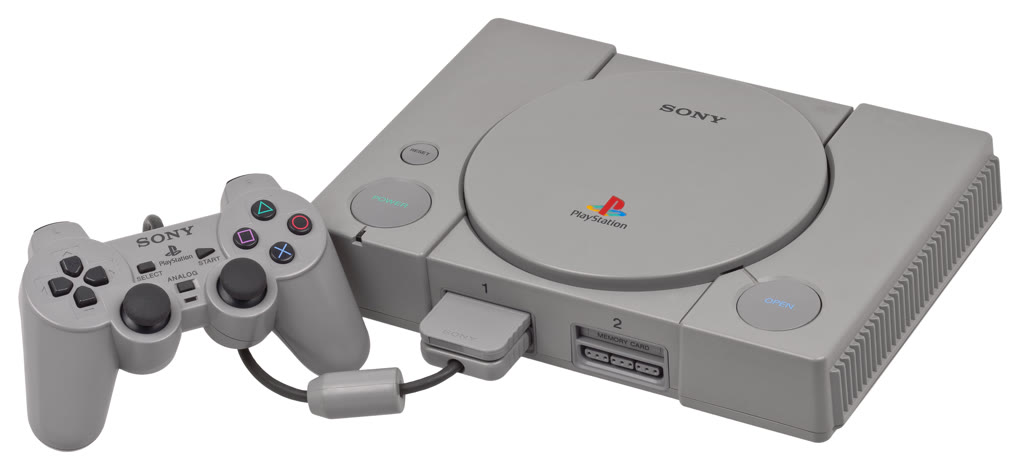
The PlayStation is a fifth-generation home console released by Sony, launching in Japan in 1994 before arriving in North America and Europe in 1995.
Spec Table
| Spec | Value |
|---|---|
| Maker | Sony |
| Type | Home console |
| Generation | 5th generation |
| Release Date | Japan: 1994 (initial); North America: 1995; Europe: 1995; Australia: 1995 |
| Launch Price | $299 USD |
| Units Sold | 102.49 million |
| Media | CD-ROM |
| CPU | R3000 processor at 33.87 MHz with 30 MIPS; 2 MB RAM and 1 MB Video RAM |
| Predecessor / Successor | None / PlayStation 2 |

History
The PlayStation’s origins trace back to a late-1980s collaboration between Sony and Nintendo on a CD-ROM add-on for the Super NES. Sony engineer Ken Kutaragi had already built the sound chip for the original Famicom, and he pushed Sony’s leadership to expand into a full CD-based console alongside Nintendo. Nintendo abandoned the deal in 1991, announcing a rival CD-ROM partnership with Philips instead, a reversal some in the industry later called a betrayal. Rather than dropping the project, Kutaragi convinced Sony president Norio Ohga to let him build a standalone Sony console from the ground up, despite internal doubts about entering the toy business.
Sony released the PlayStation in Japan on December 3, 1994, selling roughly 100,000 units on its first day even though the rival Sega Saturn had launched slightly earlier and initially outsold it. The console reached North America on September 9, 1995, following a now-famous moment at that year’s E3, where a Sony executive responded to Sega’s $399 Saturn price with a single word: “299.” The line drew a standing ovation, and PlayStation reportedly sold more units in its first two days on shelves than the Saturn had in five months. Sony’s European launch followed on September 29, 1995, and PlayStation quickly outpaced Saturn there as well, reportedly outselling it three-to-one in the UK within a few months.
Unlike Nintendo and Sega, which built their fifth-generation strategies around cartridges, Sony bet entirely on CD-ROM, a format that was cheaper to manufacture and offered far more storage for full-motion video, voice acting, and orchestral soundtracks. That decision made the PlayStation a magnet for third-party publishers who found CD production faster and less restrictive than negotiating cartridge licensing terms with Nintendo, and franchises like Final Fantasy jumped to Sony’s platform as a result. The console became a defining system of the fifth console generation, helping normalize 3D polygonal graphics and disc-based gaming as the industry standard going forward.
By the time production wound down, the original PlayStation had shipped approximately 102.49 million units worldwide, becoming the first console in history to cross the 100 million mark. That milestone cemented Sony Computer Entertainment as a dominant force in the industry and set the stage for the PlayStation 2, which would go on to eclipse even those numbers.
Library Highlights
The PlayStation’s library helped push the medium toward cinematic storytelling and genre experimentation, pairing early 3D showcases with survival-horror and racing titles that still influence their genres today.
- Final Fantasy VII
- Metal Gear Solid
- Gran Turismo
- Crash Bandicoot
- Resident Evil
- Tekken 3
- Spyro the Dragon
- Tomb Raider
Variants
Sony released several hardware revisions of the original PlayStation over its production run, most notably the slimmer, lighter PS One redesign introduced in 2000 late in the console’s life. No other major hardware variants are documented in the source data beyond these standard revisions and regional models. See the full Sony manufacturer hub for other systems the company released.
Collector Value
Original PlayStation consoles are widely available and generally affordable compared to rarer fifth-generation hardware, though pricing still varies by condition and completeness. Boxed units with original manuals and cables draw a premium over loose, tested consoles, and the later PS One redesign tends to command interest from collectors seeking a more compact display piece. Given the console’s age, buyers should expect the internal laser lens to have degraded on many units, since disc-read failure is the most common issue affecting original PlayStation hardware.
Buying Guide
Before buying a used PlayStation, ask the seller to confirm it has been tested with a disc rather than just powered on, since the laser lens commonly weakens with age and can cause read errors even on units that turn on normally. Check that the original AC adapter and AV cables are included, as third-party replacements vary in quality. Inspect the disc tray and controller ports for wear, and note that the later PS One model is generally more compact but otherwise functionally similar to the original.
FAQs
When did the PlayStation come out?
The PlayStation launched in Japan in 1994, followed by North America, Europe, and Australia in 1995.
How many units did the PlayStation sell?
The PlayStation sold approximately 102.49 million units worldwide, making it the first console ever to surpass 100 million units sold.
How much did the PlayStation cost at launch?
The console launched at $299 USD.
What CPU does the PlayStation use?
It uses an R3000 processor running at 33.87 MHz with 30 MIPS of performance, paired with 2 MB of system RAM and 1 MB of video RAM.
What console followed the PlayStation?
Sony’s next home console was the PlayStation 2, which succeeded the original PlayStation as the company’s flagship system.
Sources
Facts on this page last verified 2026-07-15.