This article contains Amazon affiliate links — as an Amazon Associate, RetroArcade earns from qualifying purchases.
Galaga is a 1981 fixed shooter arcade game released by Namco in Japan and distributed in North America by Midway Manufacturing.
Quick Facts
| Title | Galaga |
| Year | 1981 |
| Manufacturer | Namco (Japan/Europe), Midway Manufacturing (North America) |
| Designer(s) | Shigeru Yokoyama, Toru Ogawa, Hiroshi Ono, Nobuyuki Ohnogi |
| Genre | Fixed Shooter |
| Hardware | Namco Galaga arcade board |
| Ports | 7 ports, including SG-1000, MSX, and NES/Famicom — see Ports section |

History
Namco released Galaga in Japan in September 1981 as the successor to its earlier hit Galaxian, with Midway Manufacturing handling North American distribution a few months later. A small internal team led by director Shigeru Yokoyama built on Galaxian’s diving-enemy formula while adding a signature twist: certain Boss Galaga enemies could snare the player’s fighter with a tractor beam, and a successful rescue attempt granted a linked dual ship with doubled firepower. That capture-and-rescue idea reportedly grew out of a staff member’s memory of a film scene showing a ship pulled in by a beam of light.
Despite a shaky start in early location tests, Galaga caught on quickly once operators put it on their floors. It ranked among Japan’s top-grossing arcade games in both 1981 and 1982, and it kept appearing on industry sales charts for years afterward. Galaga is now counted among the most successful and influential titles of the golden age of arcade games, regularly cited alongside genre peers like Centipede as an enduring example of tightly designed fixed-shooter gameplay. Its popularity led Namco to produce a direct sequel, Gaplus, in 1984, and the tractor-beam capture mechanic it introduced has been referenced in later shooters ever since.
Gameplay
Galaga puts the player in command of a single starfighter at the bottom of the screen, tasked with clearing successive formations of insect-like alien ships that enter in scripted patterns before peeling off to dive and fire on the player. The objective in each stage is to destroy every enemy in the wave without losing all of the player’s ships to enemy fire or collision. Controls are simple: a two-way joystick moves the fighter left and right along the bottom of the screen, and a single button fires its cannon. The game’s most distinctive wrinkle is the Boss Galaga’s tractor beam, which can capture the player’s ship rather than destroy it outright; shooting down the capturing Boss Galaga frees the captive ship to fly alongside the player’s remaining fighter, doubling forward firepower for as long as both survive.
- Wave-based enemy formations that enter in patterns before diving at the player
- Tractor-beam capture by Boss Galaga enemies, risking a lost ship
- Rescue mechanic that restores a captured ship as a linked dual fighter
- Simple two-way movement and single-button firing controls
Cabinet & Hardware
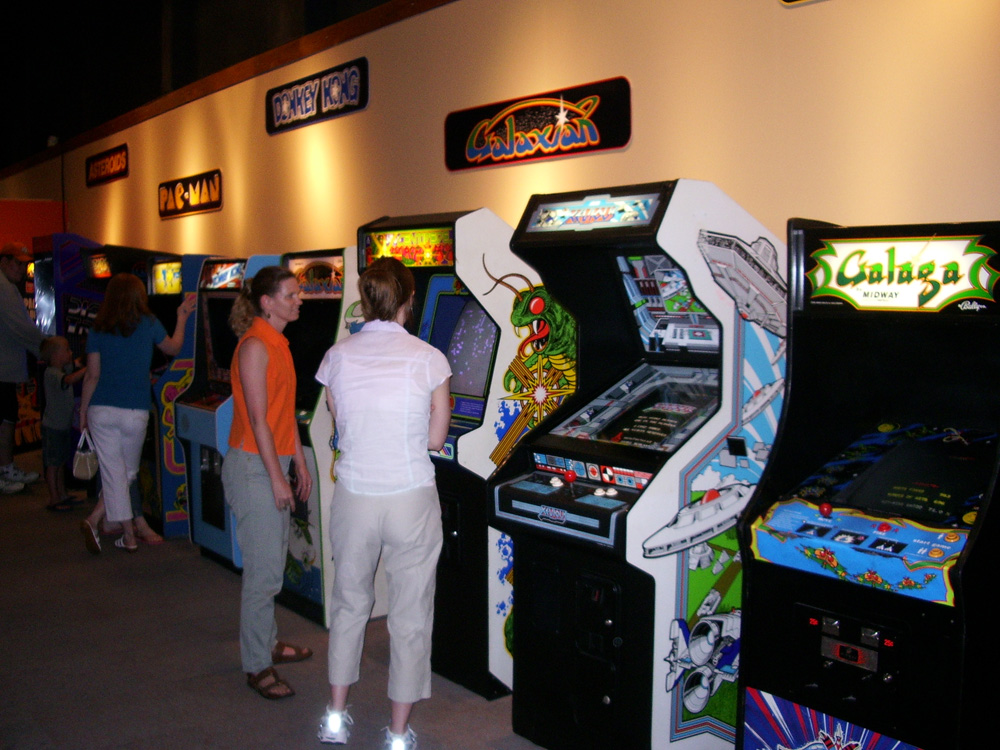
Galaga runs on the Namco Galaga arcade board, a purpose-built system that powered both the original upright and cocktail-table cabinet versions sold to arcade operators. The board’s fixed vertical-screen output suited the game’s single-screen wave design, and the cabinet’s standard control panel used just a joystick and a single fire button, keeping the physical footprint and control scheme simple compared to later multi-button shooters.
Ports & Re-releases
| Platform | Year |
|---|---|
| SG-1000 | 1983 |
| MSX | 1984 |
| NES/Famicom | 1985 |
| Atari 7800 | 1986 |
| Game Boy | 1995 |
| Xbox Live Arcade | 2006 |
| Nintendo Switch/PlayStation 4 (Arcade Archives) | 2023 |
Beyond its original run of home ports, Galaga has been re-released repeatedly on modern platforms, most recently as part of Hamster’s Arcade Archives line, which brought a faithful emulated version of the original arcade board to Nintendo Switch and PlayStation 4 in 2023. See the NES/Famicom and Atari 7800 platform pages for details on those specific ports.
Where to Play Legally Today
- Arcade Archives Galaga on Nintendo Switch and PlayStation 4, a licensed emulated release of the original arcade board
- Compilation releases such as the Namco Museum series on past and current consoles and PC
- MAME, run only with legally owned ROM dumps from a cabinet or licensed source you own
- Arcade museums and retro arcade venues that keep a working Galaga cabinet on their floor
Collector Value
Original Galaga upright cabinets remain reasonably plentiful on the collector market given how many units were sold during the game’s long run on arcade sales charts, though clean examples with original, unfaded side art and marquees command higher prices than worn or repainted units. Standalone Galaga PCBs also trade separately from cabinets, letting collectors who already own a compatible Namco-style enclosure swap in an original board. Cartridge-based home ports, such as the NES/Famicom and Game Boy versions, are widely available and inexpensive, making them an accessible way to own a piece of Galaga history without the space and cost of a full cabinet.
FAQs
Who made Galaga?
Galaga was designed by a Namco team credited with Shigeru Yokoyama, Toru Ogawa, Hiroshi Ono, and Nobuyuki Ohnogi, and it was manufactured by Namco in Japan and Europe and by Midway Manufacturing in North America.
What year did Galaga come out?
Galaga was released in 1981.
What genre is Galaga?
Galaga is a fixed shooter, a genre in which the player’s ship stays on one screen while enemy waves enter and attack in formation.
What hardware did Galaga run on?
Galaga ran on the Namco Galaga arcade board, the dedicated system built for the original cabinet.
Has Galaga been ported to home consoles?
Yes, Galaga has been ported to at least seven platforms since 1983, including the SG-1000, MSX, NES/Famicom, Atari 7800, Game Boy, Xbox Live Arcade, and Nintendo Switch/PlayStation 4 via Arcade Archives.
See also the related Galaxian arcade page, and browse the Golden Age of Arcade Games hub for more classic fixed-shooter titles.
Sources
Facts on this page last verified 2026-07-15.