This article contains Amazon affiliate links — as an Amazon Associate, RetroArcade earns from qualifying purchases.
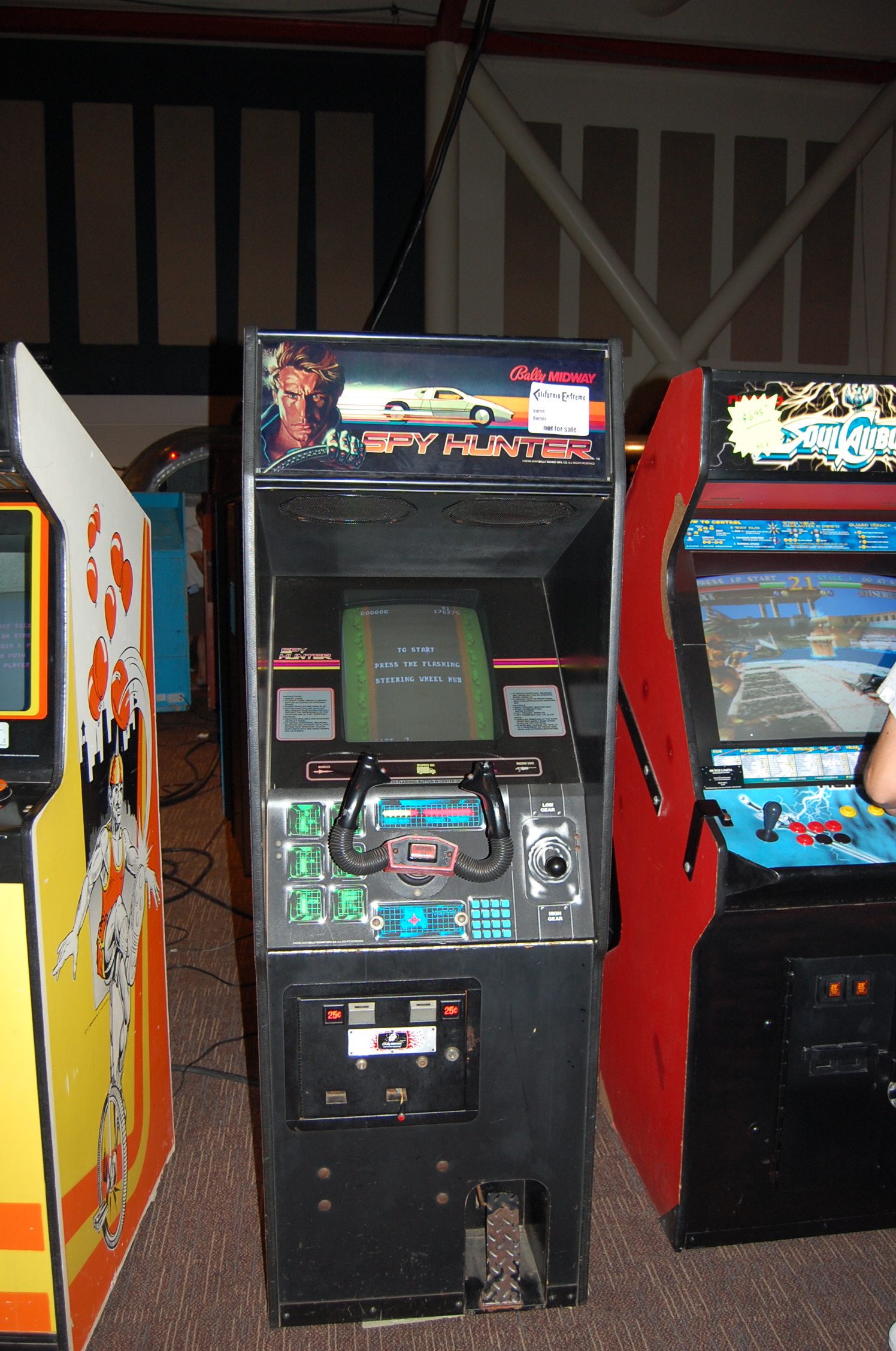
Spy Hunter is a 1983 vehicular combat driving game by Bally Midway.
Quick Facts
| Title | Spy Hunter |
| Year | 1983 |
| Manufacturer | Bally Midway |
| Designer(s) | George Gomez, Tom Leon |
| Genre | Vehicular combat driving game |
| Hardware | Arcade cabinet using Bally Midway MCR-Scroll system board. Controls feature a futuristic aircraft-style steering yoke with special-purpose buttons, a two-position stick shift, and acceleration pedal. |
| Ports | 10 ports, including Atari 2600, Atari 8-bit, and Amstrad CPC — see Ports section |

History
Bally Midway released Spy Hunter to North American arcades in November 1983, with the game reaching Europe by early 1984 and Japan later that year. Designer George Gomez, working alongside Tom Leon, is credited with sketching the scrolling road layout and shaping the game around a gadget-laden pursuit car modeled on Gomez’s own Camaro Z-28, drawing loosely on spy-film and Knight Rider style rather than any licensed plot. The result ran on Bally Midway’s own MCR-Scroll hardware, a board built specifically to handle the game’s continuously moving vertical highway, housed in a cabinet built from the wood, metal, plastic, and glass typical of arcade machines of the period.
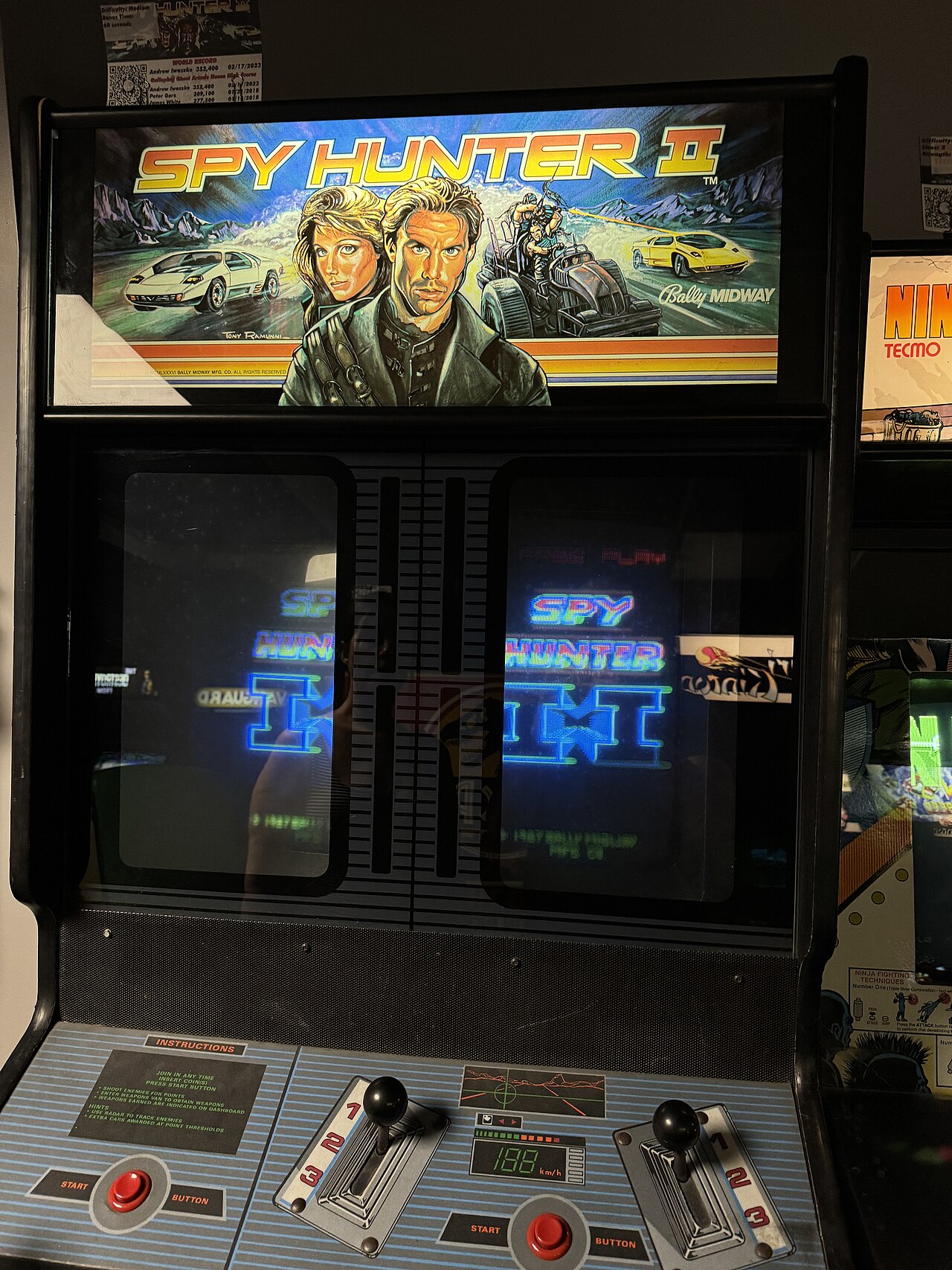
The cabinet’s distinctive yoke-style steering control helped it stand out on arcade floors, and the game quickly became one of the top five highest-grossing arcade titles of 1984 and 1985. Industry trade charts tracked it topping upright-cabinet earnings through much of 1984, and operators recognized it among the most-played machines of the mid-1980s. Bally Midway followed the original with Spy Hunter II in 1987, and a separate NES-exclusive sequel, Super Spy Hunter, extended the series to home consoles. The franchise’s reach later showed up in unexpected places, including a hidden playable version built into Microsoft Excel 2000, and the original arcade game has since resurfaced in console compilations such as Midway Arcade Treasures and Midway Arcade Origins.
Gameplay
Players pilot an armed sportscar along a vertically scrolling freeway, weaving through civilian traffic while enemy vehicles close in from ahead and behind. The car mounts a standard machine gun for regular threats, but survival against tougher enemies depends on switching to situational weapons such as oil slicks to spin out pursuers and homing missiles for enemies that require a decisive hit. Civilian traffic must be avoided rather than attacked, since hitting an innocent vehicle costs the player dearly, adding a layer of restraint to what is otherwise an aggressive shooter. Periodically the road gives way to open water, and the car transforms into an armed speedboat for a timed nautical stretch before the mission returns to the highway. Controls are handled through a yoke-style wheel, a two-position gear shift that adjusts top speed and handling, and a foot pedal for acceleration, all of which reward players who can manage weapon selection and evasive lane changes simultaneously.
- Vertically scrolling freeway combat against waves of enemy vehicles
- Switchable weapons: machine gun, oil slick, and missiles
- Civilian traffic that must be avoided rather than destroyed
- Timed speedboat sequences that temporarily change the vehicle and terrain

Cabinet & Hardware
Spy Hunter’s cabinet runs on Bally Midway’s MCR-Scroll system board, an arcade platform built to handle the game’s continuous vertical scrolling road. The control panel was designed to sell the fantasy of driving a spy car rather than a generic race vehicle, pairing an aircraft-style steering yoke fitted with dedicated weapon buttons alongside a two-position stick shift for gear changes and a floor-mounted acceleration pedal, a control layout that set the cabinet apart from the simple wheel-and-pedal setups common on other driving games of the era.
Ports & Re-releases
| Platform | Year |
|---|---|
| Atari 2600 | — |
| Atari 8-bit | — |
| Amstrad CPC | — |
| ZX Spectrum | — |
| Commodore 64 | — |
| Apple II | — |
| ColecoVision | — |
| IBM PC | — |
| NES | — |
| BBC Micro | — |
The original coin-op has also been preserved in modern console compilations, including Midway Arcade Treasures and the later Midway Arcade Origins collection, keeping the arcade version playable on hardware well removed from the original cabinet. See the Atari 2600 and NES platform pages for details on those specific ports, and the ColecoVision page for its home conversion.
Where to Play Legally Today
- Official compilation releases such as Midway Arcade Treasures and Midway Arcade Origins on consoles and PC
- MAME, run only with legally owned ROM dumps from a cabinet or licensed source you own
- Arcade museums and retro arcade venues that keep a working Spy Hunter cabinet on their floor
Collector Value
Original Spy Hunter cabinets are a recognizable fixture on the vintage arcade market thanks to their distinctive yoke steering control, with well-preserved units featuring intact side art and functioning weapon buttons commanding higher prices than worn or heavily modified examples. Standalone PCBs circulate for collectors who already own a compatible upright cabinet and want to swap boards rather than acquire a complete machine. Home ports on systems like the Commodore 64, Atari 2600, and NES remain widely available and inexpensive, offering a low-cost way for collectors to own a piece of the franchise without the space and cost of a full cabinet.
FAQs
Who made Spy Hunter?
Spy Hunter was designed by George Gomez and Tom Leon and manufactured by Bally Midway.
What year did Spy Hunter come out?
Spy Hunter came out in 1983, released to arcades by Bally Midway.
What genre is Spy Hunter?
Spy Hunter is a vehicular combat driving game in which the player controls an armed sportscar on scrolling freeways, fighting enemy vehicles while avoiding civilian traffic.
What hardware did Spy Hunter run on?
Spy Hunter ran on Bally Midway’s MCR-Scroll arcade system board, with a cabinet control panel built around a steering yoke, a two-position stick shift, and an acceleration pedal.
Has Spy Hunter been ported to home consoles?
Yes, Spy Hunter has been ported to at least ten platforms, including the Atari 2600, Atari 8-bit, Amstrad CPC, ZX Spectrum, Commodore 64, Apple II, ColecoVision, IBM PC, NES, and BBC Micro.
See also the related Tron and Tapper arcade pages, both from Bally Midway, and browse the Golden Age of Arcade Games hub for more classic driving titles.
Sources
- https://en.wikipedia.org/wiki/Spy_Hunter
- https://artsandculture.google.com/asset/arcade-game-spy-hunter-arcade-game/UAE6iGexnBy9gQ
Facts on this page last verified 2026-07-15.