
This article contains Amazon affiliate links — as an Amazon Associate, RetroArcade earns from qualifying purchases.
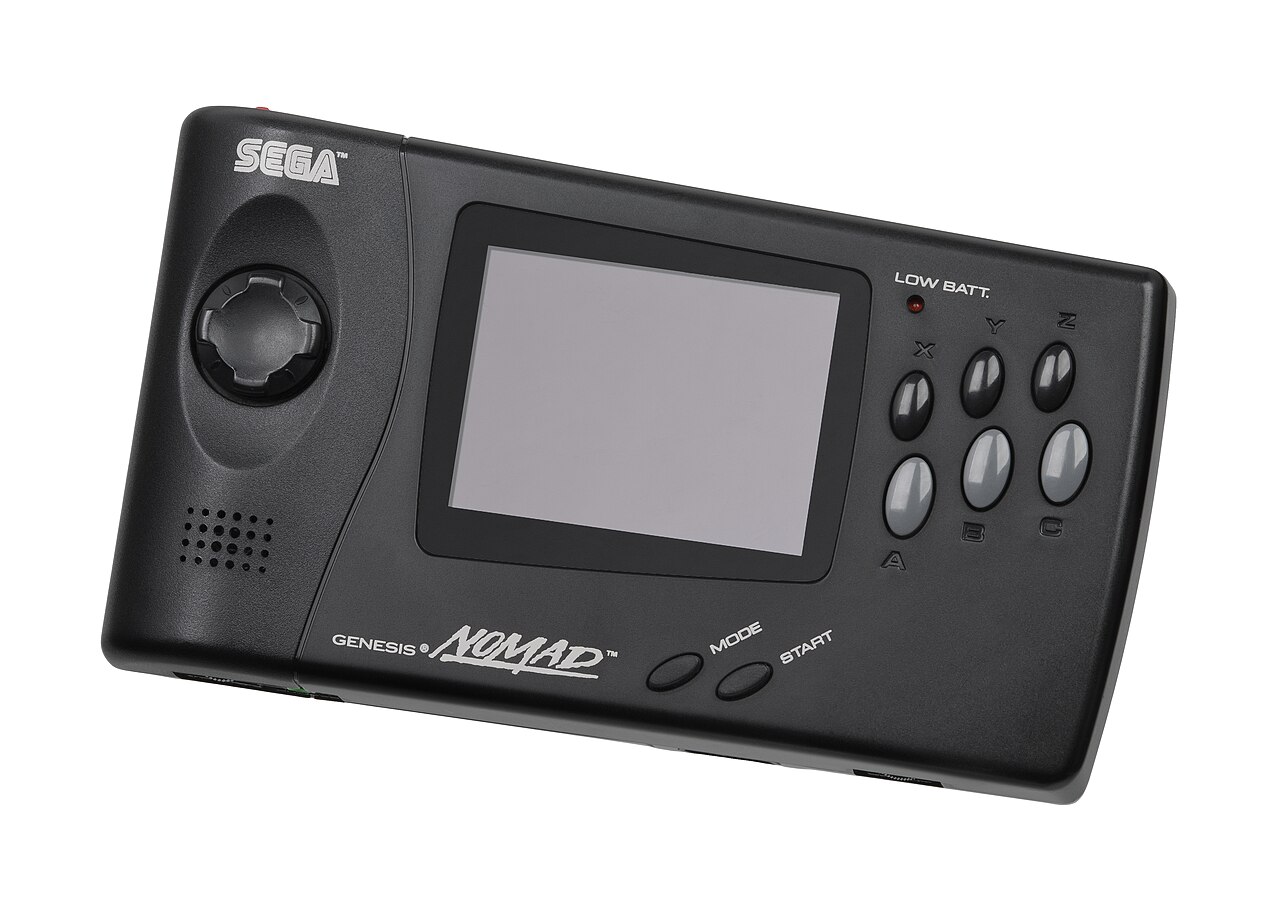
The Genesis Nomad is a fifth-generation handheld console released by Sega exclusively in North America in 1995.
Spec Table
| Spec | Value |
|---|---|
| Maker | Sega |
| Type | Handheld |
| Generation | 5th generation |
| Release Date | North America: 1995 |
| Launch Price | $179 USD |
| Units Sold | Approximately 1 million |
| Media | Sega Genesis ROM cartridges |
| CPU | Motorola 68000 |
| Predecessor / Successor | Mega Jet / None |

History
Sega released the Genesis Nomad in North America in October 1995, developed internally under the codename Project Venus. The system was a direct commercial descendant of the Mega Jet, a portable Mega Drive variant Sega had built for use on Japan Airlines flights rather than retail sale. Engineers adapted that airline-only design into a standalone handheld capable of playing the existing Genesis cartridge library, giving buyers access to several hundred titles already on the market at launch rather than a fresh line of dedicated handheld software.
At $179, the Nomad undercut the price of a Genesis and a portable television combined, and it stood out as the only handheld of its era with both a built-in screen and a video output for connecting to a home TV. Its 3.25-inch backlit color LCD displayed the same 320×224 resolution as a full-size Sega Genesis / Mega Drive, and the Motorola 68000 processor at its core meant compatibility with unmodified Genesis cartridges. Six AA batteries powered the unit for only two to three hours of play, and Sega also sold a dedicated PowerBack recharger and AC adapter as alternatives for less mobile use.
The Nomad arrived at an awkward moment for Sega. The company was simultaneously supporting the Genesis, Sega CD, 32X, Game Gear, Pico, and the newly launched Saturn, and marketing attention for the Nomad suffered as a result. Nintendo’s Game Boy, backed by a much larger and cheaper software library, remained the dominant handheld throughout the Nomad’s short life. The Nomad also could not use the Power Base Converter, Sega CD, or 32X add-ons, closing off a portion of the Genesis catalog to it entirely.
Sega discontinued the Nomad in 1999 after selling approximately 1 million units, a commercial disappointment against the tens of millions the Game Boy moved over the same stretch. It is generally remembered as the first true 16-bit handheld and, aside from the 2005 Advanced Pico Beena aimed at young children, effectively closed out Sega’s run of dedicated handheld hardware. It belongs to the same fifth console generation as the Saturn, PlayStation, and Nintendo 64.
Library Highlights
Because the Nomad played standard Genesis cartridges rather than a dedicated handheld format, its library at launch was effectively the entire existing Genesis catalog of several hundred titles rather than a curated handheld lineup.
No notable games specific to the Nomad are documented; its value came from full backward compatibility with the Genesis library rather than exclusive software.

Variants
No major hardware variants are documented. The Nomad was sold exclusively in North America and was never released internationally in any regional form. See the full Sega manufacturer hub for other systems the company released.
Collector Value
Working Genesis Nomads command a real premium among collectors today, driven largely by screen condition: the original backlit LCD is prone to dimming, ghosting, and dead pixels with age, and a unit with a bright, clean display sells for considerably more than one with a degraded screen. Complete-in-box examples with the original PowerBack charger and packaging are scarce and priced accordingly, while loose, tested consoles are more attainable for collectors chasing Sega’s handheld lineup. Given its low production run compared to contemporaries like the Game Boy, sealed units are rare and expensive.
Buying Guide
Before buying a used Genesis Nomad, test the screen thoroughly for dimming, ghosting, or dead pixels, since the backlit LCD is the component most likely to have degraded with age. Check that the battery compartment shows no corrosion from old AA batteries, and confirm the cartridge slot’s connector pins are clean and undamaged. If a PowerBack recharger or AC adapter is included, verify it powers on reliably before completing the purchase, since period-correct power accessories are increasingly hard to replace.
FAQs
When did the Genesis Nomad come out?
The Genesis Nomad launched in North America in October 1995.
How many units did the Genesis Nomad sell?
The Nomad sold approximately 1 million units before Sega discontinued it in 1999.
How much did the Genesis Nomad cost at launch?
The Genesis Nomad launched at $179 USD.
What CPU does the Genesis Nomad use?
It uses a Motorola 68000 processor, the same CPU found in the home Sega Genesis, which is why it could play unmodified Genesis cartridges.
Was the Genesis Nomad released outside North America?
No. The Genesis Nomad was sold exclusively in North America and was never released internationally.
Sources
Facts on this page last verified 2026-07-15.