This article contains Amazon affiliate links — as an Amazon Associate, RetroArcade earns from qualifying purchases.
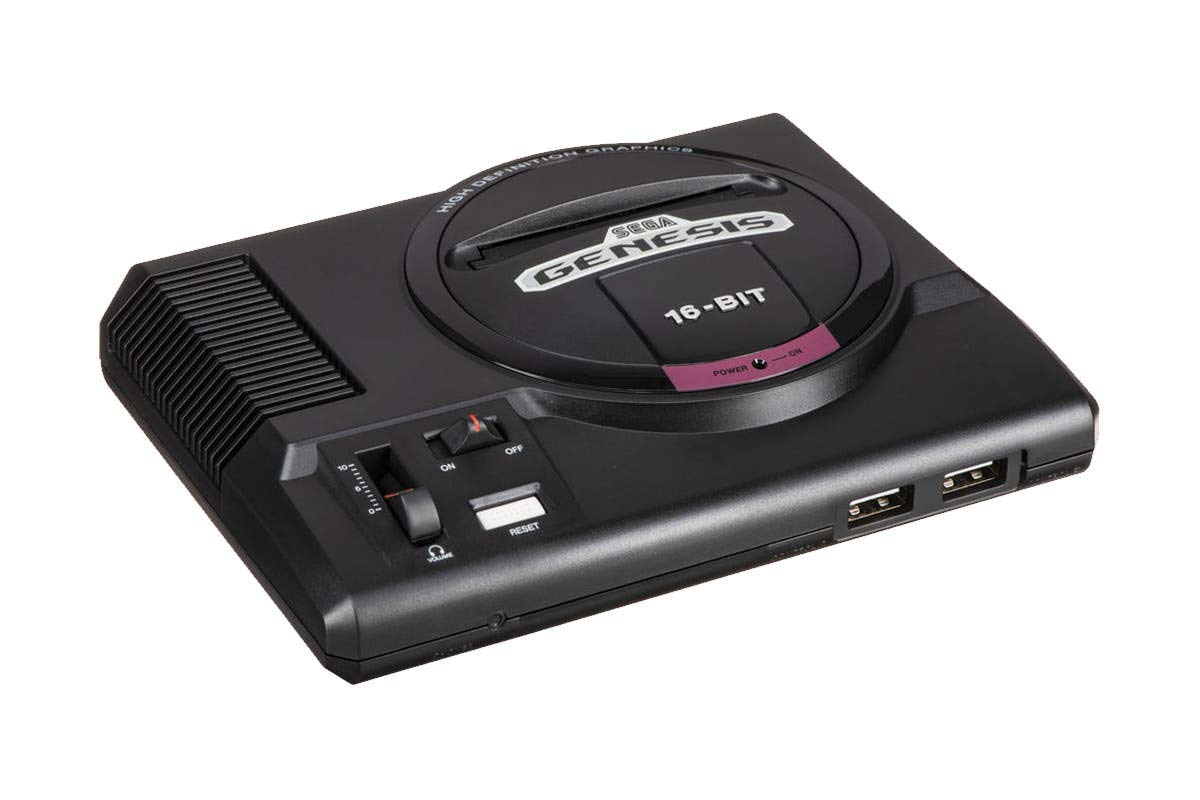
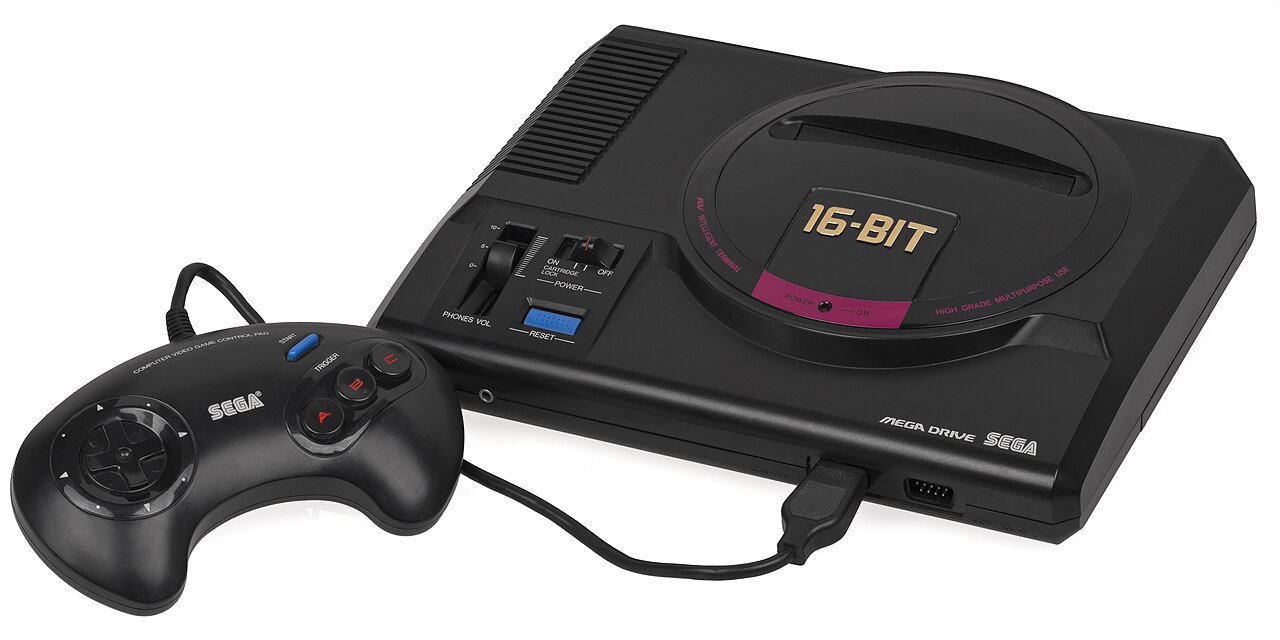
The Sega Genesis, known as the Mega Drive outside North America, is a fourth-generation home console released by Sega, debuting in Japan in 1988 before arriving in North America in 1989.
Spec Table
| Spec | Value |
|---|---|
| Maker | Sega |
| Type | Home console |
| Generation | 4th generation |
| Release Date | Japan: 1988 (initial); North America: 1989; PAL: 1990; Brazil: 1990 |
| Launch Price | $189 USD |
| Units Sold | 30.75 million |
| Media | ROM cartridges |
| CPU | Motorola 68000 @ 7.6 MHz (primary), Zilog Z80 @ 3.58 MHz (sound) |
| Predecessor / Successor | Master System / Sega Saturn |
History
Sega released the Mega Drive in Japan in 1988 as a direct answer to Nintendo’s Famicom, emphasizing raw processing power over the incumbent’s software library. The console arrived in North America in 1989 as the Genesis, followed by PAL territories and Brazil in 1990. Unlike Nintendo, which controlled Japan’s home console market almost completely, Sega positioned its new machine as the technically superior choice for players who had outgrown 8-bit hardware.
Tom Kalinske took over Sega of America in 1990 and reshaped the console’s American strategy around aggressive price cuts, a pack-in bundle, and advertising that directly needled Nintendo. The slogan “Genesis does what Nintendon’t” became the banner for a marketing campaign built to appeal to older kids and teenagers rather than the younger audience Nintendo courted. Bundling Sonic the Hedgehog with the hardware starting in 1991 gave Sega a mascot with genuine attitude, and the pack-in reportedly moved 15 million copies. The strategy worked: by 1992, the Genesis held roughly 65% of the North American 16-bit market, the first time any competitor had broken Nintendo’s dominance since 1985.
Sega also pushed the console’s library toward more mature material than Nintendo would allow on its own hardware. The clearest example came in 1993, when Acclaim released Mortal Kombat simultaneously for Genesis and Super NES. Nintendo insisted on a censored port that swapped blood for gray “sweat,” while Sega’s Genesis version shipped uncut behind a hidden code. The uncensored Genesis release reportedly outsold its SNES counterpart by a margin of roughly three or four to one, a result that fueled a 1993 U.S. Senate hearing on video game violence and pushed the industry toward the ratings system that became the ESRB. It stands among the defining systems of the fourth console generation.
The Genesis’s legal legacy proved just as influential as its marketing. When third-party publisher Accolade reverse-engineered the console’s lockout hardware to release unlicensed games, Sega sued for copyright and trademark infringement. In its 1992 ruling on Sega v. Accolade, the Ninth Circuit Court of Appeals found that disassembling copyrighted code to access unprotected functional interfaces qualifies as fair use, and that Sega had misused its own security system to force its trademark onto rival products. The decision remains a foundational precedent in software law, cited in disputes over reverse engineering and interoperability well beyond the games industry.
Library Highlights
The Genesis library leaned into fast-paced action, arcade ports, and edgier content than its main rival offered, anchored by a mascot platformer that became Sega’s answer to Mario.
- Sonic the Hedgehog
- Sonic the Hedgehog 2
- Mortal Kombat
- Streets of Rage
- Disney’s Aladdin
- Altered Beast
- Golden Axe
- Phantasy Star

Variants
Sega revised the hardware across its production run. The original Model 1, launched in 1988–89, used a DIN-style AV port and RF output alongside a front headphone jack. A redesigned Model 2 swapped those ports for a single 9-pin mini-DIN connector supporting composite and RGB video in a smaller case, and a later Model 3 introduced the Trademark Security System, a licensing check built into the boot process. Regional partners handled their own rebrands: Tectoy manufactured the console in Brazil beginning in 1990, and Samsung distributed it in South Korea under different product names. After Sega’s own production wound down, Majesco licensed the hardware in 1998 and reissued it as the budget-priced “Genesis 3.” See the full Sega manufacturer hub for other systems the company released.
Collector Value
Genesis hardware remains plentiful and affordable compared to some fourth-generation rivals, with loose, tested Model 1 and Model 2 consoles widely available at modest prices. Condition and completeness drive value the most: complete-in-box units with original packaging, manuals, and cables command a real premium over loose consoles, and sealed hardware or rare bundles can fetch significantly more from dedicated collectors. Common games like Sonic the Hedgehog are inexpensive and easy to find, while less common titles and complete role-playing games such as Phantasy Star entries carry higher prices.

Buying Guide
Before buying a used Genesis, confirm which model you’re getting, since the Model 1 and Model 2 differ in audio quality and accessory compatibility, and ask whether the console has been tested with a cartridge rather than just powered on. Inspect the cartridge slot for bent or corroded pins, check that the power supply matches your region’s voltage, and bring your own RF or AV cable if the listing doesn’t include one, since original cables are increasingly hard to source in good condition.
FAQs
When did the Sega Genesis / Mega Drive come out?
The Mega Drive launched in Japan in 1988, followed by the Sega Genesis in North America in 1989, PAL territories in 1990, and Brazil in 1990.
How many units did the Sega Genesis / Mega Drive sell?
The console sold approximately 30.75 million units worldwide over its lifetime.
How much did the Sega Genesis / Mega Drive cost at launch?
The console launched at $189 USD.
What CPU does the Sega Genesis / Mega Drive use?
It uses a Motorola 68000 processor running at 7.6 MHz as its primary CPU, with a Zilog Z80 running at 3.58 MHz handling sound.
What console followed the Sega Genesis / Mega Drive?
Sega’s next home console was the Sega Saturn, which succeeded the Genesis/Mega Drive as the company’s flagship system.
Sources
Facts on this page last verified 2026-07-15.