This article contains Amazon affiliate links — as an Amazon Associate, RetroArcade earns from qualifying purchases.
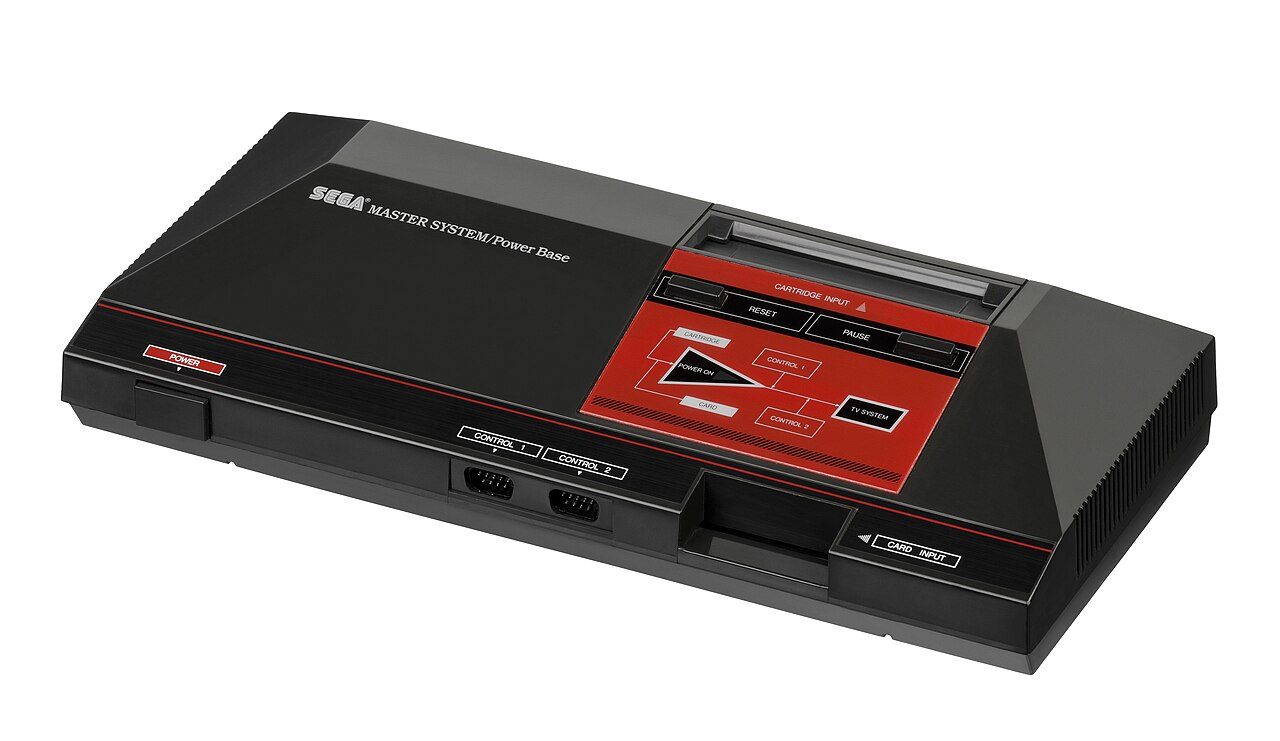
The Master System is a third-generation home console released by Sega, launching in Japan in 1985 and reaching North America the following year.
Spec Table
| Spec | Value |
|---|---|
| Maker | Sega |
| Type | Home console |
| Generation | 3rd generation |
| Release Date | Japan: 1985 (initial); North America: 1986; Europe: 1987; South Korea: 1989; Brazil: 1989 |
| Launch Price | $200 USD |
| Units Sold | 10-13 million |
| Media | ROM cartridge, Sega Card |
| CPU | Zilog Z80A @ 3.58 MHz |
| Predecessor / Successor | SG-1000 / Sega Genesis |

History
Sega released the console in Japan on October 20, 1985, as the Mark III, an upgrade to the earlier SG-1000 hardware line. When Sega repackaged the machine for Western audiences and renamed it the Master System, it launched in North America in September 1986 through a distribution deal that put it directly against Nintendo’s already-established NES. European buyers got their first look at the console in 1987, with South Korea and Brazil following in 1989 through separate regional licensees.
On paper, the Master System had the edge over Nintendo’s rival machine: its Zilog Z80A processor and dedicated video hardware gave it sharper color output and smoother scrolling than the NES could manage. That technical advantage never translated into American or Japanese sales, because Nintendo had locked up nearly every major third-party developer through exclusive publishing agreements. Companies that wanted their games on the NES were contractually barred from also releasing on Sega’s console, starving the Master System’s library of the recognizable arcade ports that drove console sales in that era.
Locked out of the market Nintendo already controlled, Sega found its opening elsewhere. In Europe, where Nintendo had not built the same retail and licensing infrastructure, the Master System became the dominant 8-bit console and reportedly outsold the NES by 1990. Brazil produced an even more striking result: Sega licensed local manufacturing to Tectoy rather than fighting for the market directly, and Tectoy built a self-sustaining ecosystem around the hardware, complete with a members’ club and continued domestic manufacturing that sidestepped Brazil’s steep import tariffs on foreign electronics. Nintendo, by contrast, did not officially enter Brazil until 1993, arriving too late to unseat Tectoy’s head start.
Tectoy’s commitment to the platform outlasted the console’s relevance everywhere else. It kept producing new localized Master System titles, including a Brazilian port of Street Fighter II in 1997, more than a decade after Sega had moved on to the Genesis worldwide. By 2012, the Master System’s install base in Brazil alone was estimated at roughly 5 million units, with tens of thousands of units still selling annually, a legacy of regional loyalty matched by few other consoles of its generation. It stands as one of the defining machines of the third console generation, remembered less for how it fared against the NES than for the very different fortunes it found once it left Nintendo’s home turf.
Library Highlights
Though it struggled to secure the arcade licenses that defined its rival’s lineup, the Master System built a distinctive library of original platformers and early entries in franchises that would go on to define Sega, alongside a handful of ported arcade hits.
- Phantasy Star
- Alex Kidd in Miracle World
- Wonder Boy III: The Dragon’s Trap
- Sonic the Hedgehog
- Fantasy Zone
- R-Type

Variants
Sega revised the console’s design over its lifetime, moving from the original Japanese Mark III to the redesigned Master System and later the compact Master System II, which dropped the card slot and reset button found on earlier models. Regional rebranding was extensive: Tectoy’s Brazilian units shipped under Sega’s own branding but with a distinct model lineup and exclusive local software, while the console was also sold under license in other markets outside Sega’s direct control. See the full Sega manufacturer hub for other systems the company released, including its Genesis successor.
Collector Value
Master System consoles are generally affordable collectibles compared to their Nintendo rivals, since lower overall production numbers in North America are balanced by the console’s continued popularity and steady supply out of Brazil. Complete-in-box North American and European units in strong cosmetic condition command a premium, while loose, tested consoles remain easy to find and inexpensive. As with any cartridge-based system of this age, check the card and cartridge slots for corrosion and confirm the power supply included matches the unit’s original voltage, since Sega sold region-specific adapters.
Buying Guide
Before buying a used Master System, confirm the seller includes the correct regional power adapter, since North American, European, and Brazilian units use different voltages and connectors that are not interchangeable. Inspect the cartridge slot and, on original Mark III/Master System I units, the card slot for bent pins or corrosion, and ask whether the console has been tested with a game rather than just powered on. RF cables are the most common included accessory, but composite-capable units and cables are worth seeking out for a cleaner picture on modern displays.
FAQs
When did the Master System come out?
The Master System launched in Japan in 1985, followed by North America in 1986, Europe in 1987, and South Korea and Brazil in 1989.
How many units did the Master System sell?
Total lifetime sales are estimated at 10 to 13 million units worldwide, with Brazil accounting for a significant share of that total.
How much did the Master System cost at launch?
The console launched at $200 USD.
What CPU does the Master System use?
It uses a Zilog Z80A processor running at 3.58 MHz.
Why didn’t the Master System succeed against the NES?
Nintendo’s exclusive licensing agreements with major third-party developers kept popular arcade ports and franchises off the Master System in North America and Japan, even though Sega’s hardware was technically more capable.
Sources
Facts on this page last verified 2026-07-15.